







EV Bloodbath: Carmakers Suffer Face-Melting Losses As Buyers Flee, Credits End
The push into electric vehicles was always bullshit, sold by the left as the move that would future-proof America’s and Europe’s legacy automakers and save the planet – and anyone not buying it was subject to a guilt trip from smug, private-jet-owning elitists. Instead, EVs are now looking like one of the costliest strategic blunders in modern automotive history. Major U.S. and European brands – including Ford, General Motors, Stellantis, Mercedes-Benz, and Volkswagen – have collectively burned through nearly a staggering $114 billion on EV ventures between 2022 and late 2025, according to an analysis by Robert Bryce in the The New York Post.
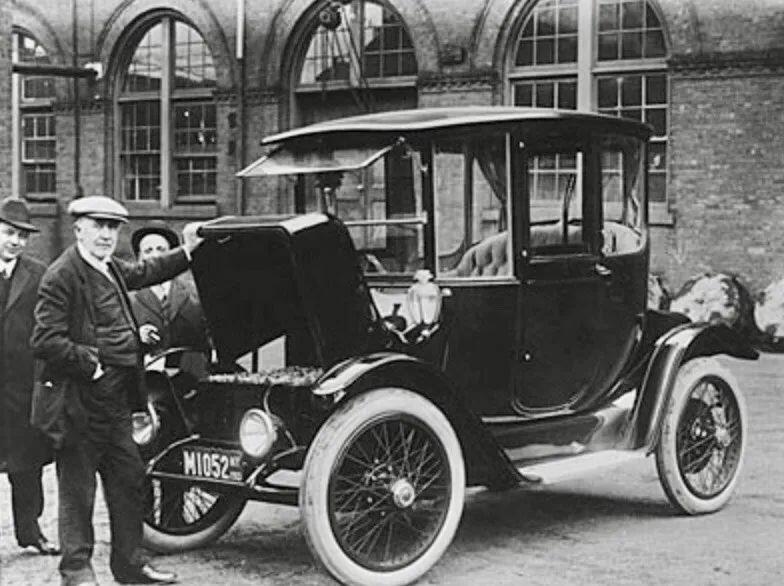
Thomas Edison with a Detroit Electric car in 1913. Credit: Wikimedia. Via RobertBryce.substack.com
Ford, Lucid, and Rivian report EV losses directly in their SEC filings, while GM, Stellantis, Mercedes, and Volkswagen do not break out EV performance, forcing analysts to rely on conservative estimates drawn from earnings results, write-downs, and public guidance. Among traditional automakers, Ford stands alone in providing clear EV-specific financial reporting, Bryce reports.
Between 2022 and the third quarter of 2025, legacy automakers alone are estimated to have lost roughly $83.6 billion on EV programs, including major write-downs at Ford and GM. EV-only startups Lucid and Rivian account for another $30.2 billion in red ink, with total losses across seven automakers approach $114 billion. The newspaper said it excluded Tesla from their analysis because a significant portion of its profits comes from regulatory credit sales and non-auto businesses.
Legacy automakers poured tens of billions into new factories, battery deals, and all-electric lineups, often under intense regulatory pressure and incentive schemes under the Biden administration that were premised on rapid, mass adoption that never fully materialized.
From 2015 through early 2024, automakers announced more than $188 billion in U.S. EV and battery investments, with spending accelerating after passage of the so-called Inflation Reduction Act in 2022, according to an Environmental Defense Fund report. GM pledged $35 billion through 2025, Ford committed $50 billion through 2026, and Volkswagen launched a $131 billion global electrification and digital push over five years.
But consumers didn’t follow Washington’s timetable.
In the U.S., EV sales briefly spiked in Q3 2025 as buyers rushed to capture the $7,500 federal tax credit before it expired on September 30. That incentive-driven surge pushed quarterly sales above 437,000 units and lifted EV market share to 10.5%, according to Cox Automotive. Once the subsidy disappeared, demand collapsed. Q4 sales fell to roughly 234,000 vehicles—a 46% drop from Q3—cutting market share nearly in half. Full-year EV sales for 2025 slipped to about 1.28 million units, marking the first year-over-year decline since 2019, Kelley Blue Book reported at the time.
Meanwhile, high-priced EVs piled up on dealer lots as average transaction prices hovered around $59,000, far above gas-powered alternatives. Range anxiety, uneven charging infrastructure, and cheaper gasoline pushed buyers back toward hybrids, trucks, and SUVs.
European automakers faced a similar reckoning.
Aggressive emissions mandates rammed through by climate-obsessed eurocrats collided with weakening demand and an onslaught of lower-cost Chinese competitors. In 2025, China’s BYD overtook Tesla as the world’s largest EV seller, underscoring how state-backed Chinese firms now dominate global EV volume, BBC reports. As pressure mounted, Volkswagen canceled or delayed multiple EV projects, Mercedes paused or scrapped several U.S.-bound EQ models, and others quietly extended the life of internal-combustion and hybrid platforms while lobbying for regulatory relief.
Tyler Durden
Wed, 02/04/2026 – 07:00