


The Arms Race In The Indo-Pacific Is Just Getting Started As Participants Pick Sides
By Benjamin Picton, senior market strategist at Rabobank
US stocks rallied hard on Friday and the VIX index had its biggest one-day fall since April of last year. The rally broke three-straight days of losses where crypto was dumped and two-year Treasury bonds had tightened 19bps. Yields on two-year US treasuries rose almost 5bps on Friday to 3.50% in the broader risk-on rally.
Prime Minister Takaichi has won a landslide victory in Japan’s general election over the weekend. Takaichi’s Liberal Democratic Party now has a two-thirds supermajority in the lower house of the Diet, granting it the power to override the upper house.
The Nikkei is up 4.7% today and 12.9% YTD, trailing only the KOSPI among major Asian indices. Asian equity markets are mostly outperforming counterparts in Europe and the United States this year. The so-called ‘Takaichi-trade’ has seen Japanese equities well bid in reaction to Takaichi’s predilection for looser fiscal settings, greater investments in technology and defence, and pressure on the Bank of Japan not to raise interest rates too quickly.
Despite this cocktail of accommodative policy, USDJPY is dealing a little softer as Finance Minister Katayama indicated that she had been in close contact with US Treasury Secretary Bessent regarding stabilisation of the exchange rate. Katayama also said that she is prepared to take measures to stabilize markets today if necessary. 10-year JGBs are underperforming, with yields up 4.9bps on the day and the 2s10s curve steepening ~3bps.
Beyond the immediate implications for JGBs, the Japanese Yen and – by extension – the Yen carry trade, this is a momentous development geopolitically. Takaichi is a China hawk who sparked something of a diplomatic crisis late last year when she suggested that a Chinese invasion of Taiwan could be considered existential for Japan. That would be sufficient to justify intervention by the Japanese self-defence force under the country’s pacifist constitution – a point that was not lost on Chinese diplomats, who reacted furiously to the implication that Japan could resist efforts to reunify Taiwan with the mainland.
According to the Financial Times, Takaichi has signaled that she is ready to test her mandate by pursuing changes to Japan’s constitution. If successful, that could see Japan re-arming more rapidly and moving to acquire offensive capabilities that have heretofore remained restricted. This would suit the strategic aims of the Trump administration – who were supportive of Takaichi in her re-election bid – but is certain to further inflame the diplomatic row with China and also runs the risk of stoking tensions with other countries who retain misgivings over the behavior of Imperial Japan during and prior to World War Two.
In short, the arms race in the Indo-Pacific may just be getting started as third parties begin to pick sides in the contest between the United States and China, and also take steps to hedge against each other.
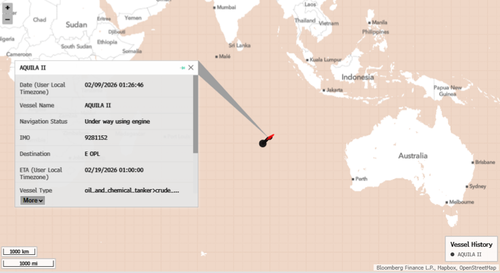
To underline this point, Indonesia and Australia have just signed a common security pact. This might ordinarily be considered an unremarkable development, except it marks something of a shift in Indonesia’s traditional non-aligned policy toward a more integrated defence posture and comes in the context of friction between Indonesia and China over territorial claims in the South China Sea.
The new agreement is particularly interesting because it is made with a Western country with whom Indonesia has not always seen eye-to-eye. Though it falls short of a mutual-defence pact, the agreement will see a significant step-up in military cooperation that highlights the strategic re-evaluation that is underway across the Indo-Pacific.
For its part, Australia has been busily upgrading its diplomatic and security ties in the region for several years now. Major agreements have recently been signed with Papua New Guinea, Fiji, the Solomon Islands, Vanuatu and Timor-Leste, while the AUKUS pact with the United States and the UK will soon see the Henderson shipyard in Western Australia used for maintenance and sustainment of nuclear submarines. Australia has also recently signed a deal to purchase eleven upgraded Mogami-class general purpose frigates from Japan – marking Japan’s first major defence export contract and a deepening of military ties between the two nations.
Needless to say, these agreements are implicitly understood as an effort to hedge against a more assertive China. This thinking is clear in the economic sphere also, as the Financial Review today reports that Australia has been quietly increasing tariffs on Chinese steel imports to protect what remains of its own domestic industry even as hopes for the conclusion of a long-awaited trade deal with the EU are rising. The pattern of freer trade for friends and restricted trade elsewhere is a template that is now being repeated globally as the world coalesces into interest blocs with geopolitical hedgerows erected in between. Those hedgerows are not impermeable, but they are growing denser over time.
Finally, while Takaichi’s political star is rising in the east another appears to be setting in the west. British Prime Minister Starmer is scheduled to address the nation today as speculation increases that he will soon be forced out of Number 10 Downing Street. Starmer’s Chief of Staff recently resigned over his role in recommending the appointment of Lord Mandelson as ambassador to the United States, despite his known links to Jeffrey Epstein.
The decision by his most senior advisor to fall on his sword may buy Starmer some time, but signs of widespread discontent on the backbench compounded by diabolically bad poll results are creating the impression that his days are numbered.
Tyler Durden
Mon, 02/09/2026 – 10:40