






Historic Negative Jobs Revisions: 1 Million Fewer Jobs Added In 2025, Only 15,000 Avg Jobs Monthly
Ahead of today’s jobs report, we warned that (another) massive negative revision was coming to the US labor market, predicting it would be “1 million plus.” We were right.
Recall that alongside today’s jobs report, the BLS would release its annual benchmark revision to the establishment survey and a methodological update to the birth-death model (as a reminder, the BLS’s preliminary estimate of the benchmark payrolls revision indicated that cumulative payroll growth between April 2024 and March 2025 would be revised 911k lower).
More importantly, the BLS would also update the net birth-death forecasts in the post-benchmark period (April 2025-December 2025) to incorporate information from the QCEW and the monthly payrolls survey. We said that a sharp downward revision to the post-benchmark period “appears likely”, reflecting the continued slowdown in the job growth measured by the QCEW and weak private payroll growth measured by the establishment survey during post-benchmark period, something we had been warning about for years.
Sure enough, in its report today, the BLS announced that “the establishment survey data released today have been benchmarked to reflect comprehensive counts of payroll jobs for March 2025. These counts are derived principally from the Quarterly Census of Employment and Wages (QCEW), which counts jobs covered by the Unemployment Insurance (UI) tax system. The benchmark process results in revisions to not seasonally adjusted data from April 2024 forward. Seasonally adjusted data from January 2021 forward are subject to revision. In addition, data for some series prior to 2021, both seasonally adjusted and unadjusted, incorporate other revisions.”
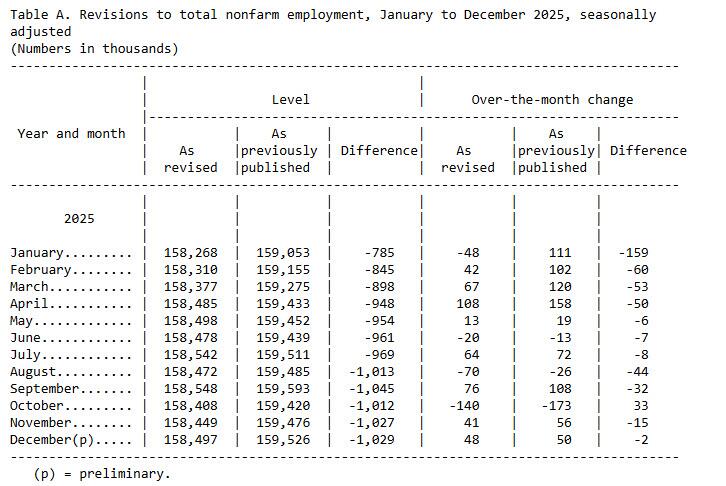
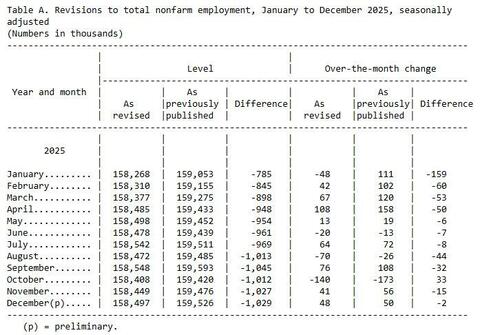
And here is the summary table the BLS published to adjust for the revised Birth-Death model (there is much more data to today’s revisions which we summarize below).
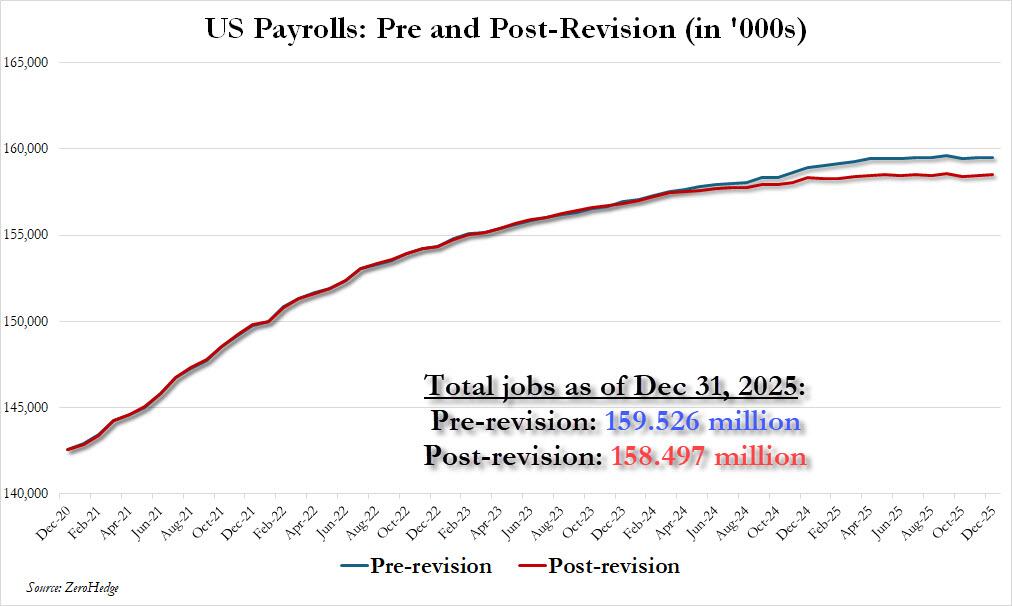
With that introduction aside, this is how the revised payrolls numbers looked.
Starting at the top, total US payrolls were revised dramatically lower starting with the Jan 2021 data and every month since, and net of the cumulative changes December 31, 2025 total nonfarm employment was revised lower by 1.029 million from 159.546 million to 158.497 million.
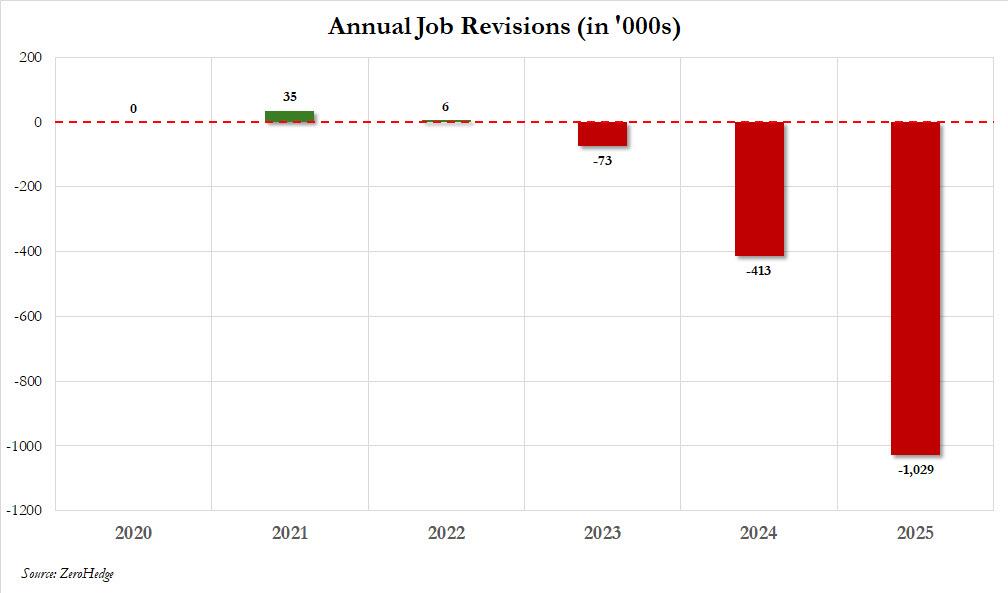
As expected, the bulk of the negative revisions took place in 2025, with negative revisions to 2024 amounting to -413K, 2023 was just -73K while 2021 and 2021 were revised modestly higher.
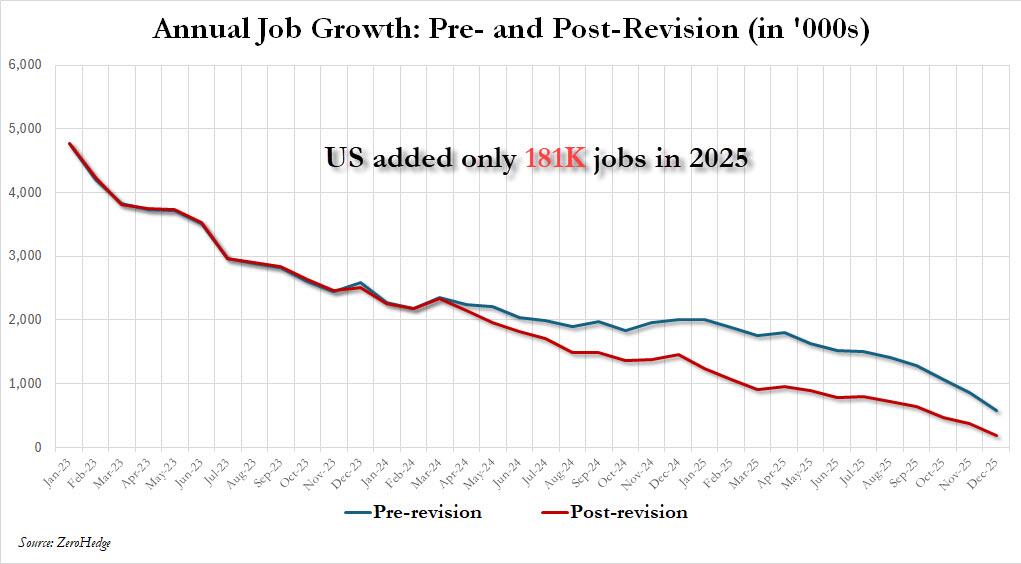
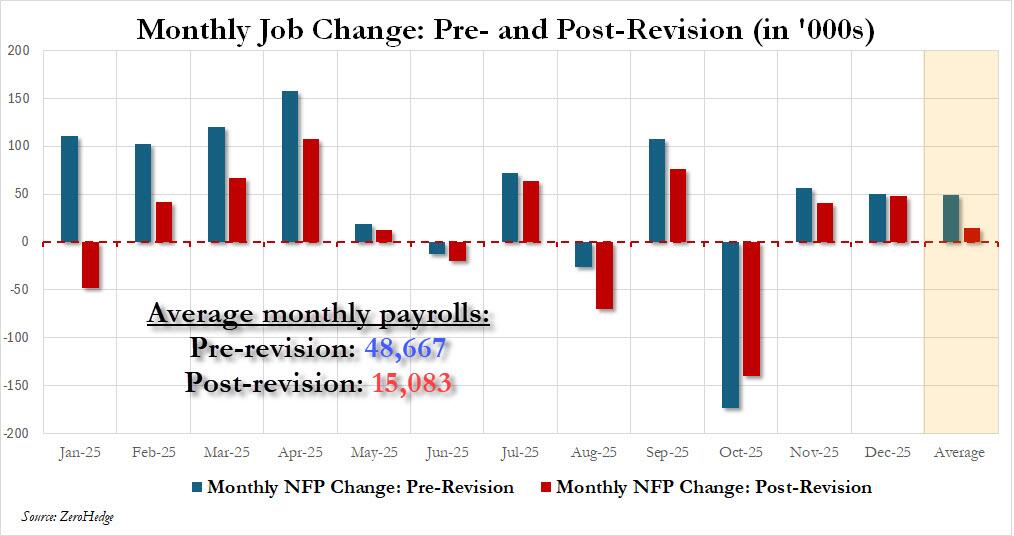
Focusing on 2025, the negative revisions to both the year and previous years, meant that the change in total jobs for 2025 was revised from an already low +584,000 to a shockingly low +181,000.
Finally, net of the aggressive revisions to 2025 monthly payrolls, what was previously an average increase of 48.7K jobs in 2025, has now been revised to just 15.1K!
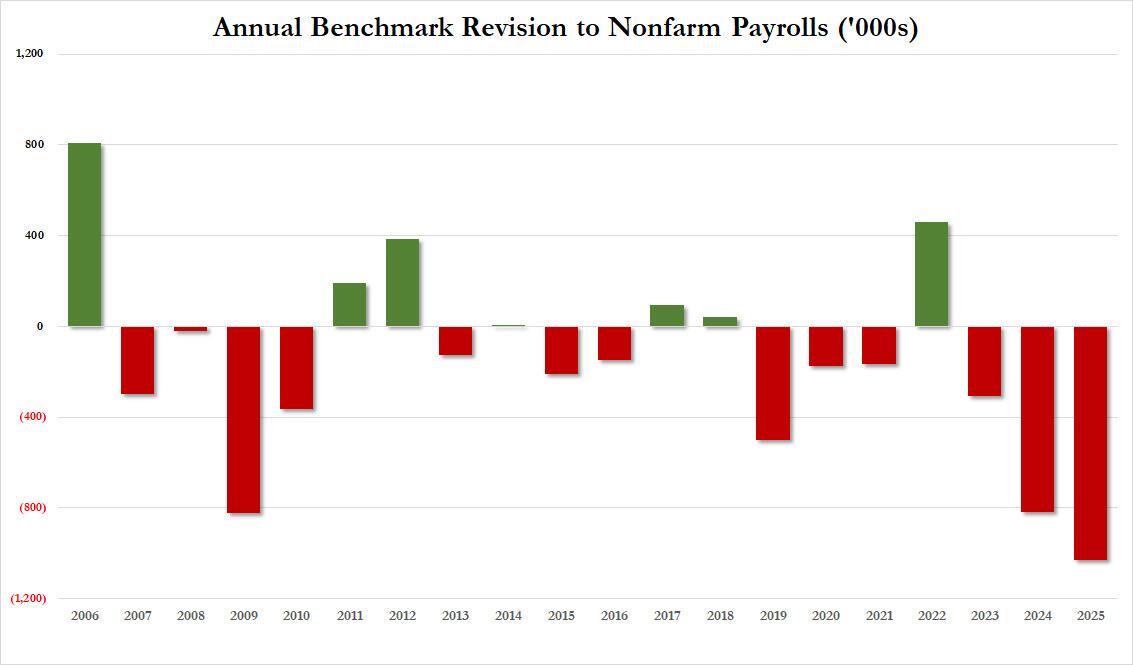
Of course, this is not the first time the Dept of Labor confirmed it has massively revised jobs lower due to erroneous adjustment factors and birth-death additions. Recall, it was last September when we first warned the April 2024 – March 2025 period would be revised massively lower (we now know it was). But it followed another huge revision for 2024 which subtracted 818K jobs and also a 306K revision to 2023.
Putting it all together, we now know with certainty that the flawed Birth-Death model (as well as other smaller seasonal adjustments), led to 2.5 million jobs being revised away since 2019, with negative revisions in 6 of the past 7 years (only 2022 saw a modest positive adjustment)
Last but not least, more revisions are coming: while the January jobs report usually incorporates new population estimates from the Census Bureau into the household survey, those figures were delayed by one month due to last year’s record-long government shutdown. Officials from the Trump administration in recent days have tried to reset expectations for upcoming jobs numbers due to deportations and slower population growth. As a result, expect even more negative revisions next month.
Appendix:
Those curious how the BLS changed its entire birth-death model methodology to incorporate current sample information each month (which follows the same methodology applied to the April through October 2024 forecasts during the 2024 post-benchmark period) should read question 9 in the CES Birth-Death Model Frequently Asked Questions.
Additionally, a BLS article that discusses the benchmark and post-benchmark revisions and other technical issues is available here.
Tyler Durden
Wed, 02/11/2026 – 11:15