







Four projects have been awarded funding from the Circular Electricals Fund, which supports innovation in product design, material use and recovery and business models. The award is run by not-for-profit group Material Focus, and follows a rigorous application and assessment process. Out of 65 applications, the four selected candidates come from University College London, British Geological Survey, Bristol Braille and Reconome
E-waste is the fastest-growing waste stream in the world. In the UK alone, we bin over 100,000 tonnes of electricals every year, and we have over 880 million unused, unwanted and discarded electricals stashed away in our homes. These electricals contain some of the most precious materials on our planet, which according to Material Focus’s research are worth nearly £1 billion, including copper, lithium and gold, which when thrown away are lost forever.
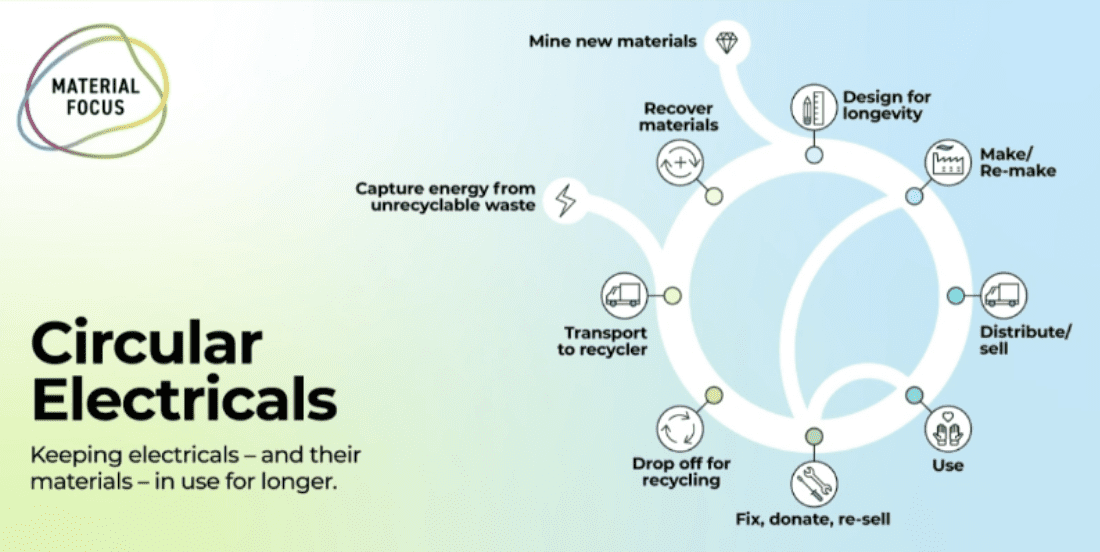
The Circular Electricals Fund provides funding for projects that will keep electricals, and their materials in use for longer. The first four projects to receive funding will address the following key priorities: improve resource efficiency, reduce environmental impact, and encourage collaboration across industry. The funded projects are:
University College London: “The Big Repair Project – making it easier for everyone to repair appliances”
British Geological Survey: “Mapping Technology Metals in Electricals”
Bristol Braille: “Future Canute : Making Electronic Braille more sustainable”
Reconome: “Scaling smart device refurbishment to increase environmental and social impact”
Scott Butler, Executive Director, Material Focus said: “ Although there is some brilliant innovation already happening, many new products still aren’t designed to be easily reused, recycled or repaired. And we lack the systems to recover all the valuable materials inside them. We are delighted to be announcing that the first of the recipients will receive £567,720 of the Circular Electricals Fund which will help drive innovation and support the development of a more circular electricals system in the UK. These ambitious projects reduce the environmental impact of electricals by improving product design, improving resource efficiency, and encouraging collaboration.”
Funded projects
University College London’s “The Big Repair Project” will focus on making appliance repairs easier for everyone, starting with washing machines. The research project led by University College London in collaboration with key industry partners, aims to transform the repair economy for household appliances. Many appliances are thrown away earlier than they should be because it is difficult or expensive for people to maintain and repair them.The project will explore how product design, new technologies, communication strategies, and business models can help people and businesses to keep products in use longer, contributing to a more sustainable and circular economy.
Mark Miodownik, Professor of Materials and Society University College London, said: “Surveys consistently show that people in the UK want to cut waste and make smarter use of the brilliant technologies that power modern life. In our research, we’re teaming up with appliance manufacturers to explore how repairs can be made simpler and more affordable – helping people keep their products working longer and reducing unnecessary waste”
The British Geological Survey’s “Mapping Technology Metals in Electricals” will undertake a deep dive into electricals and identify how much can be recovered and re-used.
Researchers at the British Geological Survey are undertaking detailed modelling to evaluate the amounts of technology metals, such as lithium in batteries and neodymium in magnets in motors, which are commonly used in electrical items. For example, e-scooters and vacuum cleaners, and whether the technology metals can be recovered from them. There is limited data on where these metals are disposed of and recycled which means opportunities to commercially recover these metals from end-of-life electrical items are not being fully utilised. The British Geological Survey is a world-leading geological survey and global geoscience organisation
Richard Shaw, Senior Mineral Commodity Geologist, British Geological Survey said: “We are delighted to have been awarded Material Focus funding to investigate the use of technology metals in everyday electrical items, like e-scooters and vacuum cleaners, across their whole life – from when they are first manufactured, used and then disposed. We hope the outputs from this work will lead to the development of new circular business models and create commercial opportunities for recovering these valuable metals from end-of-life electrical items.
Bristol Braille’s “Future Canute: sustainable electronic products for Braille users” will be the world’s first repairable, affordable full-page digital Braille display machine for blind people to read a page of digital information in Braille in the same layout and information density as sighted people. The “Future Canute” will be designed to minimise its electrical waste, maximise its lifespan with a twelve year warranty, and make the device user repairable and upgradable by blind people at home.
Ed Rogers, Managing Director, Bristol Braille said: “We welcome Material Focus’s Circular Electrical funding which will help us to develop a more sustainable product for our customers. The Future Canute will provide users of our digital Braille display with a more durable product, and make it easier for them to repair.”
Reconome’s “Intelligent device refurbishment to increase environmental and social impact” is developing an innovative data-driven solution to increase the reuse of decommissioned devices – aiming to extend the lifecycle of devices over the next year. This project aims to reduce e-waste and support digital inclusion, delivering measurable environmental and social impact. It will use technology to increase cost-effective repairs, harvest and match old components, and recommend alternate operating systems to enhance security. Through a considered approach to reuse, ethical recycling, and transparent reporting, the initiative will create a scalable model that boosts commercial viability with improved environmental and social impact, driving systemic change in IT decommissioning and procurement practices.
Nick Rawkins, CEO and Founder, Reconome: “This project helps us unlock a powerful project we’ve been excited about for some time. It enables us to bring down costs further by reducing waste and increasing the likelihood we can reuse each device we handle. We’re confident this project brings us closer to a smarter, fairer approach to technology reuse. We’re proud to be partnering with Material Focus to bring this initiative to life over the next 12 months and beyond.”