






These Are The Countries That Earn The Most From Tourism
Each year, the global tourism economy generates trillions in revenue as travelers explore new destinations and revisit old favorites.
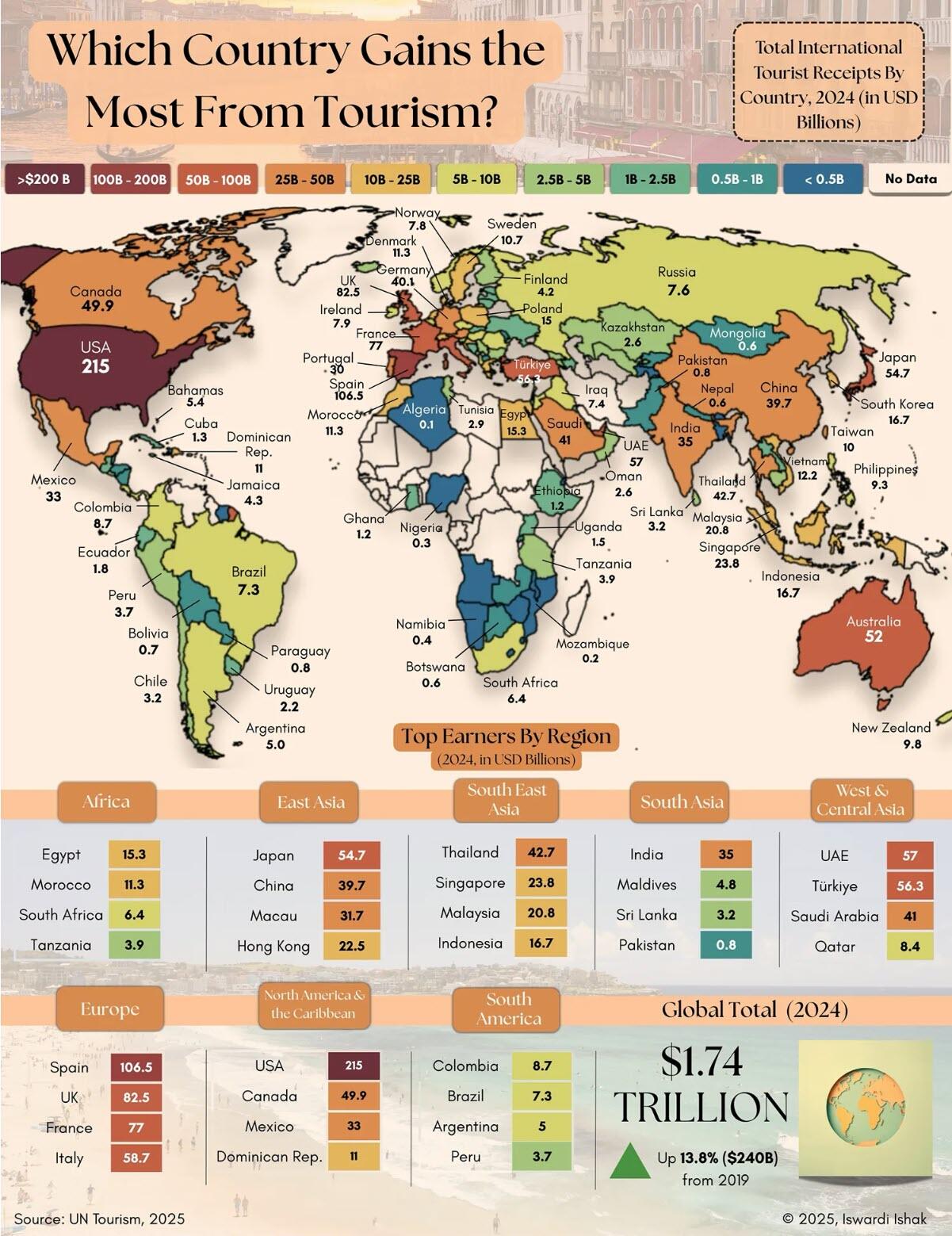
According to UN Tourism data, international tourist receipts reached a total of $1.74 trillion in 2024, which is up 14% from pre-pandemic levels in 2019.
Visual Capitalist creator Iswardi Ishak mapped the countries that benefit most from this spending, revealing which economies gain the most from foreign visitors.
Unsurprisingly, the U.S. leads by a wide margin, earning $215 billion from international visitors.
Europe dominates the top ranks, with Spain ($106.5 billion), the UK ($82.5 billion), France ($77 billion), and Italy ($58.7 billion) all drawing in major tourism income.
Japan ($54.7 billion), China ($39.7 billion), and Thailand ($42.7 billion) round out Asia’s biggest earners.
United Arab Emirates stands out, generating $45.5B, a number that rivals Europe’s tourism powerhouses.
Here’s a closer look at the data:
Country/Territory
International Tourist Receipts (2024, USD Billions)
United States of America
215.0
Spain
106.5
United Kingdom
82.5
France
77.0
Italy
58.7
United Arab Emirates
57.0
Türkiye
56.3
Japan
54.7
Australia
52.0
Canada
49.9
Thailand
42.7
Saudi Arabia
41.0
Germany
40.1
China
39.7
India
35.0
Mexico
33.0
Macau
31.7
Portugal
30.0
Austria
26.3
Singapore
23.8
Greece
23.4
Netherlands
22.6
Hong Kong
22.5
Switzerland
22.3
Malaysia
20.8
Indonesia
16.7
South Korea
16.7
Croatia
16.2
Egypt
15.3
Poland
15.0
Vietnam
12.2
Denmark
11.3
Morocco
11.3
Dominican Republic
11.0
Sweden
10.7
New Zealand
9.8
Belgium
9.4
Philippines
9.3
Czech Republic
9.1
Colombia
8.7
Qatar
8.4
Hungary
8.1
Ireland
7.9
Norway
7.8
Russia
7.6
Luxembourg
7.5
Iraq
7.4
Brazil
7.3
Jordan
7.2
South Africa
6.4
Panama
6.0
Puerto Rico
6.0
Romania
5.7
Costa Rica
5.5
Albania
5.4
Argentina
5.0
Maldives
4.8
Lebanon
4.7
Georgia
4.4
Bulgaria
4.3
Jamaica
4.3
Finland
4.2
Cyprus
4.0
Tanzania
3.9
Peru
3.7
Bahrain
3.7
Cambodia
3.6
Slovenia
3.6
El Salvador
3.5
Iceland
3.2
Uzbekistan
3.2
Chile
3.2
Sri Lanka
3.2
Serbia
3.1
Aruba
3.0
Andorra
2.9
Tunisia
2.9
Malta
2.8
Kazakhstan
2.6
Oman
2.6
Armenia
2.5
Israel
2.3
Kuwait
2.3
Uruguay
2.2
Azerbaijan
2.0
Bosnia and Herzegovina
2.0
Lithuania
2.0
Mauritius
2.0
Ecuador
1.8
Slovakia
1.7
Guatemala
1.7
Estonia
1.6
Montenegro
1.6
Uganda
1.5
Latvia
1.4
Barbados
1.4
Laos
1.3
Cuba
1.3
Saint Lucia
1.3
Ethiopia
1.2
Ghana
1.2
Fiji
1.1
Ukraine
1.0
Kyrgyzstan
0.96
Seychelles
0.93
Zambia
0.90
Antigua and Barbuda
0.88
Moldova
0.82
Belize
0.81
Honduras
0.79
Paraguay
0.77
Pakistan
0.75
Bolivia
0.74
Mongolia
0.64
Nepal
0.63
Republic of Macedonia
0.62
Botswana
0.59
Rwanda
0.58
Nicaragua
0.51
Bermuda
0.51
Bangladesh
0.44
The Gambia
0.44
Namibia
0.43
Grenada
0.36
Nigeria
0.30
Samoa
0.23
Mozambique
0.21
Bhutan
0.20
Zimbabwe
0.20
Anguilla
0.19
Brunei
0.13
Algeria
0.13
Palestine
0.13
Dominica
0.09
São Tomé and Príncipe
0.07
East Timor
0.06
Malawi
0.06
Djibouti
0.05
Haiti
0.04
Suriname
0.04
Solomon Islands
0.03
Tajikistan
0.02
Angola
0.02
Eswatini
0.02
Montserrat
0.01
Lesotho
0.01
Why Some Countries Earn More Than Others
Tourism receipts depend on several factors: not just the number of visitors, but how much each tourist spends. The U.S., for example, combines high visitor volumes with high average spending. Meanwhile, countries like Maldives or Jamaica may have smaller absolute totals but are far more dependent on tourism as a share of GDP.
In Europe, cultural heritage, high-speed transportation, and proximity to major markets help countries rack up significant tourist spending. Spain, which now outpaces even France, offers an unusually wide range of tourism experiences, from world‑class beaches and island archipelagos to historic cities, gastronomy, and cultural heritage. This diversity helps attract visitors year‑round and from multiple source markets. As a result, the country became the most-visited nation in the EU in 2024.
Tourism in Conflict Zones: The Ukraine Example
One of the more surprising figures in the dataset is Ukraine’s $1B in international tourism receipts. Despite the ongoing war, some regions of the country, particularly in the west, have remained relatively stable and open to humanitarian, business, and diaspora-related travel. Ukrainians returning to visit family and international volunteers have contributed to tourism-like spending, even under extraordinary conditions.
Tyler Durden
Thu, 02/12/2026 – 06:55