






LGBTQ+ Identity Dips In 2025 (But Doubled Over Last Decade)
Authored by Jeffrey Jones via Gallup,
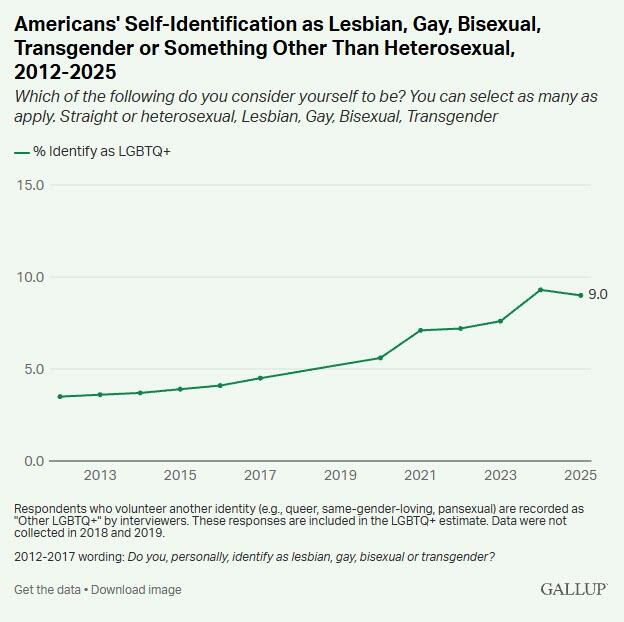
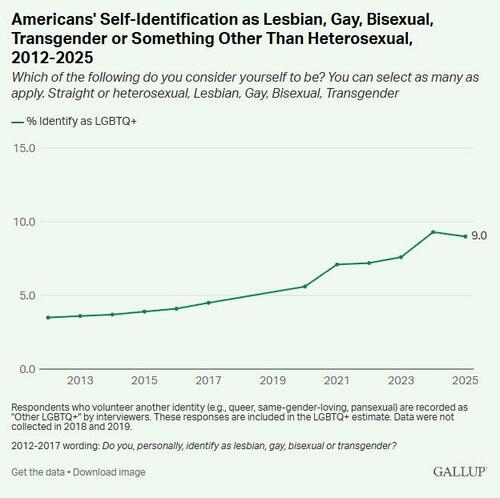
Gallup estimates that 9% of U.S. adults personally identify as lesbian, gay, bisexual, transgender or something other than heterosexual. This percentage is essentially unchanged from last year but remains more than double the 3.5% from 2012, the first year Gallup measured LGBTQ+ incidence. The current figure is also higher than readings of roughly 7% between 2021 and 2023.
The latest results are based on combined data from 2025 Gallup telephone interviews with over 13,000 U.S. adults.
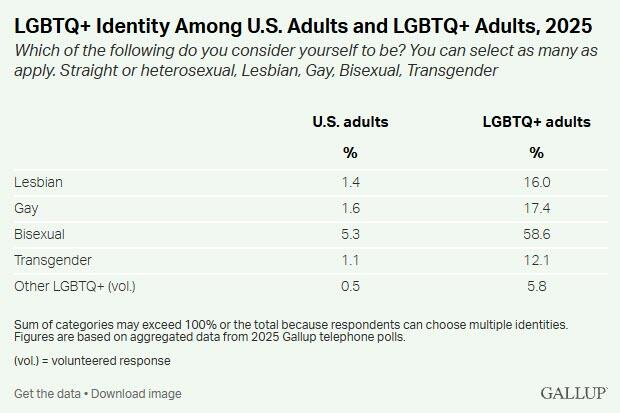
In each poll it conducts, Gallup asks respondents whether they personally identify as heterosexual, lesbian, gay, bisexual, transgender or something else. The vast majority, 86%, say they are heterosexual, while 9% identify with one of the various LGBTQ+ identities and 5% do not give a response.
The largest share of LGBTQ+ adults say they are bisexual, representing more than half of the subgroup and about 5% of the entire U.S. adult population. Meanwhile, 17% of LGBTQ+ adults identify as gay, 16% as lesbian and 12% as transgender, each representing between 1% and 2% of all U.S. adults. Another 6% of LGBTQ+ adults provide another identity, such as queer or pansexual, beyond those included in the survey.
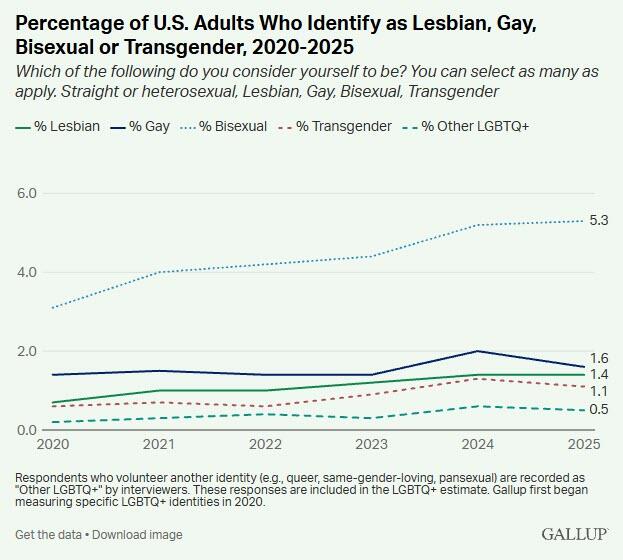
Bisexual identity has consistently been the most common LGBTQ+ identity and has grown sharply since Gallup began measuring lesbian, gay, bisexual and transgender identities as separate categories in 2020. That year, 3.1% of U.S. adults said they were bisexual, compared with the current 5.3%. Other LGBTQ+ identities have also increased over the past six years.
LGBTQ+ Identity Higher Among Younger Adults
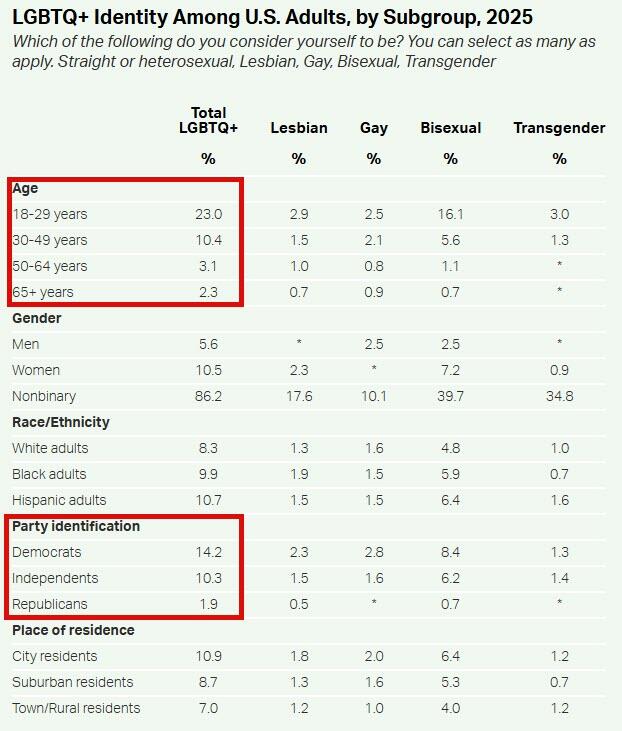
As Gallup has previously demonstrated, the recent increase in LGBTQ+ identification in the U.S. is primarily driven by higher rates among those in the younger generations. In the latest data, 23% of adults under age 30 identify as LGBTQ+, compared with 10% of those aged 30 to 49 and 3% or less among those aged 50 and older.
LGBTQ+ identification is also higher among women than men, primarily because women are much more likely to say they are bisexual. The small proportion of U.S. adults who identify as nonbinary gender overwhelmingly identify as LGBTQ+, particularly as bisexual or transgender.
Democrats are much more inclined than Republicans to have an LGBTQ+ identity. This pattern likely results from LGBTQ+ individuals aligning with the Democratic Party, given the two parties’ stances toward same-sex marriage and other gay rights issues.
City residents are more likely than those living in suburban or rural areas to identify as LGBTQ+, while rates are similar among the major U.S. racial and ethnic groups.
All of these demographic subgroups report higher rates of LGBTQ+ identification than in 2012, the earliest Gallup data. Young adults today versus those in 2012 show the largest increases, and the rate has increased much more among women than men. The smallest increases are among Republicans (1.5% in 2012 vs. 1.9% today) and adults aged 65 and older (1.9% in 2012 vs. 2.3% today).
Implications
LGBTQ+ identification has risen sharply over the past decade, mainly because more young adults today, especially young women, are identifying as LGBTQ+. As more members of Generation Z (those born between 1997 and 2012) reach adulthood, the LGBTQ+ percentage should rise further, given that nearly one in four adults in that generation currently identify as something other than heterosexual. This is in contrast to older Americans, among whom LGBTQ+ identification remains relatively uncommon.
The increase to date also reflects larger shares of Americans, especially those in Gen Z and the millennial generation, considering themselves bisexual. Bisexual identification far outpaces gay and lesbian identification among younger adults, but it is on par with gay and lesbian identification among older generations.
Tyler Durden
Mon, 02/16/2026 – 09:50