

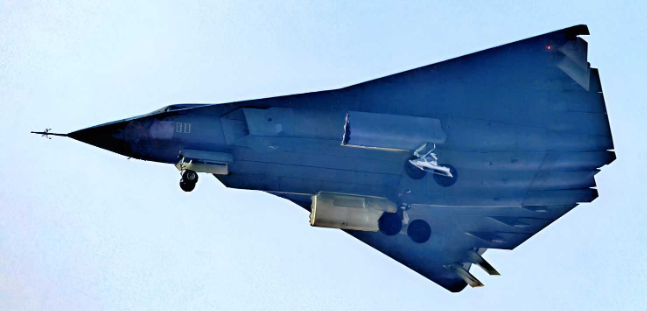
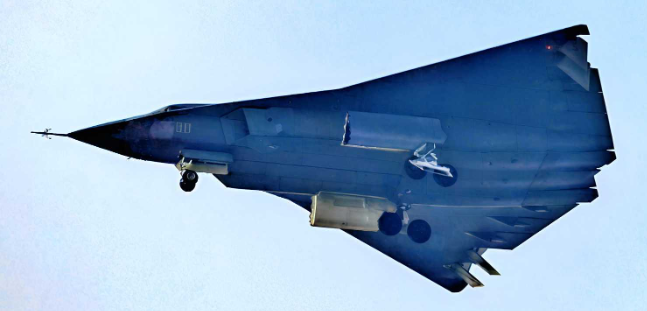
China’s military has for the first time shown a new, tailless combat aircraft widely identified by analysts as their sixth-generation fighter jet J-36, a large, unconventional prototype that flew in public alongside a J-20 chase plane and has reignited debate about whether Beijing is closing the technology gap with the West.
The alarm over China’s J-36 stems from its potential to fundamentally alter the strategic balance in the Asia-Pacific. It represents a generational leap beyond the F-22, not just in technology, but in its very concept of how air combat will be fought. Where the F-22 is a dedicated “air dominance” fighter, the J-36 is designed as a massive, stealthy “flying command center” built for long-range operations.
The J-36 is reported to operate effectively above 65,000 feet (20,000 meters), giving it a literal “high ground” over the F-22, which has a service ceiling around 59,000 feet (18,000 meters). This allows the J-36 to spot the F-22 first while remaining harder to detect itself. The 2023 incident where an F-22 struggled to intercept a Chinese balloon at 65,000 feet (20,000 meters) is often cited as a practical example of this limitation.
The J-36 likely carries the PL-17 missile with a range of over 245 miles (400 km), more than double that of the F-22’s AIM-120D (approx. 100 miles (160 km)). Combined with a potentially more powerful AESA radar, the J-36 could theoretically detect, target, and fire upon an F-22 well before the F-22 could even get into firing range. This is a great concern.
If an F-22 survives the Beyond Visual Range phase and closes to visual range, its superior agility, thanks to thrust vectoring, would give it a significant advantage in a traditional dogfight against the much larger J-36, which is not designed for that kind of maneuvering.
The J-36 is designed with a “smart” skin and powerful onboard systems to process vast amounts of data and potentially employ directed-energy jamming. It could use its electronic warfare suite to disrupt the F-22’s sensors and communications, blinding it while feeding targeting information to its own missiles or accompanying drones.
The concern is not about a one-on-one dogfight. It’s about how the J-36’s design would allow China to project power and challenge U.S. operations in a way the F-22 cannot counter.
The J-36 vs. F-22 matchup is essentially a contest of “system vs. platform.” The F-22 is an incredibly capable but finite platform. The J-36 is the centerpiece of a networked system designed to dominate a battle-space. The alarm in the U.S. comes from the realization that China has not only fielded a prototype of a sixth-generation aircraft before the U.S. has finalized its own NGAD/F-47 design , but that its design philosophy directly targets the key vulnerabilities of the U.S. way of war in the Pacific.
In short, the US is alarmed because the J-36, if it enters production as advertised, could neutralize America’s primary tactical advantage in the region by leveraging superior range, altitude, and battlespace awareness to dictate the terms of an engagement.
That means the US may find it difficult to defend Taiwan altogether.