




Software Stocks: Navigating The SaaSpocalypse
Authored by Michael Lebowitz via RealInvestmentAdvice.com,
The recent rotation from growth to value is well documented. While the return divergences between, for instance, technology stocks and materials or industrials stocks are significant, they do not tell the whole story. There are also extreme return differentials between broad industries and their sub-industries.
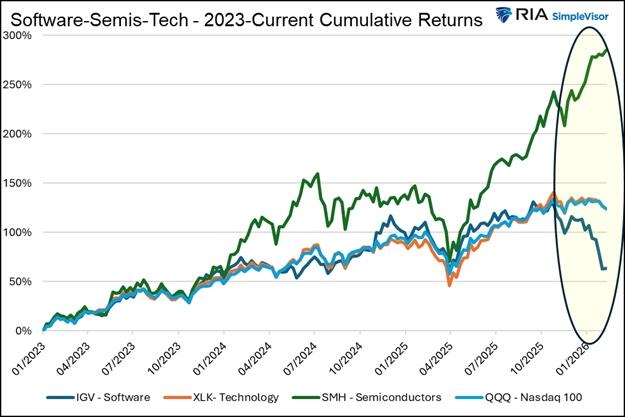
In this article, we address one such divergence between the broad technology sector and the software-as-a-service (SaaS) sub-industry. The graph below shows the wide gap in returns between software, technology, the Nasdaq 100, and semiconductor stocks. Since the well-followed software ETF (IGV) peaked on September 19, 2025, it has fallen 30%. For context, the broad technology indexes (XLK and QQQ) are flat over the period, and the semiconductor ETF (SMH) is up 30%.
Narratives Drive Passive Flows
Behind every good stock or index move is a narrative. The narrative is the market’s collective explanation for why prices move. Most narratives have some truth, some degree of speculation, and include some falsehoods. The job of an individual or professional investor is to understand the narratives driving money flows, assess their accuracy, and trade accordingly.
As if evaluating the validity of narratives weren’t hard enough, we must also consider that many narratives are, to some degree, based on expectations, in which no one knows what the future holds with certainty.
The bearish software narrative, known as “SaaSpocalypse,” which is the market rationale for big drawdowns in many software stocks, has some truths, lots of speculation, and falsehoods. Let’s explore the narrative, some counterpoints, and assess whether software stocks are a steal or, as some claim, on their way to zero.
The SaaSpocalypse Narrative
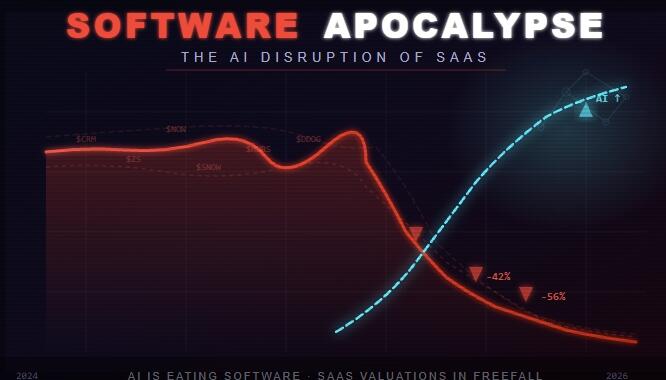
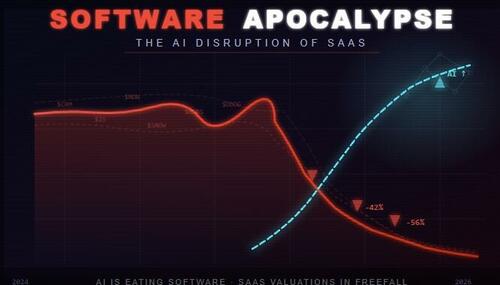
The “SaaSpocalypse” story holds that the current AI wave poses a significant threat to traditional software companies because AI changes how software is built, delivered, and priced.
If generative AI can write code, automate workflows, and rapidly and cheaply create customized applications, the value of today’s established off-the-shelf software products declines, and in some cases, may approach zero. Instead of paying for software and recurring subscription fees, enterprises and individuals may soon be able to build their own software easily and cheaply.
As if that weren’t enough of a threat to traditional software companies, AI lowers barriers to entry, enabling more competitors to quickly replicate existing software. More competition should compress profit margins and weaken the “moats” that once protected large software firms.
Rebutting The Narrative
The primary rebuttal to SaaSpocalypse is that the value of software lies beyond the code. Enterprise SaaS companies derive their lasting power from durable moats such as network effects, high switching costs, proprietary data, compliance infrastructure, and trust. AI-created software or a competing software product from an AI-driven startup might replicate the look and feel of a software program, but it cannot recreate years of customer data, deep integration with other core systems, and, importantly, the confidence required for corporate deployments. Essentially, the rebuttal argues that the narrative fails to distinguish between the look and feel of software and the other attributes that can make it valuable.
Moreover, the narratives ignore that AI will help existing software companies improve their products, reduce costs, and, in some cases, make their moats even more durable. Current software producers have a huge leg up because they already have distribution networks, a customer base, and staff who understand the intricacies of their product and how customers use it.
However, the rebuttal may not apply to all software companies. Each software product and company should be judged according to its own merits. Basic, generic products that can be easily programmed with AI are more likely to be replaceable than well-distributed products with significant usage and data connections within companies.
Strong Moats
We asked ChatGPT for examples of Saas companies with strong moats and received the following:
ServiceNow — Workflow + Enterprise System Depth
Why the moat holds up:
Deeply embedded into ITSM, HR, security, and enterprise workflows — replacing it means re-architecting internal operations, not just swapping software.
AI agents actually increase their value because orchestration becomes more important than standalone apps.
Enterprise workflows contain thousands of hidden rules and dependencies that are hard for AI copilots to replicate. Research shows LLMs struggle with these types of opaque enterprise systems.
Salesforce — Data + Ecosystem Lock-In
Why it’s durable:
Massive installed enterprise base + heavy customization.
CRM data accumulation over many years = high switching friction.
Ecosystem moat (partners, integrations, internal workflows, apps).
Even though AI can generate workflows or lightweight CRMs, enterprises still need:
permission structures
compliance layers
enterprise data governance
Datadog — Observability Data Moat
Why this one stands out:
Continuous telemetry ingestion creates a proprietary “data exhaust.”
AI needs observability platforms — agents can’t fix or optimize what they can’t measure.
Integrated logs + metrics + traces across thousands of systems = massive operational switching costs.
AI may help explain incidents, but it doesn’t replace the monitoring layer itself.
Opportunities In SAAS Stocks
We led this article with a graph showing the software ETF IGV’s gross underperformance relative to the broader technology sector. We now dig deeper to help form short-term return expectations for SaaS companies.
XLK vs IGV
The first analysis compares the software ETF IGV to the broad technology sector ETF XLK. Within the top ten holdings of XLK, Microsoft and Palantir are the only two that are also in the top ten holdings of IGV.
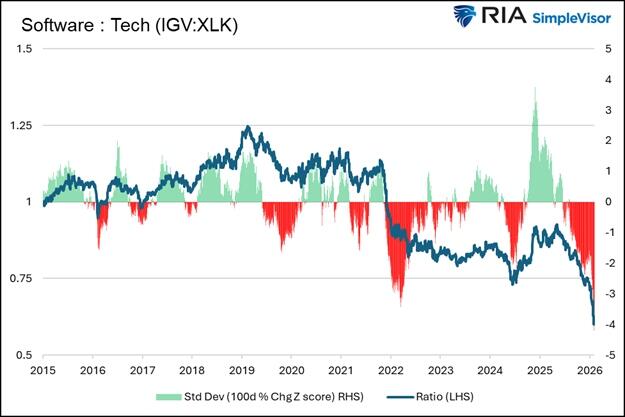
The graph below shows the price ratio of the two ETFs (IGV and XLK). As shown in red/green, the most recent 100-day price ratio change is almost 4 standard deviations from the norm.
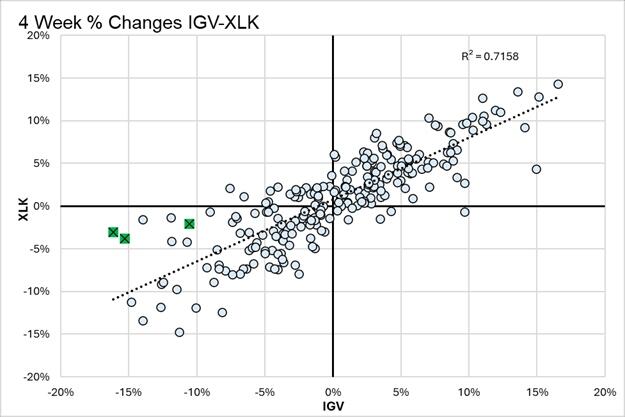
The second graphic uses the last five years to also show how detached the sturdy relationship has drifted recently. Per the most recent weekly readings (green), either XLK is 10% overpriced, or IGV is 10% underpriced.
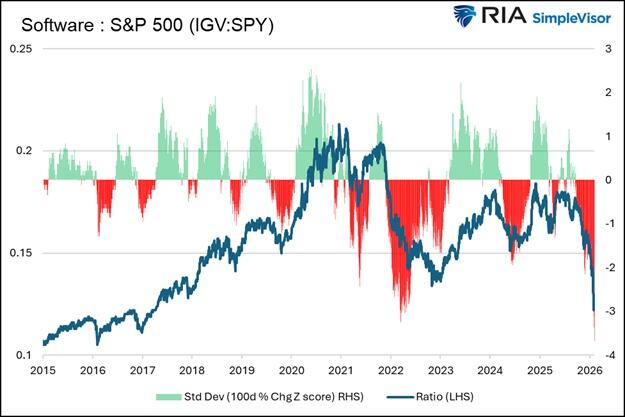
The statistical divergence is also significant when comparing IGV to SPY (S&P 500).
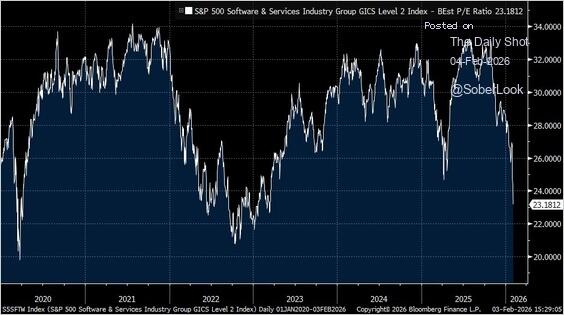
For fundamental context, we share the graph below from the Daily Shot. The P/E ratio of the software sector has fallen rapidly over the last few months, from 34 to 24. For context, the utility sector has a P/E ratio of 21.
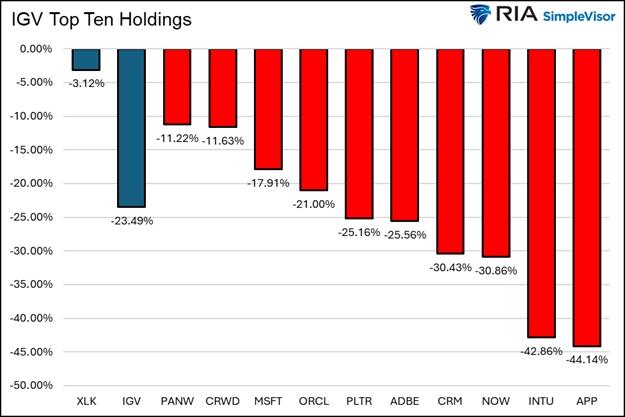
Lastly, we present the year-to-date returns of IGV’s top 10 holdings. Based solely on the returns below, the market is betting that INTU and APP have the weakest moats and that PANW and CRWD are potentially the least negatively affected by potential AI competition.
Summary
Like most narratives, the SaaSpocalypse has some truth and some falsehoods. There is also a large degree of speculation buried within it. Furthermore, the truth shouldn’t be applied broadly to all software companies and their products. In fact, AI will make some software companies more profitable and strengthen their moats. Other companies may fail as competition becomes fierce. The goal for an investor is to figure out who the winners and losers will be. Such is not a simple task, but doing so can provide significant rewards if your research proves correct.
We caution that market rotations have been volatile, with many relationships, like those shown earlier, statistically very stretched. While that may provide comfort for some, we are also aware that in markets like this, where narratives are as strong as they are, relationships can become even more divergent. If you are inclined to buy into the software sector, we recommend taking small starter positions with a stop-loss level in mind. This way, if you are early, the losses are minimal. If the rotations start favoring software stocks and the narrative fades, such evidence may warrant increasing the starter positions. Trade with caution.
Tyler Durden
Wed, 02/25/2026 – 11:25