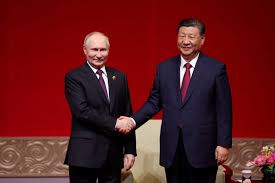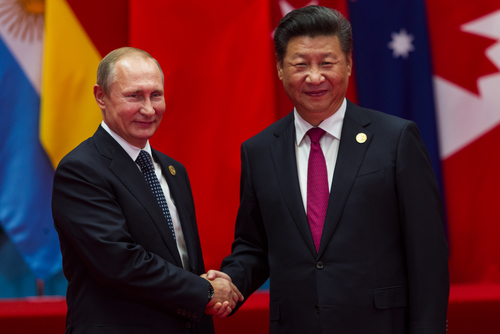







Both Moscow and Beijing immediately condemned the strike on Iran, not in emotional rhetoric, but in the language of sovereignty, international law, and regime change.
Russia did not mince words. Moscow labeled the attack a “pre-planned and unprovoked act of armed aggression” and warned it could plunge the Middle East into a humanitarian and economic catastrophe. Putin described the operation as unprovoked aggression and even a violation of international law. Russia is signaling that regime change operations are viewed as a direct threat to the global balance of power, not just a regional military action.
China’s response was equally sharp. Beijing declared the strike a “grave violation of Iran’s sovereignty and security” and stated it “firmly opposes and strongly condemns” the attack while calling the killing of a sovereign leader “unacceptable.” China understands that if regime change becomes normalized, no major power is insulated from that doctrine.
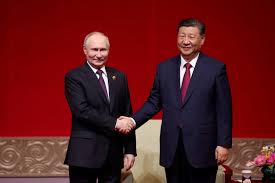
Even more significant was the joint coordination between China and Russia. Their foreign ministers condemned the operation together, calling it aggression that violates the UN Charter and explicitly rejecting policies aimed at overthrowing sovereign governments. Foreign Minister Lavrov labeled the operation a “deliberate, premeditated, and unprovoked act of armed aggression.” When you see diplomatic alignment before military alignment, it signals a shift in geopolitical blocs rather than an isolated event.
Russia offering to mediate while condemning the attack is strategic. China’s call for a ceasefire and negotiation is strategic. Neither is rushing into direct confrontation because their objective is not immediate war — it is long-term geopolitical repositioning. A prolonged Middle East conflict diverts US military resources and disrupts global energy markets.
What is critical here is that both nations framed the strike in terms of sovereignty and regime change rather than terrorism or religion. That aligns directly with the thesis outlined in my latest report, which argues that the real objective behind such conflicts is regime restructuring rather than religious confrontation. The rhetoric from Moscow and Beijing confirms they are interpreting this through the lens of strategic destabilization, not ideological warfare.
The real danger is not an immediate world war. The greater risk is a prolonged proxy escalation. Russia and China will not directly confront the United States militarily in the Middle East. But both will exploit the instability. This is no longer just a Middle East conflict. It is rapidly evolving into a geopolitical pivot, and the reactions from China and Russia confirm that they are already positioning for a long-term strategic confrontation, not a short-term regional war.