









Alaskans Carry The Most Lifetime Credit-Card Debt Of All Americans, Iowans The Least
The average American accumulates nearly $400,000 in credit card debt over their lifetime.
But the total varies significantly depending on where people live. In some states, the typical lifetime total exceeds $450,000, while in others it sits closer to $320,000.
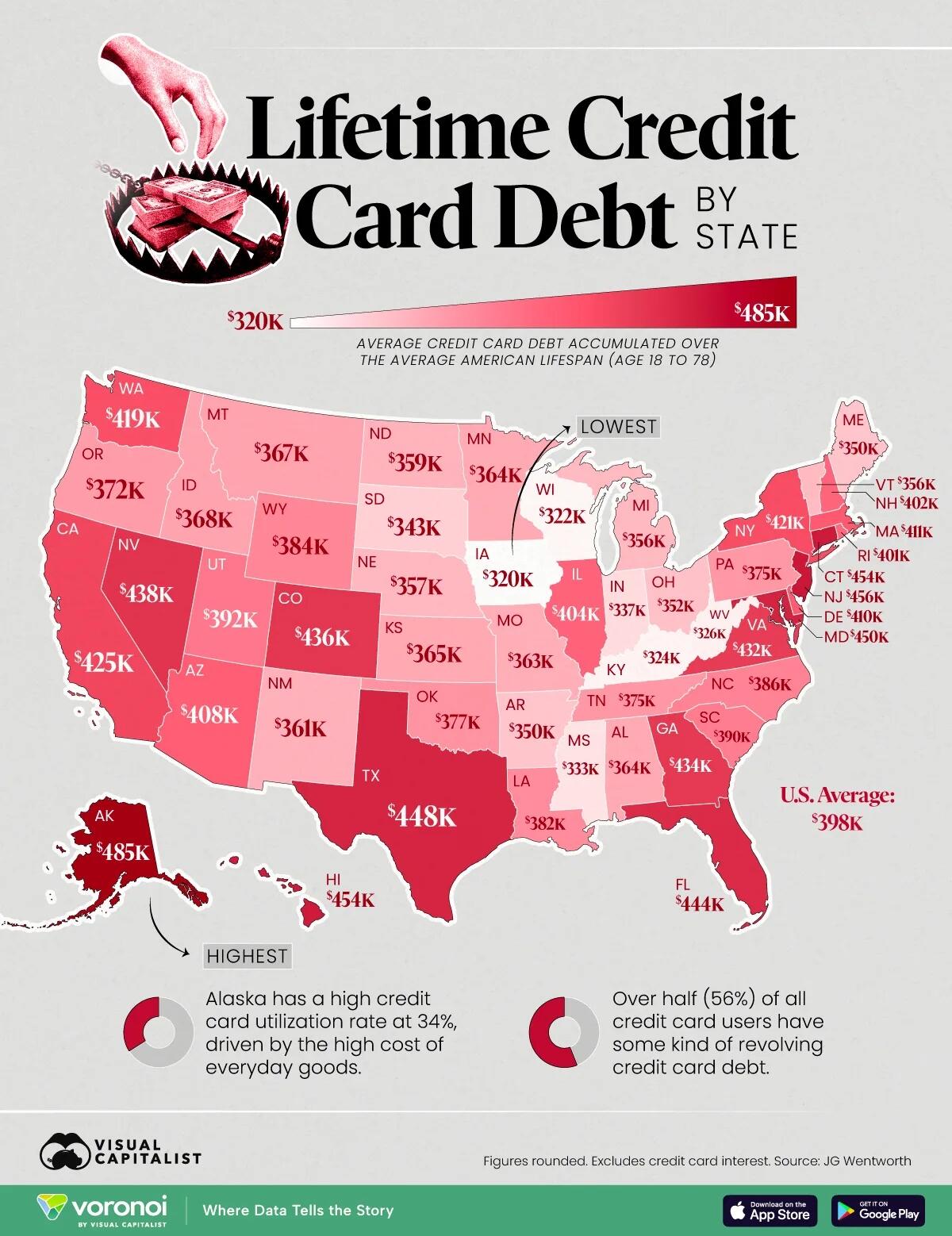
This map, via Visual Capitalist’s Tasmin Lockwood, based on data from JG Wentworth, shows which states accumulate the most and least credit card debt over a lifetime.
Which States Accumulate the Most Credit Card Debt?
Check out the data, which excludes any interest charges, below:
Rank
State
Average Lifetime Credit Card Debt
1
Alaska
$484,620
2
New Jersey
$456,300
3
Connecticut
$454,080
4
Hawaii
$453,600
5
Maryland
$449,520
6
Texas
$448,020
7
Florida
$443,520
8
Nevada
$438,480
9
Colorado
$436,020
10
Georgia
$434,280
11
Virginia
$432,000
12
California
$424,800
13
New York
$420,600
14
Washington
$418,500
15
Massachusetts
$411,180
16
Delaware
$410,460
17
Arizona
$408,000
18
Illinois
$403,560
19
New Hampshire
$401,520
20
Rhode Island
$401,160
21
Utah
$391,920
22
South Carolina
$389,880
23
North Carolina
$386,040
24
Wyoming
$384,360
25
Louisiana
$381,540
26
Oklahoma
$377,460
27
Pennsylvania
$374,700
28
Tennessee
$374,580
29
Oregon
$371,940
30
Idaho
$367,860
31
Montana
$367,320
32
Kansas
$364,920
33
Alabama
$364,440
34
Minnesota
$364,080
35
Missouri
$362,520
36
New Mexico
$361,380
37
North Dakota
$359,460
38
Nebraska
$356,700
39
Michigan
$355,920
40
Vermont
$355,680
41
Ohio
$352,260
42
Arkansas
$349,560
43
Maine
$349,560
44
South Dakota
$343,020
45
Indiana
$337,260
46
Mississippi
$333,180
47
West Virginia
$325,620
48
Kentucky
$323,940
49
Wisconsin
$322,200
50
Iowa
$319,740
Alaska has the highest lifetime credit card debt at $484,620, 21.8% above the national average. The Arctic state typically ranks high in cost of living; its remoteness adds complexity to shipping in food and fuel, which elevates prices.
New Jerseyans and Connecticuters rack up $456,300 and $454,080 of credit card debt in their lifetimes, respectively, reflecting higher costs for rent, food, and utilities. Interestingly, New Jersey and Connecticut have good salaries compared with other states, suggesting higher income enables greater access to credit.
Average lifetime credit card debt exceeds $400,000 in 20 states.
Midwestern states Iowa and Wisconsin have the lowest levels of average credit card debt at $319,740 and $322,200, respectively.
Kentucky, where public school students must complete a financial literacy course before graduating, trails closely at $323,940.
Consumer Debt Has Risen in Recent Years
Consumer spending plays a crucial role in the U.S. economy; it accounted for nearly 70% of GDP in the third quarter of 2025. Meanwhile, over half (56%) of all credit card users have some kind of revolving credit card debt, which is where payments are deferred for periodic instalments, highlighting debt’s parallel role.
While consumer debt has risen alongside inflation, mortgages, vehicles, and student loans, household debt in the U.S. is much lower than in countries such as Switzerland, Australia, and its neighbor Canada.
To learn more about global debt, check out this graphic which breaks down countries with the highest household debt.
Tyler Durden
Sun, 03/15/2026 – 23:15