







Stock Futures Surge, Oil Tumbles On Iran Ceasefire Optimism
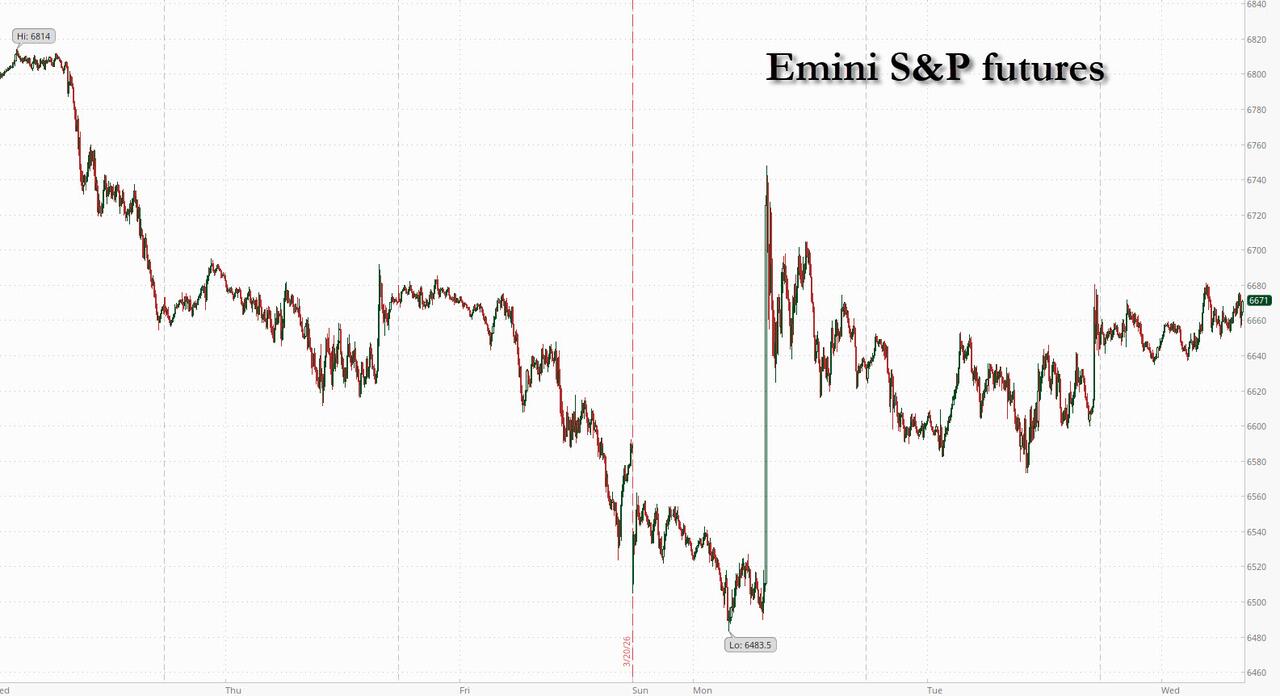
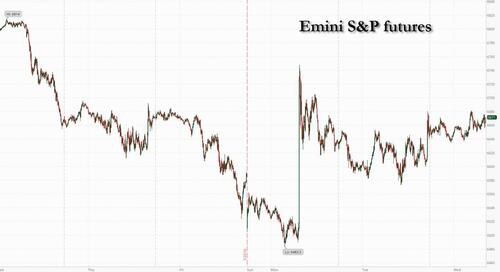
US futures are sharply higher and oil tumbles as the US reportedly offered a15-point plan to help bring the conflict to a close triggering a global rally; Meanwhile Iran is said to have rejected the plan and kept up missile and drone attacks on Israel and Arab Gulf states in response to attacks on its own facilities, while the US continues to move new military assets into place ahead of Trump’s deadline to reopen the SoH. So the situation remains fluid. Even so, S&P futures rose 1.0% and Nasdaq futures gained over 1.1% , with all Mag 7 stocks higher pre-market; Semis and Cyclicals ex-Energy are higher with some defensives such as healthcare maintaining a bid. The yield on two-year Treasuries dropped four basis points to 3.86% while 10Y yields traded down to 4.31%; the USD is flat and commodities are selling off. Energy and natgas are weaker; Brent fell 6% to below $99 a barrel even as the Strait of Hormuz remained effectively shut as a diplomatic push by the US to try to end the war with Iran gathered pace, eclipsing news of more troops being sent to the region; precious metals are rallying despite the USD being flat. Meanwhile, reminding us that another war is taking place, drones attacked Russia’s Ust-Luga port on the Baltic Sea, setting it on fire as Ukraine carried out the most intense air strike on its foe in more than a year. Today’s US economic data calendar includes February import/export priced index and 4Q current account balance (8:30am). Fed speaker slate includes Miran at 4:10pm
In premarket trading, Mag 7 stocks all rise (Alphabet +1.3%, Amazon +1.3%, Apple +0.8%, Nvidia +1.5%, Meta +0.9%, Microsoft +1%, Tesla +1.8%). Miners such as Newmont Corp. and Freeport-McMoRan Inc. were among the biggest gainers in US premarket trading.
Arm Holdings (ARM) rises 12% after the semiconductor designer said it will start selling its own chips for the first time. The new business is expected to generate about $15 billion annually within five years.
Blaize Holdings (BZAI) soars 42% after the semiconductor device company reported its fourth-quarter results and gave an outlook that analysts are positive on.
Braze (BRZE) gains 21% after the software company forecast revenue for the first quarter that was higher than the average analyst estimate. The company also reported better-than-expected revenue for the fourth quarter.
Chewy (CHWY) gains 6% after online retailer of pet food posted fourth-quarter results.
General Motors Co. (GM) climbs 2% after Wolfe raised its rating to outperform, saying investors may be underestimating several tailwinds, including a lower net tariff burden.
EchoStar (SATS) rises 5%, Rocket Lab (RKLB) gains 3% and AST SpaceMobile (ASTS) climbs 3% as the Information reports that SpaceX aims to file a prospectus for an initial public offering as soon as this week.
KB Home (KBH) falls 4% after the single-family home builder forecast deliveries for the second quarter that missed the average analyst estimate.
Sturm Ruger & Co. (RGR) rises 5% after the gunmaker said Beretta Holding said it’s prepared to commence a tender offer for up to 20% of the outstanding shares not already owned at a purchase price of $44.80 per share.
Terns Pharmaceuticals (TERN) gains 5% after Merck & Co. agreed to buy the drugmaker in a $6.7 billion deal.
In other corporate news, Meta’s rollout of new display-equipped Ray-Ban smart glasses in the EU has been hampered by battery and AI regulations in addition to supply constraints. Amazon, Qualcomm Ventures and Tether are among investors in robotics startup Neura’s latest funding round. SpaceX aims to file a prospectus for its IPO as soon as this week, The Information reported.
In AI news, Arm shares are up in premarket trading after the chip designer said it will begin selling its own chips for the first time, adding a business that it expects to generate about $15 billion annually within five years. OpenAI plans to discontinue its Sora AI video generator six months after the high-profile launch of a standalone app for the service. It will also wind down a partnership with Disney which had centered on Sora. Disney’s CEO has now seen two technology bets falter in a week.
Traders are finding some relief after weeks of headline-driven volatility that have left the S&P 500 on track for its biggest monthly loss in a year. The overnight mood was lifted by news that the US sent Iran a 15-point plan to resolve the conflict. Details are still coming out, but the AP reported that it includes sanctions relief, a rollback of Iran’s nuclear program, missile limits and access for shipping through the Strait of Hormuz. Despite Wednesday’s rebound, investors remain wary as Iran kept up attacks on neighboring states and several officials signaled that the Islamic Republic isn’t ready to negotiate.
“There’s a rebound in risk appetite this morning, which makes sense given the newsflow, but for us this is no time to buy the rally,” said Christophe Boucher, chief investment officer at ABN Amro Investment Solutions. “One can actually feel the algos reacting to the ‘peace’, ‘negotiation’ and ‘ceasefire’ keywords.”
For Francisco Simón, European head of strategy at Santander Asset Management, the sustainability of today’s rally will depend heavily on a constructive response from Iran, and the situation on the ground meant investors should remain cautious.
“The outcome does not depend solely on the US,” he said. “The regional geopolitical landscape remains complex, involving multiple actors, most notably Iran, which retains meaningful negotiating leverage. This continues to introduce an additional layer of risk, particularly through the energy channel.”
Oil fell, with WTI back down to around $88 a barrel. The retreat in oil prices prompted traders to scale back expectations for tighter monetary policy from central banks. Swaps now price in less than a one-in-five chance of a Federal Reserve interest-rate hike this year, while pointing to between two and three increases from the Bank of England. Traders priced in three BOE hikes on Tuesday. ECB President Christine Lagarde also pushed back against expectations of an imminent response to higher energy prices, saying that the ECB could look through a limited, short-lived shock.
While bond markets continued to signal a more negative scenario for the war than equities, “these perspectives should converge once visibility improves, likely returning to a more benign baseline,” said Roberto Scholtes, head of strategy at Singular Bank.
The impact on companies and supply chains continues to play out. Airgas said it will curtail helium shipments after Qatar halted production at a major LNG facility. Governments are rushing to secure supplies of critical crop nutrients ahead of the spring planting season. And the Trump administration is said to be preparing to expand the opportunity for sales of higher-ethanol E15 gasoline this summer.
Europe’s Stoxx 600 advanced 1.4%, heading for its first three-day run of gains since the conflict began. Mining and technology stocks are leading gains, while telecoms and personal care shares are the biggest laggards. Here are the biggest movers Wednesday:
UBS shares rise as much as 2.6% amid broader gains for financials and as Bank of America analysts reiterate a buy rating on the Swiss firm
Diageo rises as much as 2.5% after BNP Paribas upgraded the drinksmaker’s stock to neutral from underperform, citing improved risk-reward following material underperformance and trough valuation levels
Croda shares rise as much as 5.4% after Morgan Stanley raised the stock to overweight from equal-weight, the second bank to upgrade the stock this week
Grifols shares rise as much as 9.5%, the most since July 30, following the Spanish blood plasma company’s plan to list a minority stake in its US biopharma business
Lanxess shares soared 16% after JPMorgan double upgraded the German specialty chemical company, saying it should get an earnings boost as the war in Iran eases competitive pressures and increases pricing power
Volex shares rise as much as 13% after the UK connectivity and power product group said it expects financial performance to be significantly ahead of market expectations
ASOS shares rise as much as 17%, the most in more than four months, after the online fashion retailer posted first-half earnings that surpassed analysts’ forecasts
RS Group shares drop as much as 6.7%, the most in 14 months, after the distributor of electronic and industrial products warned like-for-like sales are expected to decline in the year to the end of March
Reckitt Benckiser shares fall as much as 2.8% after JPMorgan (neutral) cut its first-quarter sales forecast for the consumer goods company, citing weak seasonal over-the-counter products and destocking after a poor flu season
Inwit shares slide as much as 9.9% after key customer Swisscom sought to terminate their service agreement in 2028, a move that escalates a dispute between the two parties
Earlier, Asian stocks rose for a second session, with all major markets in the green, as hopes for a de-escalation of the Iran war gathered strength on reports of diplomatic efforts by the US. The MSCI Asia Pacific Index rose as much as 2.4%, the most since March 10, with chipmaker TSMC among the biggest contributors. Benchmarks rose more than 1.5% each in South Korea, Japan, India and Taiwan.
The rebound in risk assets was driven by expectations of a negotiated settlement in the Middle East conflict. The US has presented Iran a 15-point plan to end the war, people familiar with the matter told Bloomberg News, while Israel’s Channel 12 reported that Washington is seeking a one-month ceasefire for negotiations. Elsewhere in the region, Indonesian stocks gained as the market reopened after a weeklong holiday. Australian shares climbed as inflation rose less than expected in February.
In FX, the US dollar is unchanged, while the Aussie dollar is leading declines against the greenback, falling 0.5%. The pound is little changed after UK inflation held at an 11-month low in February as expected.
In rates, treasuries were relatively stable overnight, broadly holding Tuesday’s late gains into the US session as the Trump administration stepped up efforts for ending the war with Iran.US yields lower by 3bp to 4bp across the curve with spreads broadly trading within a basis points of Tuesday close. US 10-year yields trade around 4.32%, near bottom of day’s range and with 10-year note futures trading toward top of Tuesday range — in the 10-year sector bunds and gilts outperform Treasuries by 2.5bp and 5bp on the day. Oil prices hold losses, supporting European bonds over the London session. In the UK, February CPI data printed broadly in-line with estimates, while PPI data was slightly softer than estimates. US session focus includes a 5-year note auction, which follows Tuesday’s poor 2-year auction. This week’s Treasury auction cycle resumes with a $70 billion 5-year note sale at 1pm New York, following a weak 2-year note auction on Tuesday that tailed the WI by 1.8bp. The WI 5-year at ~3.972% is ~36bp cheaper than the February stop-out, which tailed the WI by 0.7bp
In commodities, WTI and Brent futures both trade lower by over 5% on the day, supporting S&P futures (+1.0%) and lower Treasury yields, following report that the US drafted a 15-point plan to help bring the Iran conflict to a close. Brent crude futures for May fall about 5% to around $99 a barrel, while WTI traded around $88 a barrel. European natural gas futures drop 5.5%. Precious metals gain.
Today’s US economic data calendar includes February import/export priced index and 4Q current account balance (8:30am). Fed speaker slate includes Miran at 4:10pm
Market Snapshot
S&P 500 mini +0.9%
Nasdaq 100 mini +1.1%
Russell 2000 mini +1.4%
Stoxx Europe 600 +1.5%
DAX +1.8%
CAC 40 +1.6%
10-year Treasury yield -4 basis points at 4.32%
VIX -1.4 points at 25.53
Bloomberg Dollar Index -0.1% at 1207.99
euro little changed at $1.1602
WTI crude -5.2% at $87.51/barrel
Top Overnight News
Iranian officials have told the countries trying to mediate peace talks with the U.S. that they have now been tricked twice by President Trump and “we don’t want to be fooled again,” according to a source with direct knowledge of those discussions. They worry Trump is buying time as he brings more military equipment to the Middle East. Axios
Iran has received an American 15-point plan for a ceasefire for the Iran war through intermediaries from Pakistan, officials in Islamabad said Wednesday. The proposal was sent even as Washington began to move paratroopers to the Middle East to back up a contingent of Marines already heading to the region. AP
Chinese artificial intelligence service stocks rallied after state media highlighted a sharp increase in domestic AI model adoption and a surge in token usage they generate. BBG
Chevron’s refining head warned that California is heading toward a fuel crisis and that it may quit refining oil in the state unless officials roll back taxes and regulations. BBG
Australia’s inflation eased slightly in February, but remained well above the central bank’s target range, keeping the door open for a further rise in interest rates. Headline inflation was 3.7% on-year in February, easing from 3.8% in January, but still well above the 2% to 3% range targeted by the Reserve Bank of Australia. WSJ
The U.K.’s annual rate of inflation was unchanged in February, but is set to rise over the coming months as energy and food prices jump in the wake of the U.S.-Israel conflict with Iran. CPI was inline on the headline for Feb at +3%, but ran slightly ahead on core (+3.2% vs. the Street +3.1%) and services (+4.3% vs. the Street +4.2%). WSJ
SpaceX may file an IPO as soon as this week, The Information reported. The company may try to raise more than $75 billion, but won’t decide until a few weeks before the offering. BBG
DHS funding deal receives critical pushback from both sides of the aisle, raising doubts about whether an agreement is imminent. Politico
The DOJ acknowledged that they did not have evidence of wrongdoing in its criminal investigation of the Fed over the cost of its building renovations, according to a transcript of the court proceedings. WaPo
A more detailed look at global markets courtesy of Newsquawk
APAC stocks traded higher with risk sentiment spurred by hopes of a halt to the Iran conflict after optimistic comments from US President Trump regarding negotiations, while it was reported that the US was working on a 1-month ceasefire and offered a 15-point plan to Iran for ending the conflict. ASX 200 rallied with gains led by outperformance in mining stocks as gold producers cheered a rebound in the precious metal, while the federal and Queensland governments announced a AUD 2bln bailout for Rio Tinto’s Boyne aluminium smelter. Nikkei 225 outperformed and returned to above the USD 53,000 level as Iran ceasefire hopes to alleviate the recent oil and inflation-related pressures. Hang Seng and Shanghai Comp were positive, albeit to varying degrees throughout the day, as participants digested a slew of earnings releases, while the PBoC conducted a CNY 500bln on 1yr MLF operation.
Top Asian News
Australian Inflation Rate YoY (Feb) Y/Y 3.7% vs. Exp. 3.8% (Prev. 3.8%, Low. 3.5%, High. 4.0%).
Australian Inflation Rate MoM (Feb) M/M 0.0% vs. Exp. 0% (Prev. 0.4%, Low. -0.2%, High. 0.4%).
Australian RBA Weighted Median CPI YoY (Feb) Y/Y 3.5% vs. Exp. 3.6% (Prev. 3.6%).
Australian RBA Weighted Median CPI MoM (Feb) M/M 0.2% vs. Exp. 0.3% (Prev. 0.3%).
Australian RBA Trimmed Mean CPI YoY (Feb) Y/Y 3.3% vs. Exp. 3.4% (Prev. 3.4%, Low. 3.3%, High. 3.4%).
Top European News
UK Business Secretary Kyle is to hold emergency talks with company bosses Wednesday morning about the impact of the Iran war on the UK economy, Sky News reported.
Nigel Farage’s Reform UK abandoned pledge to nationalise water and energy companies, according to FT.
Danish PM Frederiksen’s bloc wins the election but lacks the majority with the left bloc winning 84 seats, right bloc gets 77 seats, and Danish moderate party wins 14 seats to become kingmaker, according to AFP.
US President Trump endorses Hungarian PM Orban, stating he’s a truly strong and powerful leader with a proven track record delivering of phenomenal results.
FX
DXY is slightly firmer this morning, with the trough of the day coinciding with its 21 DMA at 99.07 (vs peak of 99.42). Geopols once again the main driver of action for the index this morning; to recap, a US-led 15-point ceasefire plan has been formed, whilst Iran has denied negotiations entirely. Earlier today, the index dipped off best levels on reports that Iran had received the 15-point plan, pointing to some initial progress to diplomacy. DXY fell from 99.36 to 99.25 within a few minutes, before then reversing much of that move thereafter.
G10s are entirely lower vs USD this morning. The net-importers of energy regions (EUR, GBP, JPY) appear to be faring better vs peers, given the pressure in crude prices in recent trade. Antipodeans are underperforming, with underperformance in the Aussie in the aftermath of the slightly softer-than-expected Australian monthly inflation data.
EUR has had some ECB speak to digest this morning, and a few regional data points. ECB President Lagarde highlighted that “small, one-off and short-lived supply shocks can be looked through”, but noted that it “will not be paralysed by hesitation”. No move on her comments. Chief Economist Lane also provided some commentary, where he stated that market-based inflation expectations have risen since the start of the Iran conflict. Also, in the rearview, German Ifo metrics were fairly resilient, with Business Climate holding steady at 88.6 (topping expectations), whilst Expectations dipped to 86.0 (prev. 90.2). ING believes the recent Middle East conflict should only “delay, not derail” the rebound in Germany. EUR is currently a touch lower vs USD, and trades within a 1.1587-1.1630 range.
GBP is also incrementally lower vs the USD, holding within a 1.3370-1.3436 range and trading in close proximity to its 100 DMA (1.3407), 21 DMA (1.3390) and 200 DMA (1.3433). Cable saw some fleeting upside on this morning’s inflation report, where headline printed a touch below expectations though core and services Y/Y figures topped expectations. Ultimately, the data lacks significance given it surveys the February period, before the Iran conflict began. Nonetheless, the series marginally adds to the stagflationary diagnosis the UK economy is currently subject to.
Barclays FX month-end rebalancing: strong USD buying against most majors, and moderate buying against the EUR, JPY and GBP.
Central Banks
Fed’s Goolsbee (2027 voter) said energy shocks can pose risks to both sides of the Fed mandate, while he doesn’t know if they can cut rates again and it depends on how long the war will last. Possible that energy prices could stay high after the war ends. Likely to see a downturn in consumer sentiment. It’s not an obvious playbook for what to do and it’s a bad situation for a central bank.
Fed’s Barr (voter) sees rates holding steady for some time and wants evidence of sustainable inflation retreat. Labour market seems to be stabilising. Middle East conflict raises additional risk.
ECB’s Lagarde said “Small, one-off and short-lived supply shocks can be looked through. But as expected deviations from our inflation target grow larger and more persistent, the case for action becomes stronger.”. “When the energy shock hit in 2021–22, several of these channels were operating simultaneously. But there are factors today which point to a lesser pass through.”; namely, the initial shock has thus far been smaller, and today’s macroeconomic backdrop is more benign. “We will not act before we have sufficient information on the size and persistence of the shock and its propagation. But we will not be paralysed by hesitation: our commitment to delivering 2% inflation over the medium term is unconditional.”
ECB’s Lane said the central bank will at every meeting consider what the scenario is before setting policy.
BoJ Minutes from the January 22nd-23rd meeting stated some members expressed the recognition that the Bank was currently at the stage of closely monitoring developments in economic activity and prices as well as financial conditions.
Riksbank Minutes (Mar): Thedeen said “Our starting point with low inflation gives us some respite until we have a clearer picture of the economic consequences of the war…”.
RBA Assistant Governor Jones said RBA is shifting focus from if to how on digital tokens.
RBNZ Chief Economist Paul Conway urged New Zealand’s government to pursue structural reforms to lift productivity, saying monetary policy can’t solve the cost-of-living crisis alone.
Fixed Income
A bullish start to the day as the progress towards a ceasefire weighs on the energy space, allowing yields to ease from highs and in turn underpinning the fixed income space. Thus far, USTs have been as high as 110-30 with gains of 17 ticks at best. However, the benchmark remains shy of the WTD peak at 1110-04+ and by extension well off recent peaks.
Elsewhere, EGBs and Gilts are bid, with gains of 43 and 53 ticks respectively, but off best levels by around 20 and 40 ticks.
Bunds unreactive to remarks from ECB’s Lagarde and Lane, which largely stuck to the script from last week. Elsewhere, the March German Ifo series was better than expected, though the readings did decline from the prior, with the exception of the Current Assessment. However, the series clearly shows that the economy is feeling the impact of the Middle East situation, but participants are yet to determine if the crisis is a lasting one or not, in terms of its economic impact. In short, further evidence of stagflation in the EZ.
For Gilts, the bias was bullish given the above. However, the February CPI series marginally added to the stagflationary diagnosis the UK economy is currently subject to. Nonetheless, Gilts opened higher by around 35 ticks before climbing to an 88.62 peak with gains of 99 ticks at best. Ahead, BoE’s Greene may weigh in on the UK’s precarious economic situation.
Germany sells EUR 1.726bln vs exp. EUR 2.0bln 2.60% 2041 and 0.00% 2052 Bund.
Italy sells EUR 2.0bln vs exp. EUR 1.75-2.0bln 2.20% 2028 BTP & EUR 2.0bln vs exp. EUR 1.5-2.0bln 1.10% 2031, 1.80% 2036 BTPei.
German KfW Head of Capital Markets said Euro Green bond issuance “likely to come early” in Q2; Issuance window is now shorter amid the conflict.
Commodities
WTI and Brent futures have pulled back this morning in a continuation of the premium unwind following reports the US is proposing a one-month ceasefire mechanism being developed by Witkoff and Kushner, similar to frameworks used in Gaza and Lebanon, whilst US also sent Iran a 15-point plan to end the war (full Newsquawk Analysis on the board). Iranian representatives reportedly told the Trump administration that the bar for returning to ceasefire talks remains high. There are also efforts to begin talks as soon as Thursday. The reports of US diplomatic drive have driven cautious optimism that the conflict may ease, helping lift equities and weigh on crude. Brent is trading below USD 96/bbl (in a USD 93.45-97.00/bbl range), while WTI trades a little beneath USD 89/bbl (in a USD 96.59-89.57/bbl range), despite the continued disruption in the Strait of Hormuz and additional US troop deployments to the Middle East.
Nat gas prices meanwhile are weaker by some 7.5% at the time of writing, trading on either side of EUR 50/MWh, whilst reports suggested Dutch gas storage levels fall to the lowest point for this time of the year since 2010.
Spot gold edged higher overnight and returned above the USD 4,500/oz level amid softer yields and lower oil prices, with the bullion currently within USD 4,456-4,602/oz. Analysts at ING suggest that “Near term, gold remains highly sensitive to Fed policy expectations, currency moves and geopolitical developments. Risks remain elevated as Iran retains control over the Strait of Hormuz and Israel continues operations against Iranian assets.”
Copper futures benefit alongside the positive risk environment amid hopes for a ceasefire in the Iran conflict, with 3M LME copper in a USD 12,192.00- 12,348.35/t. Desks also suggest that positioning data points to a cautious rebound in risk appetite across base metals.
Russia’s Baltic Sea ports of Primorsk and Ust-Luga have reportedly suspended crude oil and oil products loadings after drone attacks.
Russia is reviewing its energy supply chains amid Middle-East crisis to prioritise neighbouring nations, Tass reports.
Hungarian PM Orban said gas flows to Ukraine will stop until oil flows through the Druzhba pipeline resumes.
Japanese PM Takaichi requests the IEA to prepare additional oil release if needed, and met with IEA Executive Director Birol.
IEA said it stands ready to release additional volumes from strategic oil reserves as required to support market stability.
Valero (VLO) is said to be preparing its Port Arthur refinery to restart.
Italian PM Meloni to meet top Algerian officials today in an effort to secure alternative gas supplies, according to FT.
US President Trump’s administration is expected to lift summer gasoline regulations to curb energy prices as soon as Wednesday, according to sources.
Venezuela’s opposition leader Machado said the country requires USD 150bln to boost oil output to 5mln bpd.
Cosco (601919 CH / 1919 HK) have resumed new bookings for standard containers to the UAE, Saudi Arabia, Bahrain, Qatar, Kuwait and Iraq, effective immediately.
Trade/Tariffs
China’s Commerce Ministry, on Mexico’s tariff increases on Chinese and non-FTA products, said it creates investment barriers; said China reserves the right to take measures.
Geopolitics
Iranian source says Pakistan has handed a US proposal to Iran, while the venue of talks is still being discussed, Reuters reports.
Iran has reportedly received the 15-point US ceasefire proposal, according to AP citing Pakistani officials. The Pakistani officials described the proposal broadly as touching on sanctions relief, civilian nuclear cooperation, a rollback of Iran’s nuclear program, monitoring by the International Atomic Energy Agency, missile limits and access for shipping through the Strait of Hormuz.
Iran’s Ambassador to Pakistan said there were no talks between the US and Iran, either directly or indirectly, IRNA reported; said “friendly countries” seek to lay the ground for talks, “hopes these efforts can help in ending the war”.
Iran suspects US President Trump’s peace talk push is a trick, while Iranian officials told countries attempting to mediate peace talks that they have been tricked twice by Trump and don’t want to be fooled again, according to a source cited by Axios.
Iranian officials have told the Trump administration via channels that they do not want to resume negotiations with Envoy Steve Witkoff and Jared Kushner, while it prefers to negotiate with VP JD Vance.
Iranian representatives have communicated to the Trump administration a high bar for re-entering ceasefire negotiations, according to people familiar with the matter cited by WSJ/Dow Jones.
United Command of Iranian Armed Forces spokesperson said US is negotiating with itself, according to IRNA.
Iranian Foreign Ministry spokesperson said there is no dialogue or negotiations with the US; no one trusts US diplomacy. Forces are focussed on defense.
Iranian Navy Commander says USS Lincoln strike group is under constant Iranian monitoring and will be targeted as soon as it comes within range of missile systems, SNN reports.
A senior analyst with knowledge of the ongoing ceasefire talks said that discussions between the US and Iran were making quiet but swift progress.
Israel’s UN envoy said Israel is not part of negotiations between the US and Iran.
US and Arab officials say mediators from Turkey, Egypt and Pakistan are pushing to have a meeting arranged between US and Iran in the next 48 hours, but both sides remain far apart, according to WSJ.
Trump administration increasingly using US Treasury Secretary Bessent to communicate its case on Iran as it seeks to contain market fallout, Semafor reported. Some critics called the choice unusual and a sign of dysfunction, while others said his standing in economic circles made him a credible spokesman. White House officials said he was key to reassuring markets and the public.
US orders 82nd Airborne army paratroopers to the Middle East as earlier flagged, according to Washington Post. US officials said that seizing Kharg Island is among the plans the administration is considering.
US Senate voted 53-47 to block resolution that would limit President Trump’s Iran war power.
Israel hit a Russian-Iranian weapons smuggling route in the Caspian Sea, according to WSJ.
IDF said it has started a new wave of strikes targeting Iranian regime’s infrastructure in Tehran.
Five explosions at a missile site in Isfahan this morning, Al Hadath reported citing Iranian media.
IAEA Chief Grossi said talks between Washington and Tehran on the nuclear program and other issues may be held in Islamabad in the coming days.
Kuwait’s General Authority of Civil Aviation said drones targeted fuel tanks at Kuwait’s international airport, causing a fire, although there were no casualties reported.
UK PM Starmer said UK is now working with partners on a plan to ensure flows of goods through key maritime routes, following a call with the Saudi Crown Prince.
US Event Calendar
7:00 am: United States Mar 20 MBA Mortgage Applications, prior -10.9%
8:30 am: United States Feb Import Price Index MoM, est. 0.6%, prior 0.2%
8:30 am: United States 4Q Current Account Balance, est. -208.5b, prior -226.4b
4:10 pm: United States Fed’s Miran in Moderated Conversation on Digital Assets
DB’s Jim Reid concludes the overnight wrap
Markets continue to gyrate around the latest Iran headlines, with softness earlier yesterday amid doubts on the status of any negotiations between the US and Iran giving way to more optimism late in the US session and into Asia this morning. So that sent Brent crude on a decent roundtrip, peaking at $105/bbl just after the European close but falling back to $100 by the end of the US session, and down to $99.38 as I type. Together with inflationary signals from the flash PMIs, that backdrop had seen sovereign bonds lose ground as investors priced in more hawkish central banks, though 10yr Treasuries (+1.9bps to 4.36%) pared back most of an 8bp intra-day rise by the close and have rallied another -1.6bps this morning. And while US equities struggled yesterday, with the S&P 500 falling -0.37%, its futures are up by a larger +0.72% this morning. So it’s fair to say we’re a bit all over the place but that sentiment net net is on the up since the later part of the US session.
In terms of the latest on the conflict, investors were trading headlines once again, with oil prices clearly moving on the back of different reports. Initially that had led to a negative mood as the war showed no sign of easing up. Indeed, Israel’s defence minister Israel Katz said that strikes on Iran were continuing at “full intensity”.
However, a flurry of reporting and commentary on possible talks then emerged during US hours. A key trigger for an improved mood came just after the US equity close as Israel’s Channel 12 reported the US was proposing a one-month ceasefire for talks as it sent Iran a 15-point plan to end the conflict, with the details of the plan also reported by Axios and New York Times. A little earlier Trump said that Iran had offered a “present” related to energy flows through the Strait of Hormuz as a show of good faith and that Secretary of State Rubio and Vice President Vance were also involved in the negotiations.
So while it’s not clear just how receptive Tehran is to Washington’s diplomatic push, the news helped take some of the risk premia out of oil markets, with Brent crude dropping by about $4//bbl late in the US session to close at $99.91/bbl, and trending a little lower still to $99.38 overnight. That’s still a touch above its lows at $96/bbl right after Trump’s Monday announcement of “productive conversations” with Iran but well below the $113/bbl it had reached right before that post.
Overnight, the Wall Street Journal reported on Iran’s demands in the ongoing negotiations, which appear notably hawkish. According to the report, Tehran is seeking the closure of all US military bases in the Gulf, firm guarantees against any further attacks, an end to Israeli strikes on Hezbollah, the complete lifting of sanctions on Iran, reparations for war-related damage, and no restrictions on its missile programme. Obviously all negotiations start from extreme positions but this is some list. US troops are building in the Gulf so everything remains very fluid
In the meantime, yesterday also brought the flash PMIs for March, which showed that the global economy was clearly slowing under the impact of the Middle East conflict. For instance, the Euro Area composite PMI was down to a 10-month low of 50.5 (vs. 51.0 expected), and the US composite PMI fell to an 11-month low of 51.4 (vs. 51.9 expected). The only bright spot was that they weren’t even worse, with both still (just about) above the 50 mark that separates expansion from contraction. So that fits with broader market pricing, which isn’t yet at recessionary levels, although we’ve seen a clear step-down from the pre-conflict trajectory. At the same time, the PMIs pointed to rising inflationary pressures, with the euro area composite input price series seeing its sharpest spike since March 2022, while in the US the composite output price series rose to its highest level since September 2022.
US equities struggled to gain traction yesterday, with the S&P 500 (-0.37%) falling back after Monday’s bounce, with big losses among some of the more cyclical sectors. Indeed, the Mag 7 fell -1.37%, and the NASDAQ fell -0.84%. Once again, the energy sector (+2.05%) was the main outperformer, climbing to another record high. And the broader mood wasn’t too negative, with most S&P 500 constituents higher on the day, whilst the small-cap Russell 2000 rose +0.45%. In Europe, there was also a relatively stronger performance, with the STOXX 600 up +0.43% as energy and materials stocks led the gains.
Yesterday’s US equity underperformance wasn’t helped by a couple of familiar concerns. First was a renewed bout of fears around private credit, as Ares Management limited withdrawals from one of its private credit funds. And that follows the news on Monday that Apollo was limiting withdrawals. So that hit the shares of some of the companies in space, including Ares (-1.01%) and Blackstone (-1.25%). The second concern was in the software space, with that component of the S&P 500 down -3.43%, marking its worst day in the last month. That followed a report from The Information that Amazon Web Services were developing AI tools which could automate functions in its sales and business development functions. So that revived the prominent concerns in January and February about disruption, and several stocks like Oracle (-4.70%), Workday (-5.67%) and Salesforce (-6.23%) saw strong declines.
For sovereign bonds, the losses were more consistent on both sides of the Atlantic, as higher oil prices and the PMI releases revived investor fears about higher inflation and potential rate hikes. So investors dialled up the probability of an ECB hike at the next meeting in April, taking that back up to an 86% chance. In turn, yields on 10yr bunds (+2.4bps), OATs (+4.8bps) and BTPs (+7.6bps) all moved higher.
Over in the US, Treasury yields had drifted 4-5bps higher on the day by the European close, before seeing some sizeable headline-driven volatility. Yields first spiked higher following a soft 2yr auction as well as a WSJ report that the US was sending a unit of airborne troops to the Middle East. However, this move reversed late in the session on increased ceasefire hopes. By the close, the 2yr yield (+3.8bps) was up to 3.89%, whilst the 10yr yield (+1.9bps) reached 4.36% before dipping further to 4.344% this morning. There were also fresh milestones for the US 10yr real yield (+4.0bps), which hit an 8-month high of 2.05%.
Asian equity markets are advancing this morning as the headline ping pong continues. As I check my screens, the Nikkei (+3.05%) is leading gains followed by the S&P/ASX 200 (+1.81%) and the KOSPI (+1.56%) as falling oil prices and revived optimism over a diplomatic resolution in the Middle East is enhancing investor sentiment in the region. Chinese equity risk is also up over a percent.
Early morning data showed that Australia’s consumer inflation eased marginally, with the headline CPI rising by +3.7% y/y in February, a decrease from +3.8% previously. However, underlying measures remain stubborn, as the Reserve Bank of Australia’s (RBA) preferred metric, which excludes significant price fluctuations, has remained steady at 3.3%. Net net the report was a touch softer than expected but the data does not yet account for the surge in energy prices triggered by the conflict in the Middle East. Following the release of this data, yields on the policy-sensitive 3-year Australian government bonds fell -11.3bps, trading at 4.62%, while the 10-year yields have dropped by -9.2bps, currently standing at 4.95%.
Looking at the day ahead, data releases include the UK CPI print for February, and the German Ifo business climate indicator for March. Otherwise, central bank speakers include ECB President Lagarde, the ECB’s Lane, Rehn, Kocher and Villeroy, the Fed’s Miran, and the BoE’s Greene.
Tyler Durden
Wed, 03/25/2026 – 08:13