

“Surprise” X1.5 Solar Flare Detected Ahead Of NASA’s Rocket Launch To Moon
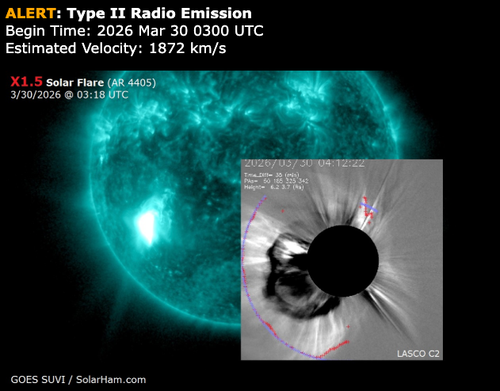
Space weather website SolarHam reported Monday morning that a “surprise X1.5 solar flare” was detected on the sun and may impact Earth within the next 48 hours. This comes ahead of NASA’s Artemis II launch on Wednesday and could affect the launch if the solar storm is severe.
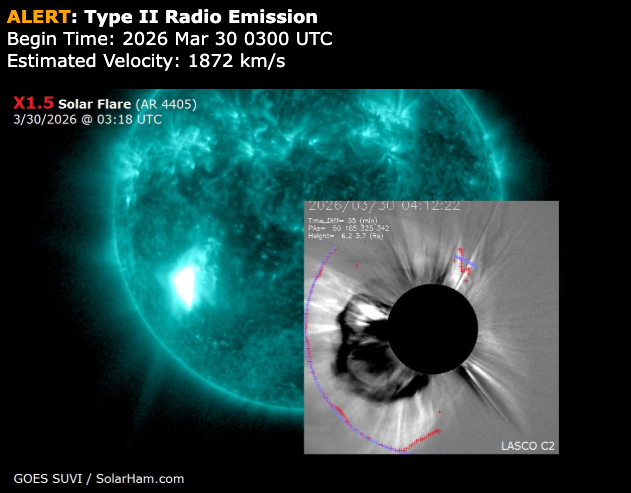
“AR 4405 erupted this morning at 03:18 UTC (Mar. 30) with a surprise X1.5 solar flare. This event launched a halo coronal mass ejection (CME) into space, which also appears to have an Earth-directed component,” SolarHam wrote in a space weather update earlier this morning.
A 1.15 X-flare exploded from sunspot 4405, launched a gigantic coronal mass ejection into space which will impact Earth and our surrounding space environment right around April 1st. This is the date set for the launch of Artemis II, a ten day space mission around the Moon by… pic.twitter.com/3cTNRkbsHQ
— Stefan Burns (@StefanBurnsGeo) March 30, 2026
The update continued, “Although the main bulk of plasma is heading to the east, the edge of the CME should pass Earth within the next 48 hours.”
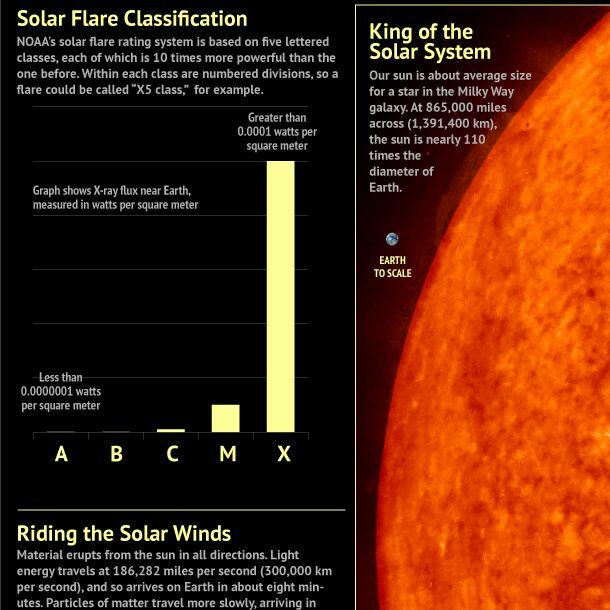
For context, an X1.5 solar flare is large. The standard scale goes A, B, C, M, then X, with each step representing a 10-fold increase in X-ray intensity. That means an X-class flare is the strongest major category.
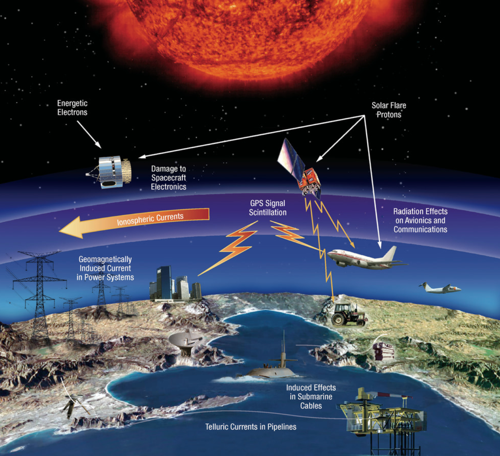
A strong X-class solar flare can affect GPS, satellites, communications, and power grids, and even cause delays in rocket launches. The size of the disruption depends on whether it is Earth-facing and whether it is accompanied by a coronal mass ejection.
Upcoming this week is NASA’s Artemis II crewed mission atop the Space Launch System rocket. So far, government forecasters are calling for an 80% chance of acceptable weather on launch day. NASA has not provided any update indicating that the current solar storm threat will affect the mission. Artemis II is currently targeted for no earlier than Wednesday, April 1, at 6:24 p.m. EST.
Tyler Durden
Mon, 03/30/2026 – 18:30