


New Bill Opens Door For Killer AI Weapons
A newly introduced U.S. Senate bill would allow the military to deploy autonomous lethal artificial intelligence systems by granting the Secretary of Defense the authority to override its own restrictions.

Senate Bill S.4113—the “AI Guardrails Act of 2026,” introduced March 17, 2026 by U.S. Senator Elissa Slotkin (D-MI)—is being presented as a framework to limit how the Department of Defense uses AI.
But the actual text includes a built-in waiver mechanism that enables those same systems to be approved and used under national security justifications.
This means a Pentagon-approved AI system could independently identify and engage targets, making life-and-death decisions without real-time human input.
There is no language in that waiver clause limiting where the system can be used, whether targets are foreign or domestic.
The bill has been read twice in the Senate and referred to the Senate Armed Services Committee, where it now awaits further consideration.
The waiver raises questions about how often “extraordinary circumstances” will be invoked, who ultimately decides when autonomous lethal force is justified, and what meaningful limits—if any—remain once that authority is exercised.
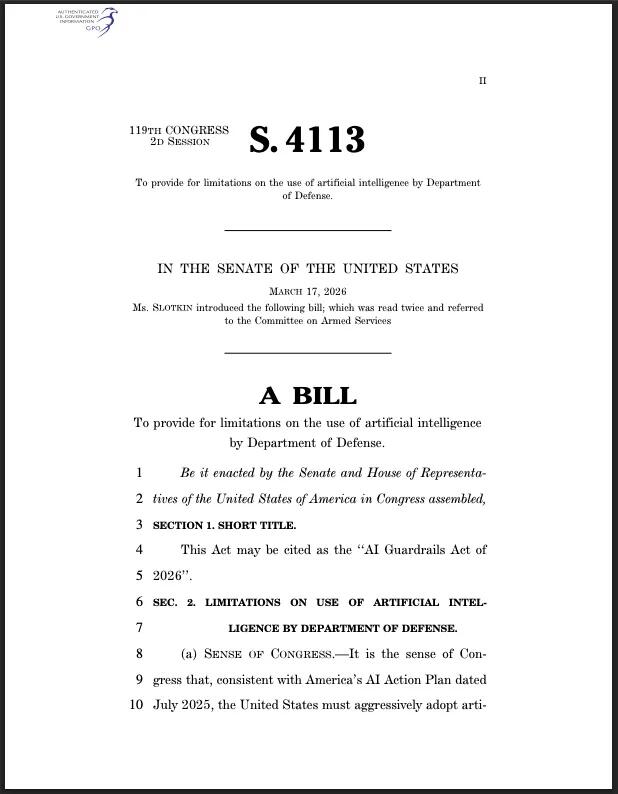
Waiver Authority Built Into the Core Restriction
The bill prohibits the use of AI for:
Launching or detonating nuclear weapons
Domestic monitoring or targeting without legal basis
Using lethal force through autonomous weapon systems without human oversight
Immediately following that restriction, the bill states:
The Secretary of Defense “may waive the prohibitions… for up to one year” and renew that waiver if “extraordinary circumstances affecting the national security of the United States require the waiver”
How It Works
The decision to authorize autonomous lethal systems is placed with the Secretary of Defense.
Waivers last up to one year
Waivers can be renewed
Congress is notified after issuance
Notifications may include classified components
The bill requires certification that the system’s error rate does not exceed that of human operators performing comparable functions.
Operational Scope
The waiver applies to:
Development
Field deployment
System modifications
It also covers changes to:
Mission sets
Target sets
Operational environments
Algorithmic behavior
Each of those changes can trigger continued or expanded authorization under the same waiver structure.
Sponsor Background
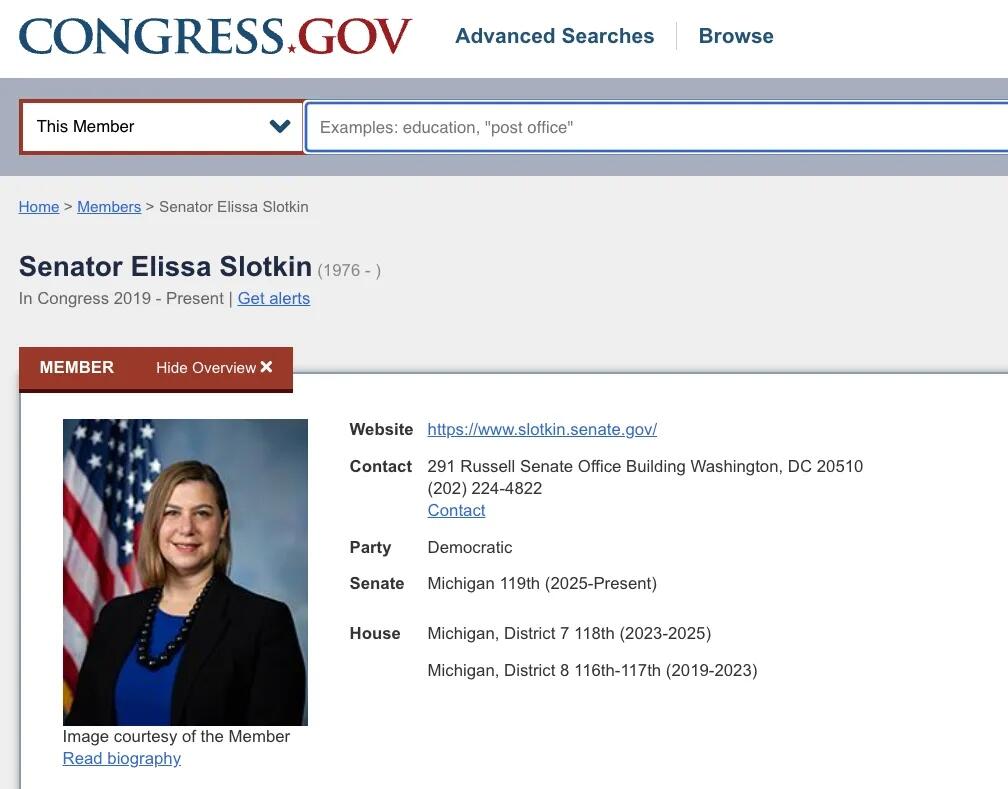
The bill was introduced by Sen. Elissa Slotkin, whose background includes:
CIA analyst
Department of Defense official
Acting Assistant Secretary of Defense for International Security Affairs
Her professional history is directly tied to the national security institutions governed by the bill.
Campaign Finance Alignment
Slotkin’s donor base includes multiple sectors tied to AI development, autonomous systems, and the broader defense-tech pipeline enabled by this bill.
According to OpenSecrets data, top contributors include:
Alphabet Inc ($96,669) and Amazon ($53,771)—major AI developers and federal cloud contractors
General Motors ($57,081) and Ford ($54,020)—advancing autonomous and robotics systems applicable to military use
University of Michigan, Michigan State, Harvard, Stanford—key hubs for federally funded AI and defense-related research
Kirkland & Ellis ($52,360) and WilmerHale ($81,463)—heavily involved in structuring large-scale federal and defense contracts
The bill authorizes deployment of autonomous AI systems under a renewable waiver controlled by the Pentagon.
The companies and institutions funding Slotkin are directly tied to building the AI, infrastructure, and legal frameworks required to support that expansion.
The legislation opens the door, and her donor base sits inside the ecosystem that stands to operate and profit within it.
Bottom Line
The legislation places a restriction on autonomous lethal AI systems while granting the Secretary of Defense—currently Pete Hegseth—the authority to waive that restriction under “national security” conditions.
That waiver:
Is controlled by a single Pentagon official
Can be renewed indefinitely
Applies to real-world deployment, targeting, and system evolution
Contains no language limiting where such systems may be used
Congress is notified after the fact, not required to approve.
The authority to deploy autonomous lethal AI systems sits inside the same section that claims to restrict them.
Tyler Durden
Thu, 04/02/2026 – 07:20