

EU Parliament Shocks Brussels: Chat Surveillance Rejected, Deportation Centers Approved
Submitted by Thomas Kolbe
Brussels’ assault on industry and small-to-medium businesses is a child of German ideology. This applies not only to the absurd climate battle; German statism also reveals itself in the proposed spying system of EU-wide chat surveillance. The open-border policies, executed in the style of a hippie state, can be attributed equally and without hesitation to Germany’s political record of this century.
Three dramatic political miscalculations, three intellectual detonations, leading to devastating societal consequences. All made in Germany, but certainly not made for Germany.
Berlin’s climate crusade and hippie ideology have inflicted severe economic and societal damage on the European Union, sparking a social movement that points to deep internal cultural and social conflicts.
The next generation will struggle to preserve its identity in Europe and assert itself politically. That this identity is not even articulated on a national German level guarantees the exclusion of the AfD under the Brandmauer-Ägide.
Colorful and intellectually reduced coalitions of SED communists, red and green socialists, and the statist CDU, randomly blended together, shape this Brandmauer idyll in Germany. The parliamentary Thursday in Brussels must have struck like a whip.
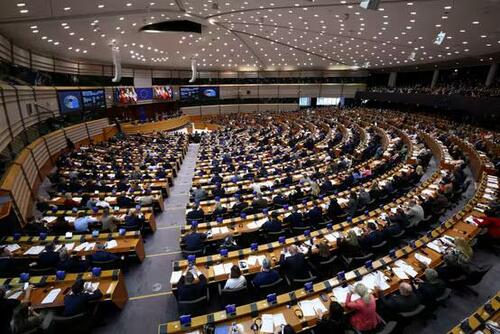
The European People’s Party (EPP), including the CDU/Union, joined forces with three right-conservative parties, among them the AfD, France’s Rassemblement National, and the Patriots for Europe (PFE), against the three ideological pillars of the globalist, German-inspired political restructuring project of the EU.
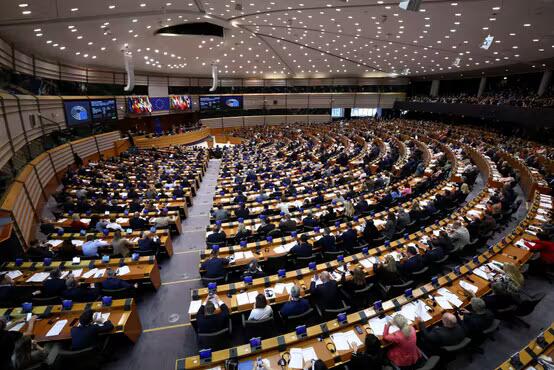
The political hammer of the day was undoubtedly the EU Parliament’s resolution to force the EU Council and Commission into a debate over establishing migrant deportation centers in third countries. A decision is expected in June. Yet at this point, the Parliament itself is powerless, as it famously has no legislative initiative rights.
We can therefore anticipate that political undermining of this resolution will begin immediately.
A shock, at least, for the Berlin political-media bubble, which is primarily engaged in covering up the consequences of uncontrolled migration and systematically pursuing and sanctioning criticism of the open-border regime with a comprehensive censorship apparatus.
Following the migration decision, the same parliamentary majority struck again against one of Berlin and Brussels’ favorite political projects. They also rejected the push for comprehensive private chat surveillance. This means the proposed EU regulation for so-called end-to-end encryption, which could have decrypted massive messaging content, is temporarily off the table.
How this will proceed remains unclear. Chancellor Friedrich Merz already announced a national solution for this issue on the same day. He seems in no hurry to assert ultimate control over citizens’ private communications.
For – and Thursday in the European Parliament demonstrated this – the wind is blowing increasingly against the German party cartel, and it comes from the patriotic side of the house.
Opposition is growing. Strong political forces like Italy’s government under Prime Minister Giorgia Meloni are shaping substantial opposition, which in both rhetoric and action resists both the climate cult and the open-border policies.
Multiculturalism, alongside the green degrowth agenda, counts among Germany’s political priorities. And the German chief ideologues are increasingly losing their allies in Brussels.
It won’t be long before Berlin could indeed stand isolated. This was indicated by the third surprising vote on Thursday.
Finally, the Parliament voted to loosen the EU supply chain law and reduce, above all, the environmental due diligence obligations for companies.
What purpose does it serve to require companies to document and analyze arbitrarily set social and ecological standards along complex supply chains, even down to primary production?
Brussels’ bureaucracy pushes such regulations deep into national power structures. We know this mechanism from CO2 taxation: German ideology is declared general EU regulation via Brussels, a new source of revenue is created, and a sanctions mechanism is established. At its core, this policy represents pure isolationism, dressed in the garb of European moral posturing with a distinctly German flavor.
How far must the European economic crisis penetrate society before the conservative-patriotic coalition can bring itself not to halt halfway but to ban bureaucratic monsters like the supply chain law permanently into the eternal hunting grounds of political delusions?
An interesting parliamentary week in otherwise sleepy Brussels ends with a bang, raising the question: is there perhaps reason to hope that the ideologically stuck political system can heal itself?
Could the geopolitical pressure, particularly from the United States, enable the conservative-patriotic coalition to gain the upper hand within the EU?
Ultimately, it is up to voters to create clarity at the national level and enforce a course correction. Should Germans, however, continue to resist a paradigm shift, the country could face mid-term isolation on a European level, as the wind there clearly blows from a conservative-patriotic direction.
* * *
About the author: Thomas Kolbe is a German graduate economist. For over 25 years, he has worked as a journalist and media producer for clients from various industries and business associations. As a publicist, he focuses on economic processes and observes geopolitical events from the perspective of the capital markets. His publications follow a philosophy that focuses on the individual and their right to self-determination
Tyler Durden
Mon, 04/06/2026 – 07:25