


As Los Angeles Hits “Breaking Point” Population Exodus, Houston’s GDP Rockets Higher
California – which spends nearly 40% of taxpayer revenue ($95.5 billion, not including federal funds) on social services that’s rife with fraud – and which spends roughly 25% of its $95.5 billion Medi-Cal budget (free healthcare) on illegal immigrants, is in the midst of a massive population exodus due to housing affordability, crime, taxes, wildfires, parental rights, and homelessness.

And while San Francisco and Los Angeles compete for the biggest cesspool in the country, LA county just took the crown when it comes to population loss.
According to the latest US Census data, Los Angeles county lost over 53,000 residents – marking the largest decline in any US city between July 1, 2024 and July 1, 2025 – while the overall population loss from 2020 to today is roughly 300,000 people.
“There is a real sense of burnout. They are paying insane taxes and getting absolutely nothing in return,” according to real estate developer Robert Rivani in a comment to Fox Business. “People feel like they’re living in a place that’s draining them financially and in exchange they’re dealing with rising crime, shrinking services, and a sense that everyone around them is trying to leave too.”
“It isn’t just one factor, it’s the breaking point phenomenon. The taxes, the lack of safety, the red tape,” Compass Real Estate agent Chad Carroll told the outlet. “I have a client from California whose home was broken into twice in the past six months. The whole political landscape there is destroying the state.”
“These are individuals who have spent their lives building businesses and wealth,” he added, “and they feel that California has become a place that takes everything and gives back very little in terms of safety, infrastructure and opportunity.”
Houston We Have The Opposite Of A Problem
Meanwhile, Houston is undergoing a transformation. Not only can you actually get homeowner’s insurance (13% of realtors said they’ve had at least one home fall out of escrow because a buyer couldn’t find insurance),
Let’s compare to Los Angeles:
Housing Affordability & High Cost of Living: LA housing is 2.5–3× more expensive than Houston (median ~$900k+ vs ~$340k).
High Taxes: Houston has no state income tax. Los Angeles has a top rate of 13.3%.
Crime, Homelessness & Public Safety: Houston has far lower homelessness (~14× lower rate) and better recent crime trends.
Parental Rights & Education Policies: Houston/Texas has stronger parental notification and consent laws.
Wildfires, Natural Disasters & Insurance Crisis: Los Angeles faces severe wildfire insurance non-renewals and premium spikes. Houston does not.
Jobs, Wages & Economic Opportunity: Houston has stronger job growth and better cost-of-living-adjusted wages.
Traffic, Congestion & Infrastructure: Los Angeles has significantly worse traffic (83 vs 56 hours lost per year).
Broader Quality-of-Life: Houston has lighter regulations, faster permitting, and lower energy costs.
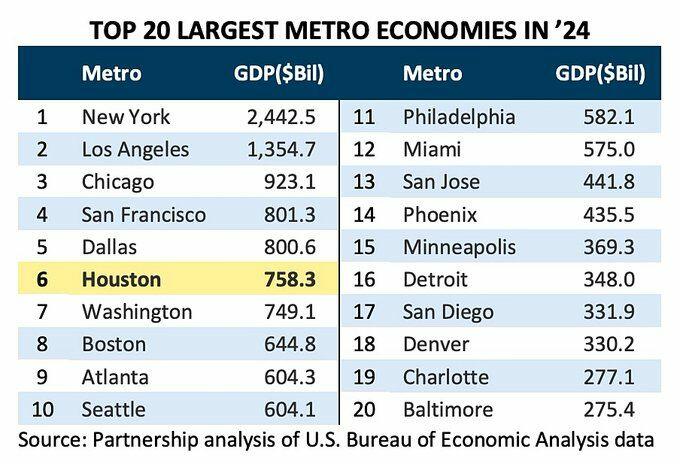
About that job growth: Houston real estate experts @Houstonomics just revealed that Houston became the 6th largest metro economy in 2024 (most recent data), and became the second fastest growing city out of the country’s 20 largest metro economies.
In a Saturday post on X (via Capital.news), they note: The numbers are in, and they demand attention.
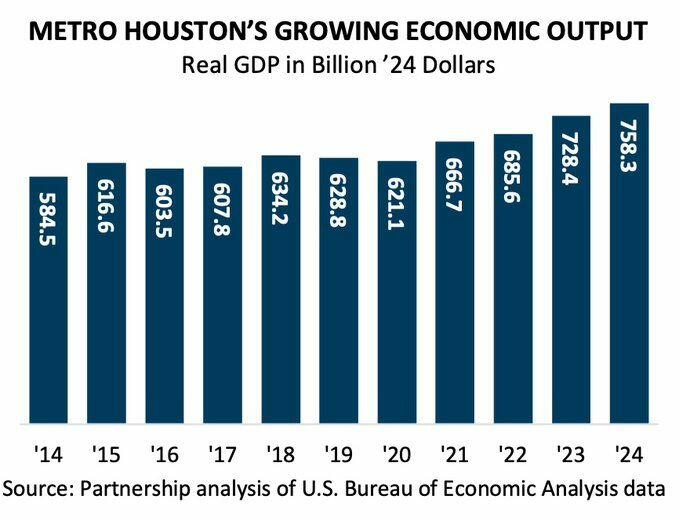
Metro Houston’s GDP hit $758.3 billion in 2024, crossing three-quarters of a trillion dollars in real, inflation-adjusted terms for the first time on record. That makes Houston the 6th largest metro economy in the United States, ahead of Washington D.C. and closing in fast on the cities above it.
But the size of the number is not the real story. The velocity is.
Houston grew at 4.1% in 2024, nearly double the national rate of 2.8%. Over the prior two years, only Seattle grew faster among the 20 largest metro economies. In absolute dollar terms, Houston added $72.6 billion in output, second only to New York City. That is not an oil town riding a commodity cycle. That is a diversified industrial powerhouse firing on all cylinders.
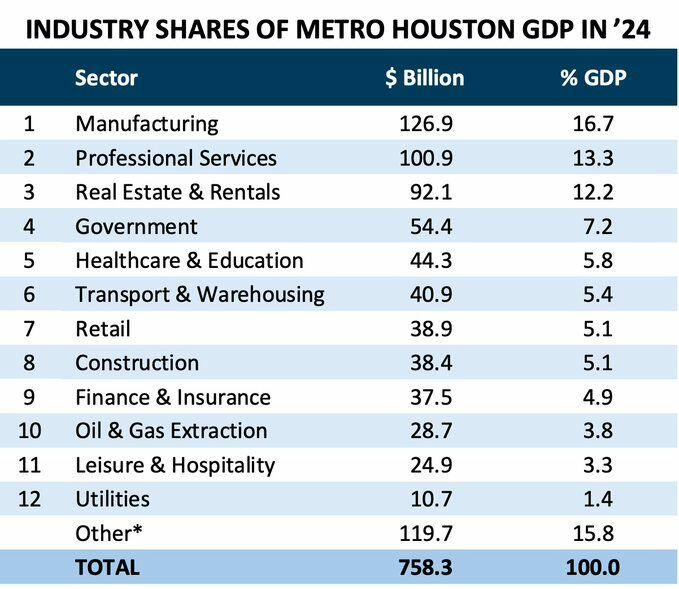
The conventional wisdom about Houston has always centered on energy. And yes, energy is still woven into the fabric of this city. But oil and gas extraction has fallen from 7.7% of GDP in 2014 to just 3.8% today, even as total output has grown. The city has not abandoned energy. It has grown everything else around it faster.
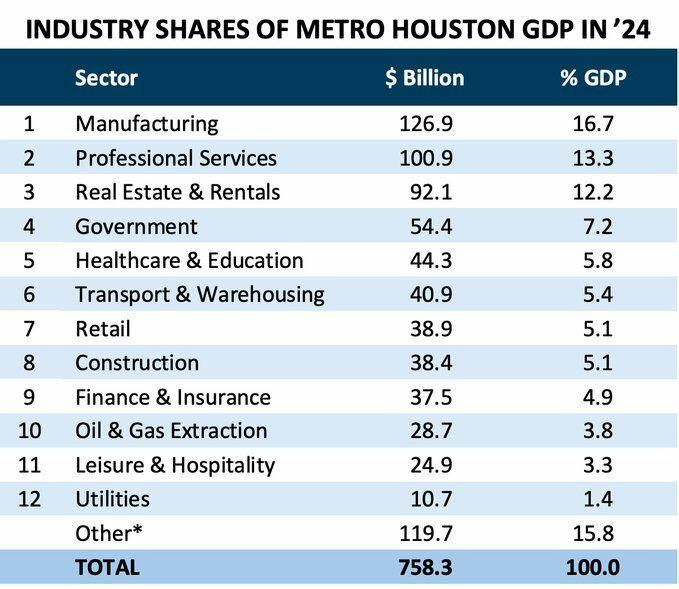
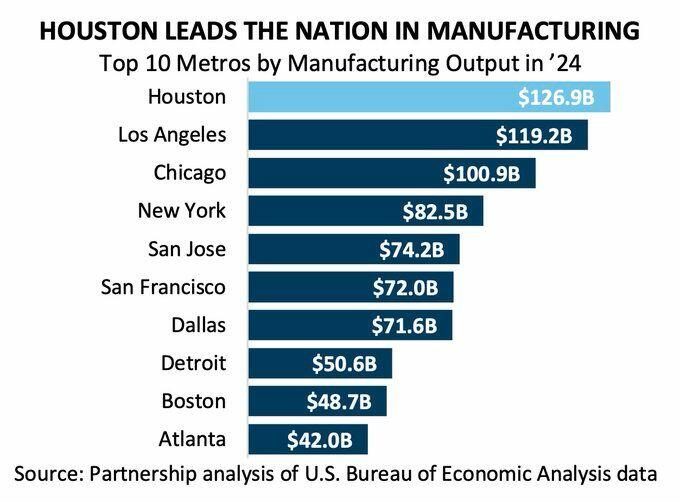
Manufacturing tells that story best. Houston produced $126.9 billion in manufactured goods in 2024, leading every metro in the country for the third straight year. More than Los Angeles. More than Chicago. More than double Detroit. Recent project announcements from Foxconn, Eli Lilly, and Tesla signal that this base is expanding well beyond its petrochemical roots.
Worker productivity reinforces the picture. The average Houston worker generates $221,000 in economic output per year, nearly 19% above the national average. That figure has risen 11.1% since 2019, outpacing the 7.9% national gain. Houston achieves this not through a narrow concentration of tech billionaires, but through the rare combination of skilled blue-collar workers and world-class industrial capital operating at scale.
Then there is trade. Nearly one in four dollars produced in Houston gets exported to global markets. No other major metro comes close. Dallas and Chicago export roughly 6% of their output. Houston exports 24%. The Port of Houston connects this industrial base to the world, and the world keeps buying.
The investment community is paying attention. In 2025, the Greater Houston Partnership recorded 683 new business announcements, a 26.5% increase over the prior year. Of the 683 announcements tracked in ’25:
35 disclosed employment figures totaling 14,834 new jobs.
42 reported $10.5B in capital investment.
665 disclosed 602.8M SF in space occupancy.
Of those, 117 came from foreign-owned firms, the highest volume on record. Companies from around the world are choosing Houston not as a backup plan, but as a primary destination.
The Purchasing Managers Index has shown continuous expansion for 68 consecutive months. Vehicle sales hit an all-time regional record. Sales tax revenues rose 5.9% in 2025, even after adjusting for inflation. The macro data and the street-level data are telling the same story.
Houston is not having a moment. It is building a permanent position at the top tier of American economic geography. The city that the coastal consensus once dismissed as a boom-bust energy town has quietly become one of the most productive, most export-oriented, most globally connected industrial economies on the planet.
The data is out. The question is whether the rest of the country is paying attention.
Data sourced from the Greater Houston Partnership, “Houston:The Economy at a Glance,” March 2026.
It is in population growth. Wait until Elon Musk gets that Chip plant up and running. https://t.co/Fnt8u9v7aW
— Houstonomics (@Houstonomics) April 4, 2026
Tyler Durden
Tue, 04/07/2026 – 22:10