

Here’s Why Trump’s Hormuz Blockade Should Stoke ‘Strait Chaos’ For China
The currently closed Strait of Hormuz, situated between Oman and Iran, connects the Persian Gulf to the Gulf of Oman and the Arabian Sea, and has emerged as a major flashpoint in the US-Iran war. The Bab el-Mandeb Strait, off Yemen’s coast, has also remained a focal point among critical maritime chokepoints, given ongoing threats from Iran-linked Houthi rebels.
While both critical chokepoints have been in sharp focus in the news cycle and among US officials, institutional research desks, intelligence analysts, observers, the OSINT community on X, and even everyday viewers watching Fox News or CNN, there is also another set of regional and transregional straits that warrant additional monitoring given their importance to global energy flows and commercial shipping.
Shifting from the Hormuz chokepoint, the latest data from Bloomberg, citing AIS ship-tracking data, shows that tankers bound for China transiting from the Gulf area through the Strait of Malacca is yet another maritime chokepoint, especially for energy and trade flows into Asia.
The Strait of Malacca, at its narrowest point, is only 1.7 miles wide, creating a natural bottleneck. Most of the tankers transiting the tiny but very critical strait are hauling crude and LNG bound not just for China, but also for Japan, South Korea, and other countries in the region. This strait is a key link between Hormuz and China’s coastal refineries.
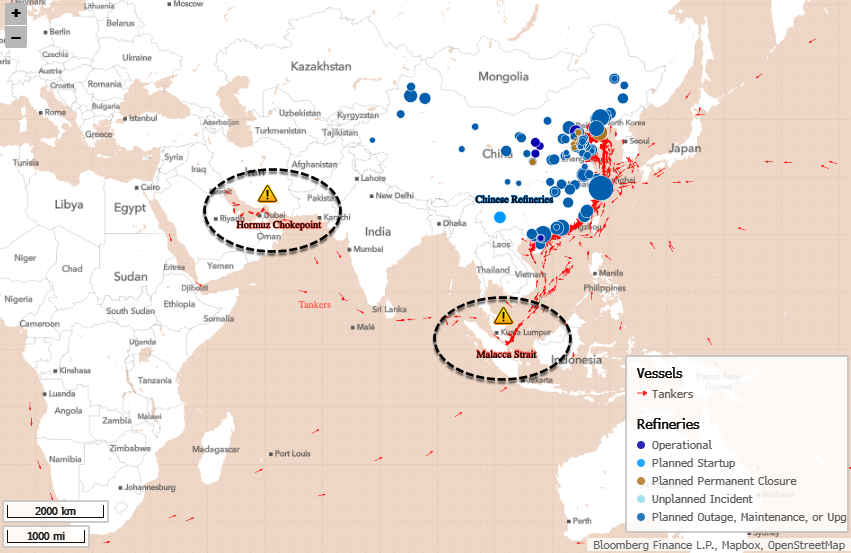
The list of narrow maritime chokepoints through which energy products flow on tankers should be very concerning to Beijing, given the US blockade of Hormuz and its potential to serve as a pressure campaign against China ahead of the Trump-Xi meeting.
Strait of Hormuz
This is the most important upstream chokepoint for China’s Gulf oil imports. A large share of Chinese crude from Saudi Arabia, Iraq, the UAE, Kuwait, and Qatar must exit through Hormuz first.
Strait of Malacca
This is China’s main downstream maritime bottleneck. Even after oil clears Hormuz, much of it still has to pass through Malacca on the way to East Asia. This is the classic “Malacca dilemma.”
Singapore Strait
Operationally linked to Malacca. Disruption here would compound any pressure on vessels transiting between the Indian Ocean and the South China Sea.
Lombok and Makassar Straits
These are major alternative routes if Malacca becomes constrained. Pressure here would matter because Chinese shipping would likely try to reroute through Indonesia.
Sunda Strait
Less ideal than Lombok, but still a secondary bypass route. It matters mainly in a broader interdiction or diversion scenario.
Bab el-Mandeb
This would affect Chinese crude and product flows tied to the Red Sea/Suez route, including some cargoes from North Africa or Atlantic Basin-linked trade. It is less central than Hormuz or Malacca for Gulf oil, but still important.
Our assessment here is that China’s crude import routes are highly vulnerable at Hormuz and Malacca, and the US can certainly throw a wrench in that system and disrupt those flows, as Hormuz has proven.
Zoltan Pozsar of advisory firm Ex Uno Plures explained it best: the Trump administration is “methodically building a portfolio of assets” to pressure China, centered on strategic energy supply nodes and maritime chokepoints that have historically supported Beijing’s cheap crude imports.
The obvious question is what happens if China doesn’t play ball with the US ahead of Trump’s upcoming Xi meeting. Beijing can clearly see the emerging pattern in which the Trump administration is willing to use US naval power, maritime chokepoints, and even the threat of blockade to generate leverage. That’s why the other straits noted above should serve as a warning to the Chinese leadership.
Tyler Durden
Sun, 04/19/2026 – 13:25