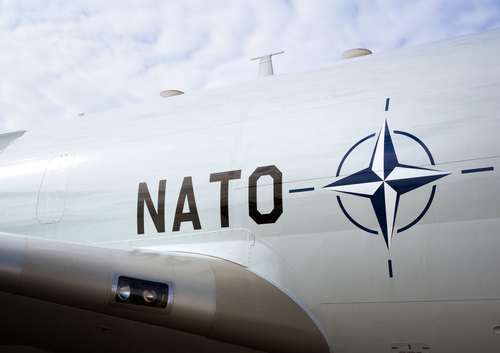







The latest statements coming out of Washington are the result of a structural imbalance that has existed for decades. President Donald Trump is now openly considering pulling the United States out of NATO, calling the alliance a “paper tiger” and questioning its value after European allies failed to align with US policy beyond their immediate interests.
To understand this, you have to start with the numbers because they expose the reality far better than any political statement. NATO’s total defense spending is estimated at roughly $1.5 to $1.6 trillion, yet the United States alone accounts for about 62% of that total. That means Washington is effectively funding the majority of the alliance while the remaining members collectively contribute less than half. In 2025, US defense spending approached $980 billion, dwarfing every other member combined.
Europe, by contrast, has only recently begun increasing spending after years of underinvestment. EU defense expenditures reached about €381 billion in 2025, which equates to roughly 2.1% of GDP, barely meeting the long-standing NATO guideline. Trump threatened to withdraw from the lopsided alliance in his first term, warning that Europe was relying on American taxpayers to subsidize its security.
For years, most NATO members failed to meet even the 2% GDP target agreed upon in 2014. It was not until after the Ukraine conflict escalated that spending began to rise meaningfully. Even now, only a handful of countries, such as Poland and the Baltic states, exceed 3% of GDP, while many others hover just above the minimum threshold.
Europe has shown no hesitation when it comes to Ukraine. Defense spending across European NATO members and Canada has surged by roughly 50% between 2022 and 2025, driven almost entirely by the war in Ukraine. Arms imports into Europe have more than tripled in response to the conflict, with the United States supplying approximately 58% of those imports. This is where the contradiction becomes impossible to ignore. Europe is willing to spend when the conflict is on its doorstep, yet it continues to rely on the United States for both funding and military capability.
This is exactly why I have said there is no real benefit for the United States in NATO in its current form. It has evolved into an institution where the burden is not shared equally. It has also become a political structure dominated by career policymakers who continue to push interventionist agendas without bearing proportional responsibility. NATO has become a retirement home for Neocons, a place where the same foreign policy ideas persist regardless of outcomes. The illusion of safety is a fallacy, as NATO is a globalist organization that promotes war and acts on the offense.
The discussion about increasing defense spending to 5% of GDP by 2035 only reinforces the problem. To reach that level, NATO members would need to add trillions in additional spending. Estimates suggest total NATO expenditures could rise to over $4 trillion annually under such targets, a figure that would place enormous strain on European economies. For many countries, this would require either massive borrowing or cuts to social programs, neither of which is politically sustainable.
Europe talks about strategic autonomy and independence, yet it continues to depend on the United States for both security and military hardware. Even now, more than half of European NATO arms imports come from the United States, highlighting just how reliant the continent remains.
What we are witnessing is the slow breakdown of a post-World War II structure that no longer reflects the current geopolitical reality. NATO was created for a different era, one where the United States was willing to underwrite global security without question. That era is ending. The financial burden is becoming too large, and the political return is becoming too small.
Trump is not creating this issue. He is articulating what the numbers already show. If the United States is paying the majority of the costs while receiving inconsistent support in return, then the value of the alliance is called into question. This is not about isolationism. It is about cost versus benefit.
Ukraine was neither a NATO member nor part of the EU. In fact, both alliances rejected Ukraine’s request to join. Europe went ahead and financed their entire war; meanwhile, those same leaders refuse to assist the US against Iran because it is “not their war.” Europe effectively bit the hand that has been feeding it by loudly rebuking US military action.
If the United States steps back, Europe will be forced to confront a reality it has avoided for decades. It will have to fund its own defense, build its own capabilities, and manage its own conflicts without relying on Washington as a backstop. That transition will expose just how fragile the current structure has become.