








Armor-Piercing Ammo Metal Up 557% As China Chokes Supply, War Demand Surges
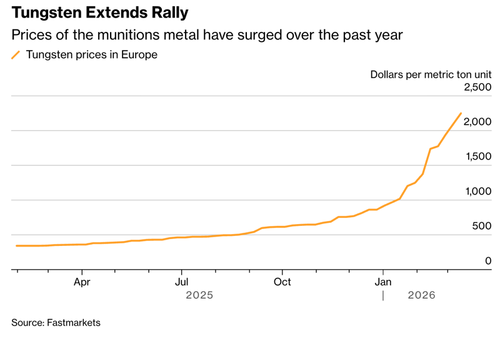
Tungsten, used in missiles, tank rounds, armor-piercing ammunition, and some smaller-caliber munitions, has surged in price over the last year as China curbed exports and global supplies tightened.
This is a major concern, as multi-front conflicts – from the Middle East to Eastern Europe – are depleting interceptor missile supplies.
Bloomberg cites new data from commodity price reporting agency Fastmarkets showing tungsten prices have surged to $2,250 per metric ton this month, up 557% since Beijing added certain tungsten products to its export control list in February of last year.
“In my 12 years working across the commodity space and dealing with a lot of weird and wonderful metals, I have never seen a market as tight as tungsten is right now, aside from maybe lithium in 2021,” George Heppel, vice president of commodity research, told Bloomberg.
He warned, “This isn’t like lithium, where there was a huge pipeline of projects that could come online.”
The problem with rare earth metals is that China dominates the global market. It controls roughly 79% of global tungsten mined output, which Western companies rely on heavily.
According to Project Blue, a London-based commodity research firm, manufacturers have been searching for alternative supplies since China significantly tightened export controls last year. Chinese shipments of restricted tungsten products were down about 40% last year, the firm said.
The tungsten squeeze highlights why the Trump administration has been furiously rewriting global supply chains away from China, especially with the push to build out domestic rare earth supply chains critical for the military and semiconductor industries.
“The industrial base is desperate for material,” said Almonty Industries CEO Lewis Black, whose firm is set to begin commercial production at the site of an idled mine in South Korea and is seeking to develop the first U.S. tungsten mine in a decade.
“We’ve never been in a situation where the market is determining the price,” Black said. “So we don’t really know where it’s going to settle.”
One year ago, Black warned his customer base was in a “state of disbelief” amid China’s tightening of global supplies.
“It’s the warning shot, because we cannot exist without it,” Black told Bloomberg’s Annie Lee in an interview at the time.
He noted: “Our economy, manufacturing, defense, everything, is so dependent on it. And yet, Russia, China and North Korea have about 90% of the output.”
Shares of Almonty in the U.S. are up 127% this year, as the market is waking up to the fact that this company is expected to become one of the largest tungsten producers outside China.
Almonty is also developing a U.S. tungsten project in Montana that it says could become the first U.S. tungsten mine in about a decade.
Military-related tungsten demand is set to surge this year because the metal is used in missile components and other weaponry deployed in the conflict zones of the Middle East and eastern Ukraine. Major U.S. defense companies have already signaled to the Trump administration that missile production will quadruple, putting even more pressure on critical metals.
Tyler Durden
Mon, 03/16/2026 – 16:50