









Britain Once Led The World. What Happened?
Authored by Damian Pudner via the Foundation for Economic Education,
An unsettling look at the economic settlement that the UK now seems willing to accept can be found in the latest fiscal forecast, published on March 3.
By the end of the forecast period, borrowing will have decreased from 5.2 percent of gross domestic product (GDP) in 2024–2025 to about 1.6 percent. Public debt stabilizes at roughly 95 percent of national income. At those levels, even small shifts in interest rates matter: The Office for Budget Responsibility (OBR) estimates that a sustained 1-percentage-point move in the Bank Rate changes government borrowing costs by about 15 billion pounds (about $20 billion).
In the later years of the forecast, economic growth limps along at about 1.5 percent, while unemployment is expected to peak at 5.33 percent. Meanwhile, the tax burden approaches an unprecedented 38 percent of GDP, the highest sustained level in the postwar era, as public spending remains significantly higher than its pre-COVID-19-pandemic share of the economy.
Taken together, these forecasts describe an economy settling into a comfortable equilibrium of high taxation, high debt, and chronically modest growth. Expectations are quietly lowered and economic underperformance is being normalized.
There is no ambition here. Nothing is reset. Nothing is reimagined. Nothing really changes.
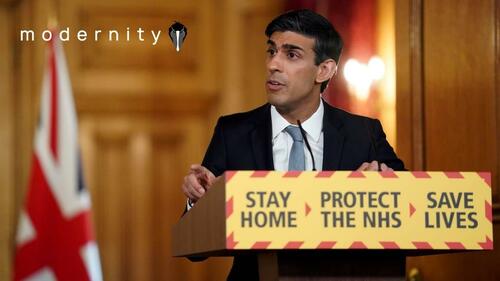
There is something unmistakably Starmerite about the entire outlook. Prime Minister Keir Starmer’s political persona is built on reassurance and managerial competence. The chaos will stop. The adults are back. Nothing dramatic will happen on his watch. Chancellor of the Exchequer Rachel Reeves is no different.
But countries do not restore economic dynamism through managerial composure alone.
The UK was once the workshop of the world. Later it became one of the most open and dynamic economies in Europe. When the postwar economic model began to falter in the 1970s, the country eventually recognized that incremental tweaks would not suffice. Structural reform became unavoidable.
What followed was neither cautious nor gradual. The reforms of the 1980s dismantled large parts of the existing economic model and replaced them with something far more competitive. Nowhere was that clearer than in the financial sector. The Big Bang of 1986 swept away restrictive practices, opened London’s markets, and helped turn the city into one of the world’s dominant financial centers.
Whether one applauds or criticizes those reforms, their ambition is undeniable. That sense of ambition is strikingly absent from the UK’s economic debate today.
Instead, the state is not being structurally rethought. It is simply being financed more heavily. The clearest example is the continued freeze in income tax thresholds. According to earlier OBR analysis, this policy alone will be raising roughly 67 billion pounds (about $89 billion) per year by the end of the decade.
By 2030–2031, about 1 million more people will be brought into paying income tax, and roughly 1.6 million people will pay the 45 percent rate, a level originally introduced to target the “super-rich.” At the same time, another 1 million pensioners will be drawn into paying income tax. This is both unsustainable and politically corrosive.
As Prime Minister Margaret Thatcher reminded us, “You cannot tax a country into prosperity.”
The broader economic outlook is equally modest. Productivity growth is expected to recover only slowly, reaching roughly 1 percent annually in the medium term. That supports GDP growth of about 1.6 percent. Such growth may just about stabilize the debt ratio, but it is nowhere near the pace required to transform living standards or expand the country’s economic capacity.
Even the recent improvement in government revenues owes something to favorable financial conditions rather than deep structural change. Stronger equity markets have lifted receipts from capital gains and corporation taxes. Yet the same fiscal projections warn how vulnerable this is to reversal. A sharp fall in equity prices would quickly worsen the public finances. The OBR warns that a 35 percent correction in UK and global equity markets could widen the current budget deficit by about 26 billion pounds (about $34 billion) in 2027–2028. Even a more limited scenario—in which UK equities fall by 15 percent—still adds about 15 billion pounds (about $20 billion) to borrowing.
In other words, the strategy works provided growth improves modestly and financial markets remain cooperative. That is not a robust foundation for long-term prosperity.
Downing Street’s rhetoric is “growth, growth, growth.” The figures point to something more akin to steady, steady, steady or, perhaps more accurately, dull, dull, dull.
Growth is not being unleashed as much as carefully managed.
The economic horizon contains little in the way of bold reform or institutional redesign. For a country with the UK’s economic history, that is a strikingly modest ambition.
The UK deserves something more.
It cannot tax its way back to economic leadership. Nor can it rely on rising asset prices or modest productivity gains to do the work.
Increasing the economy’s potential for production would be the main goal of a more serious agenda: a tax system that rewards enterprise and investment rather than subtly expanding the middle-class tax base, planning reform that actually increases the supply of housing, and regulatory frameworks that promote innovation rather than administrative caution.
In short, something with the seriousness and disruptive intent of the Big Bang.
Political bravery will be needed for that. It will necessitate a government that is willing to pursue reform even if it goes against long-standing interests. Above all, it will necessitate a political elite that is prepared to acknowledge that cautious maintenance of the status quo is not a viable approach to national renewal.
The UK once set the pace of the global economy. Today, it risks settling for the careful management of mediocrity. And that, more than anything else in the fiscal forecasts, should concern us all.
Tyler Durden
Sat, 03/21/2026 – 08:10