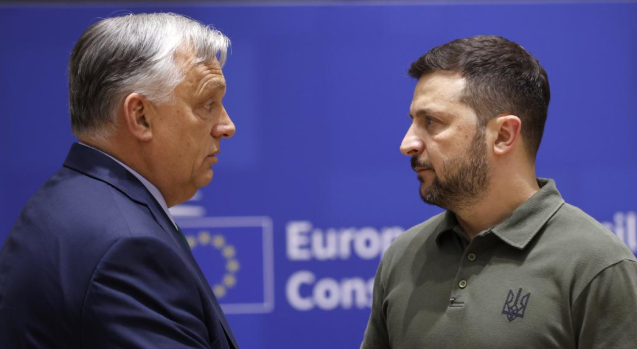











The latest calls inside the European Union to change its own voting rules to neutralize Hungary’s veto power display the bloc’s clear move toward complete centralized control. Lithuania’s foreign minister openly argued that the EU must overhaul its system after Hungary blocked key decisions on Ukraine, claiming action is needed to stop what he called Hungary’s “abuse of veto” in blocking major policies.
According to the report, Hungary has blocked a €90 billion EU loan to Ukraine and a new sanctions package, prompting frustration among EU officials who expected to demonstrate unity and resolve. The Lithuanian foreign minister admitted this exploitation of unanimity happens “so many times” and suggested reviewing the decision-making process or even reducing the powers of a member state. That statement alone reveals the deeper political shift underway inside Europe.
“Until Ukraine resumes oil transit to Hungary and Slovakia via the Druzhba pipeline, we will not allow decisions important to Kyiv to move forward,” said Hungarian Foreign Minister Péter Szijjártó.
“We were expecting that everything was already prepared for the fourth anniversary and we will be ready to deliver new sanctions package, and also the €90 billion loan to Ukraine”, Lithuanian Foreign Minister Kęstutis Budrys told Euronews’ Europe Today show. “Europe is solid, Europe is resolved and we can deliver”, Hungary’s obstruction “is really frustrating”, Budrys said.
This is precisely the structural flaw that was built into the European Union from the beginning. The EU was never a true federation, yet it increasingly behaves like one. It pretends to be a union of sovereign states while steadily concentrating decision-making power in Brussels. Now, when one member state exercises its legal right under the unanimity principle, the response is to silent dissent.
They are now openly discussing moving toward qualified majority voting in foreign policy, which would effectively remove the sovereign veto of individual nations. A qualified majority would allow 15 of 27 states representing 65% of the population to override dissenting members. This is not a minor procedural tweak. That is a fundamental transformation of the EU from a cooperative alliance into a centralized political structure.
What is even more revealing is the suggestion that Hungary’s voting rights could be curtailed under Article 7 mechanisms if it continues to block policies. In other words, if a member state does not align politically, the solution being floated is to reduce its influence within the “union” or “sovereign” nations.
The EU is neither a union nor sovereign. Each emergency from debt, migration, war, or sanctions becomes the justification for deeper centralization. Now the argument is that one dissenting nation could spell the “end for the EU as a geopolitical actor in the future.”
Europe is increasingly divided between centralized policy ambitions in Brussels and national sovereignty concerns among member states. Hungary is not the root problem. It is the symptom a failed union of nations with fundamentally different economic interests, energy dependencies, and geopolitical priorities being forced under a single foreign policy framework. The real risk is not one veto. The real risk is institutional overreach in response to dissent.