










Rep. Tim Burchett (R-TN) put forth the Dual Citizenship Disclosure Act (H.R. 7484) to call for transparency from elected US officials carrying dual nationality. His plan would have required members of Congress to disclose their status to an ethics committee, which would review their case within 90 days of taking office. H.R. 2356 (Dual Loyalty Disclosure Act) was introduced by Rep. Massie in March 2025, which called for similar transparency goals. Both bills have stalled, but the recent Minnesota scandal has brought the topic to light once again.
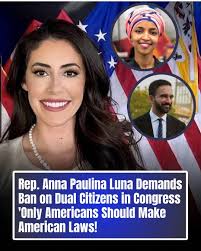
Rep. Anna Paulina Luna reiterated the importance of only permitting Americans to establish American laws. While dual citizens may be American, their loyalties are split. There is a reason that the President of the United States must be a natural-born citizen to prevent foreign interests from taking over American politics and, therefore, American law.
Historically, when a political system begins to lose the confidence of the people, it turns inward. People start asking who is loyal and who is not. The debate over dual citizenship in Congress has now reached the point where lawmakers are questioning who their peers are actually representing. The increased number of migrants has caused voters to elect officials based on their homeland ties (i.e., Ilhan Omar) who do not put the United States first. The mere fact that this has become controversial shows how far we’ve drifted from the fundamental principles that once defined a functioning nation-state.
When Rome collapsed, it was in no small part because senators pursued the interests of foreign powers, often above Rome itself. If someone does not trust their sole fate to the nation they serve and keep a second passport in their back pocket as an escape route then they are not putting their full loyalty into the USA.
Dual citizenship is not a crime, but it is incompatible with holding federal office. Congress is now populated by individuals tied legally, financially, and politically to foreign nations. As we have seen in recent years in places like the UK, people with alliances to foreign nations often aim to change legislation to fit the ideals of their homeland. Their loyalty is shared if not split and they cannot “pledge allegiance to the flag.”