









Conservative Hardliner Elected President Of Costa Rica
High on the minds of Costa Rican voters as they went to the polls on Sunday was undoubtedly the surge in drug-related violence across the otherwise stable Central American country, which has been a trend for the region generally.
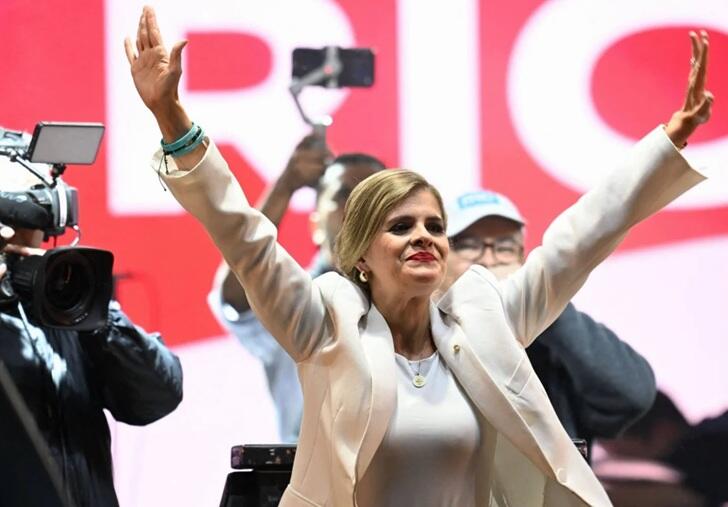
Conservative candidate Laura Fernandez by Monday morning was able to quickly declare victory in the presidential election after early results confirmed a decisive lead, causing her nearest rival to concede. She took nearly half the vote.
By early Monday, the Supreme Electoral Tribunal reported that ballots from 81% of polling stations had been counted, giving the Sovereign People’s Party candidate 48.9% of the vote. The figure clears the 40% threshold needed to avoid a runoff, effectively ending the race in the first round.
Her closest challenger, economist Alvaro Ramos of the National Liberation Party, trailed far behind with 33%. A distant third was progressive architect and former first lady Claudia Dobles, who failed to reach 5%.
This marks another clear victory and mandate for the Right in Latin American politics. Ferdandez is vowing “deep and irreversible change”. The country’s second republic, born after the 1948 civil war, “is a thing of the past,” she’s declared in a victory speech.
The relatively young, 39-year-old leader told a large enthusiastic audience of flag-waving supporters, “It’s up to us to build the third republic” based on a vision that is “respectful and firm on the rule of law.”
“Any law that is ineffective, that has become obsolete, that has become a hindrance to development, will be modified or repealed,” she proclaimed.
Costa Rica, though long regarded as one of Central America’s safest and most stable democracies, has seen crime surge amid the regional expansion of transnational criminal gangs.
One regional monitor included rare mention of Costa Rica as giving increased cause for concern in a review of Latin American narco and crime hubs:
While it remains outside the most dangerous tier, its homicide rate has risen from 11.56 in 2015 to 16.6 in 2024. Key port cities like Limón are emerging as major cocaine export points, mirroring Ecuador’s descent into narco-violence.
#Nacional | 🗳️ Elecciones 2026: Nayib Bukele felicita a Laura Fernándezhttps://t.co/bDgy9i63aX
— MultimediosCR (@multimedioscr) February 2, 2026
Previously on the campaign trail Fernandez openly signaled admiration for El Salvador’s President Nayib Bukele, whose hardline and unapologetic security policies have driven murder rates sharply lower and earned him sky-high approval ratings at home.
Fernandez has said she will declare states of emergency in gang-dominated areas and complete construction of a high-security prison modeled on El Salvador’s Cecot facility.
International press reports have picked up on this trend:
The country of 5.2 million people, famous for its white-sand beaches, has long been seen as an oasis of stability and democracy in Central America.
But in recent years, it has gone from transit point to logistics hub in the global drug trade. Drug trafficking by Mexican and Colombian cartels have seeped into local communities, fuelling turf wars that have caused the murder rate to jump 50 percent in the past six years, to 17 per 100,000 inhabitants.
…Bukele was the first foreign leader to congratulate her.
Fernandez’s win confirms a rightward lurch in Latin America, where conservatives have ridden anger towards corruption and crime to win power in Chile, Bolivia, Argentina and Honduras.
A good map of how #LatinAmerica is finishing 2025. The map will get bluer starting in early 2026. @thetimes
Reasons for the rightward shift? Security, lack of economic growth, migration, and of course, the catastrophic failures of #Chavismo, #Castrismo, and #Orteguismo. pic.twitter.com/s94z5WI5ty
— Ryan Berg, PhD (@RyanBergPhD) December 27, 2025
She has shot back at critics who warn that her rule will serve to erode democracy and civil liberties, saying her leadership will uphold “dialogue and national harmony” but which is at the same time “firmly based in the rule of law.”
Tyler Durden
Mon, 02/02/2026 – 13:25