






The latest polling data coming out on the Democratic Party is not just bad. It is historically weak, and what is even more telling is that the erosion is coming from within their own base. This is not the opposition attacking them. This is their own voters losing confidence, and that is always the beginning of a political fracture.
Recent polling shows the Democratic Party sitting at a net favorability of roughly -20, with more than 55% of Americans viewing the party unfavorably. At the same time, even among Democrats themselves, enthusiasm has collapsed compared to prior cycles. An AP-NORC poll found that support within the party has not recovered since the 2024 election loss, and even loyal voters are far less confident than they were historically.
The press will try to spin this as temporary dissatisfaction or “mid-cycle frustration,” but they fail to understand how cycles work. When you see declining confidence not just from independents but from the core base itself, that signals internal division. The coalition begins to fracture because it was never truly unified in the first place. It was held together by opposition, not by shared vision.
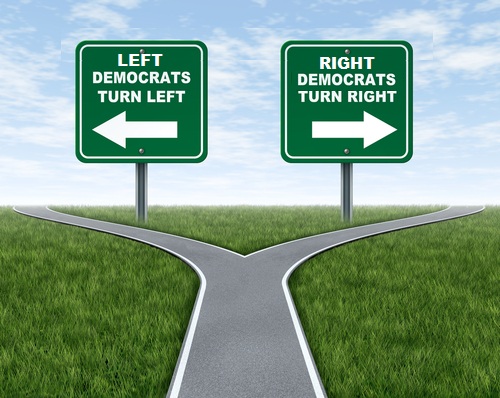
The Democratic Party has become a coalition of competing interests that cannot coexist long-term. You have the progressive faction pushing aggressively left, while a large portion of the traditional base remains far more moderate. Even internal surveys acknowledge that the average Democratic voter is far less extreme than the activist wing that dominates policy and media narratives.
You can already see the cracks forming. Infighting is becoming more aggressive, particularly in key races, where Democrats are now attacking one another before even facing the opposition. This is exactly what happens before a political realignment. The party turns inward, and the fragmentation accelerates.
The Republican Party has consolidated into a more unified base, while the Democrats have expanded into a broader coalition that is inherently unstable. The more ideologically diverse the coalition becomes, the harder it is to maintain cohesion as confidence declines.
This is the early stage of a political restructuring and the death of the Democratic Party. When a party loses the confidence of its own base, it begins to splinter. Factions emerge, new movements form, and eventually the old structure can no longer hold.
I have stated before that the Democratic Party, as it currently exists, is unlikely to survive intact into the next major political cycle.