




“Expect Moderate Disruptions”: Oil Tankers Avoid Strait Of Hormuz As Operation Fury Hits Iran
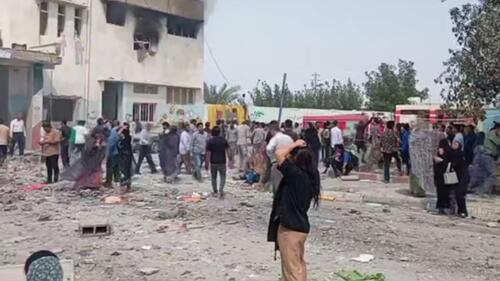
Automatic Identification System (AIS) vessel-tracking data indicate that multiple tankers abruptly reversed course near the entrance to the critical maritime chokepoint of the Strait of Hormuz early Saturday, following the U.S.-Israeli operation (Operation Epic Fury) targeting Islamic Revolutionary Guard Corps command-and-control infrastructure in multiple Iranian cities.
Bloomberg reporter Stephen Stapczynski pulled data from the Terminal that shows shipowners of crude oil, crude products, and LNG tankers are avoiding the strait, even though the waterway remains open and traffic has not stopped entirely.
“A number of oil and LNG tankers are avoiding sailing through the Strait of Hormuz NYK has advised its ships to avoid the waterway,” Stapczynski wrote on X.
A number of oil and LNG tankers are avoiding sailing through the Strait of Hormuz
NYK has advised its ships to avoid the waterway pic.twitter.com/oAubwJBjxs
— Stephen Stapczynski (@SStapczynski) February 28, 2026
Stapczynski noted.
PLEASE NOTE: There are still tankers traveling through the waterway. Not a total halt right now https://t.co/pSzNZuBMoL
— Stephen Stapczynski (@SStapczynski) February 28, 2026
Less than a day before Operation Epic Fury began, Bloomberg macro strategist Michael Ball warned, “US military action on Iran would result in sudden-yet-tradeable risk aversion. The negative markets impulse only sustains if there’s material disruption to regional oil production and shipping flows around the Strait of Hormuz.”
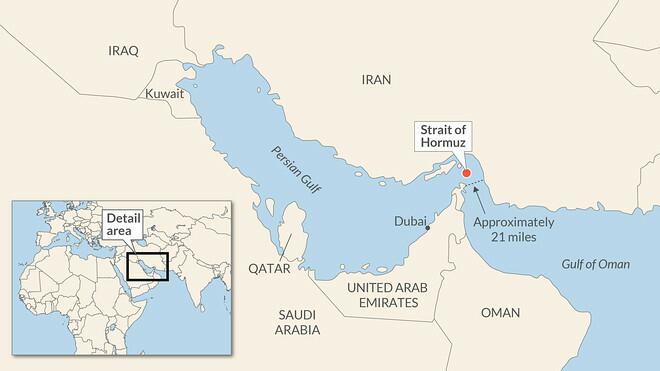
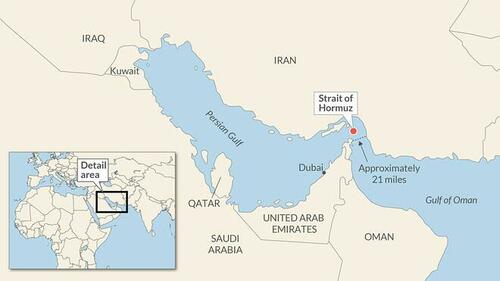
Map: Strait of Hormuz
Sources told CNN earlier this morning that Operation Epic Fury was the result of “months of joint planning” and will involve several days of attacks. The key question is whether the operation against Iran will spill over into next week. If it does, that would suggest potential disruptions at the critical maritime chokepoint, which handles one-fifth of global seaborne oil and LNG flows.
Rapidan Energy Group analyst Fernando Ferreira commented on the situation, indicating:
Iran understands that threatening traffic through Hormuz is its most credible asymmetric lever. Even limited interference can raise oil prices and impose immediate economic costs on the US and its partners, increasing pressure on Washington to de-escalate.
We expect at least moderate disruptions to Gulf oil flows in the coming days, with the risk tilted toward something more severe if tensions escalate further.
And here it is:
FT: INSURERS TO CANCEL POLICIES FOR SHIPS IN GULF, HORMUZ STRAIT
Goldman analyst Adam Crook provided clients, shortly after the operation began, with an overview of how oil and gold were positioned heading into the weekend:
Tallulah Adams (Commods Sales): “We have seen significant engagement from the franchise in Oil and European Gas upside over previous weeks, being the most directly impacted Commodities in an escalation scenario (20% each of Global Oil and LNG flows transit through the Strait of Hormuz).
Oil remains the most direct and liquid expression as a geopolitical hedge – while a full closure of the Strait of Hormuz remains a tail scenario, even a disruption of flows through the Strait via other means (targeting of ships, insurance issues) poses an upside scenario closer to $100/bbl. Additionally, whilst not our base case, an attack on Iranian Oil infrastructure puts 2mb/d of Iran Crude exports at risk.
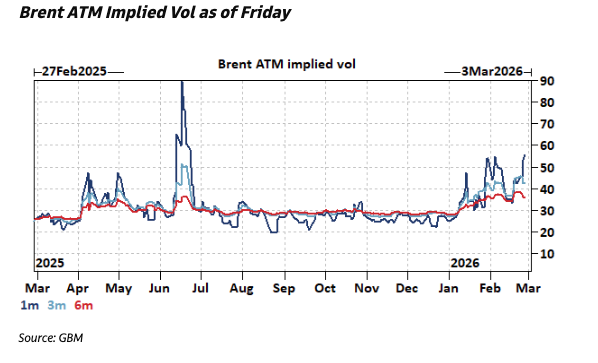
Despite a Middle East escalation remaining top of mind, positioning ironically feels cleaner (vs mid-Feb) with franchise flows skewed toward profit taking over the past week. This has kept a lid on call vols despite increasingly hawkish news flow + flat price moving higher in a high spot-vol correlation regime. Front month Brent implied volatility was at 60v on Friday, compared to a high of 90v in June last year. Meanwhile, 1 month 15 delta call skew was at 14 vols, compared to a 27 vol high last June. Net managed money (Brent + WTI combined) is sitting in the 59th percentile vs the previous 3 years. To play for a reprice in front vols and skew, we like owning front wingy outright calls.
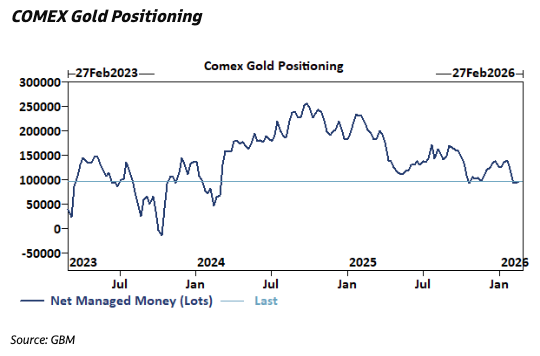
Additionally, we have seen a re-engagement in Gold upside as prices have consolidated above $5000/oz and 5 day realised vols have compressed to 27v vs a 100v high. Gold upside flow has migrated from VKO’s/Continuous KO’s to a mix of vanillas/EKO’s/Digis. While ETF holdings have continued to build, the market feels under positioned from the fast-money community – net managed money on Comex is sitting only in the 17th percentile vs the last 3 years and SHFE positioning is on multi-year lows.
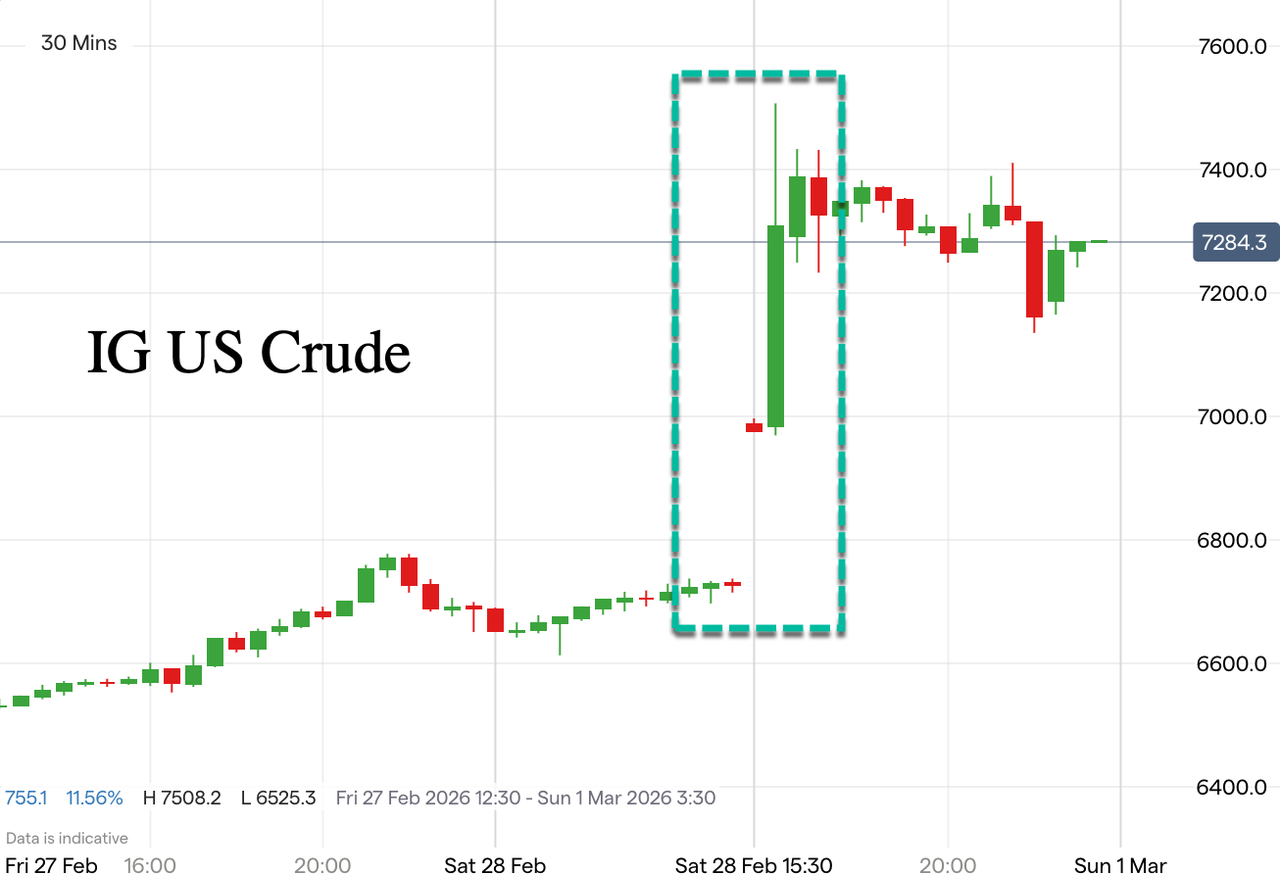
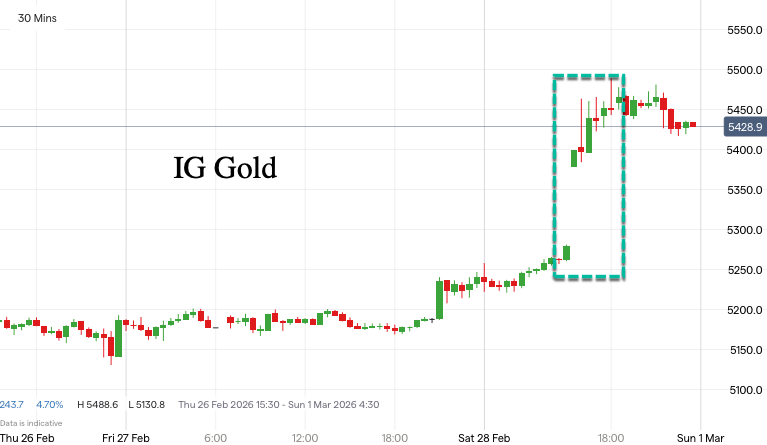
A synthetic weekend market via IG has crude oil prices up as much as 8%.
IG has gold up nearly 3%.
Related:
Playbook For Iran Risk “oils Down To Disruption
Supertanker Rates Soar As War Fears Put Strait Of Hormuz Chokepoint At Risk
Operation Epic Fury coverage:
Iran Retaliates On US Bases In Five Countries Simultaneously As Tehran Bombed
Iran Signals Ready To Deescalate After Defense Minister, IRGC Chief Killed In US-Israeli Strikes
The key question is whether this operation remains confined to the weekend or spills into next week. If a spillover does occur, it would be unequivocally bullish for Brent crude and gold futures on Sunday evening.
Professional subscribers can read more Iran research on our new Marketdesk.ai portal.
Tyler Durden
Sat, 02/28/2026 – 12:15