



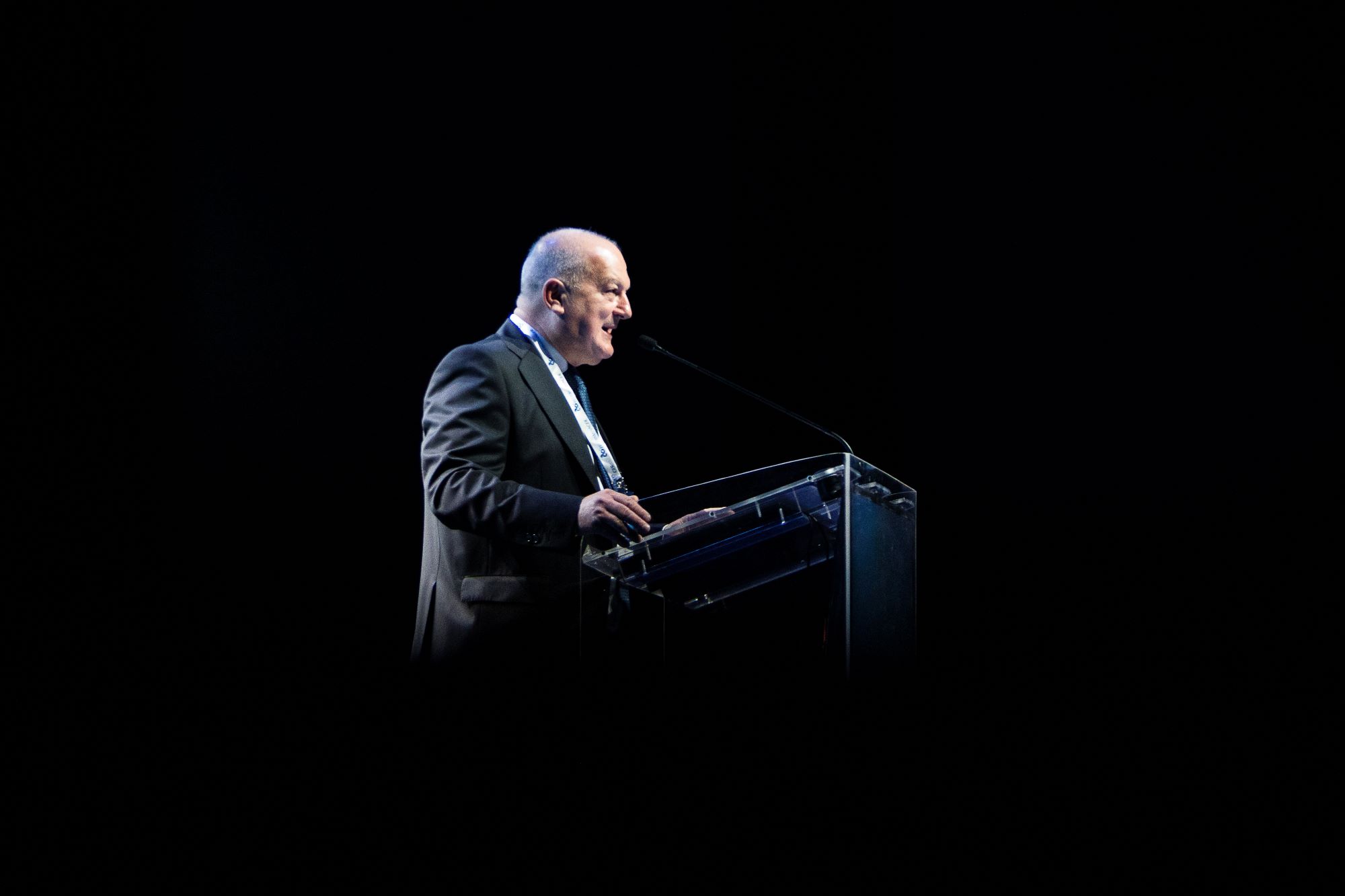
At the Auditorium Conciliazione in Rome, the National Assembly celebrated the Federation’s 80th anniversary, with speeches from ministers, institutional representatives, and political leaders.
“We are asking the Government for an extraordinary plan to introduce managerial structures in 20,000 small and medium-sized enterprises over the next ten years, in order to double the number of Italian companies capable of successfully competing worldwide and driving the entire national production system.”
With these words, Valter Quercioli, president of Federmanager, opened the National Assembly titled “Industrial Horizons – Italy that builds the future”, held at the Auditorium Conciliazione in Rome to mark the 80th anniversary of the association representing over 180,000 managers in the Italian industrial sector.
At the core of Quercioli’s appeal is a request for a ten-year industrial policy program worth €10 billion (€1 billion per year) to support the growth and managerial development of SMEs.
“Today, 5% of companies keep Italy at the top of global excellence,” he noted, “but to compete worldwide we need to invest in the next 5% — the 20,000 companies that can become the country’s new engine.”
Quercioli called for a more balanced tax system that rewards merit and does not penalize those who create value. “When a minority of taxpayers pays 43% of personal income tax, we are no longer in a progressive system but an unbalanced one,” he said, urging for a stronger fight against tax evasion and avoidance and for incentives to promote “tax loyalty.”
The president acknowledged the 2026 Budget Bill as “a first step in the right direction,” but stressed that “much more needs to be done.”
Federmanager also urged the Government to act on three priority areas: strengthening supplementary pension and healthcare systems by raising deductibility limits; promoting fiscal measures to support corporate welfare; and returning to interprofessional funds the resources taken through mandatory withholdings.
On pensions, the Federation called for fair indexation for retired managers and a clear accounting separation between welfare and assistance spending.
Mario Cardoni, Federmanager’s Director General, emphasized that Italy, the second-largest manufacturing power in Europe, must invest in managerial quality to grow:
“Today only 5% of our companies have advanced managerial governance. Raising this share to 10% within ten years, by investing €10 billion, would mark a turning point in the country’s industrial policy.”
The event saw the participation of several Government representatives: Ministers Adolfo Urso (Industry and Made in Italy), Marina Calderone (Labor and Social Policies), Luca Ciriani (Parliamentary Relations), Deputy Minister Maurizio Leo (Economy and Finance), Undersecretary Alessio Butti (Technological Innovation), and Cardinal Fabio Baggio, Director of the Borgo Laudato Si’ Center.
Undersecretary Luigi Sbarra, speaking on behalf of the Prime Minister’s Office, expressed strong appreciation for Federmanager’s role:
“It is a great association that in 80 years has played an important, positive, and responsible representative role, serving businesses, labor, and the country.”
Sbarra described the Government’s presence as “a sign of recognition and appreciation for the association’s work and its contribution to the growth of Italy’s industrial system.”
In his speech, Alessio Butti, Undersecretary for Technological Innovation, reiterated the need for constant dialogue between institutions and businesses to address the ongoing digital revolution:
“This is a delicate phase in which artificial intelligence, quantum computing, and digitalization are radically transforming enterprises. This is why continuous training pathways are needed to create the managers of the future.”
Butti noted that the Budget Law already includes measures in this direction, highlighting the Government’s intention to work closely with the managerial system to accompany the country’s digital transformation.
Also in attendance was Senator Maurizio Gasparri, leader of Forza Italia in the Senate, who expressed strong appreciation for Federmanager’s work and Quercioli’s remarks.
“I felt present more as a manager than as a politician. Those who lead complex organizations, such as parties or parliamentary groups, also exercise a managerial role.”
Gasparri said he fully shares Federmanager’s proposals, particularly on enhancing managerial roles, tax and pension reform, and strengthening innovation policies. “I identified so much with the association’s values,” he joked, “that I said I want to join Federmanager.”
For the senator, the Federation represents “a model of industriousness, seriousness, and meritocracy” that should also inspire politics.
Democratic Party Secretary Elly Schlein also attended, echoing several themes raised by Quercioli and calling for stable, long-term industrial policy.
“Businesses need continuity in incentives and the ability to plan investments,” she said, criticizing the bureaucracy of the ‘Transition 5.0’ program and suggesting a return to the Industry 4.0 model with structural incentives such as hyper- and super-amortization.
Schlein stressed the need to reduce energy costs, noting that “Italy has the highest electricity bills in Europe,” and proposed decoupling energy prices from natural gas costs, following the examples of Spain and Portugal.
On industrial crises, she referenced the Taranto steel plant: “We need a concrete strategy for the former Ilva. If necessary, even temporary nationalization to ensure environmental protection, public health, and employment.”
Finally, the PD leader emphasized the importance of human capital and managerial training:
“What matters most is not ownership, but the quality of management. Tax incentives must support both technology and people’s training.”
To mark the anniversary, Federmanager inaugurated a thematic exhibition showcasing Made in Italy excellence, featuring contributions from 25 major companies including Eni, Leonardo, Fincantieri, Ferrari, Ferrero, Stellantis, Pirelli, Enel, Rai, and Thales Alenia Space.
The exhibition highlights the role of managers and enterprises in the country’s industrial development, emphasizing the link between innovation, competence, and social responsibility.