

First Of Many? UAE Exits OPEC As Iran Chaos Triggers Nationalistic Realignment Among Producers
Just days after the UAE publicly signaled liquidity concerns by requesting swap lines from the Federal Reserve to ease pressures on the country’s banks, major Gulf oil producer, the UAE, has decided to exit the oil cartel – an unexpected development that crossed Bloomberg headlines on Tuesday morning around 0822 ET.
OPEC finished https://t.co/RtxJdZQeQh
— zerohedge (@zerohedge) April 28, 2026
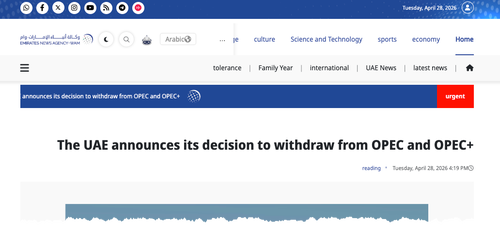
The official website of the Emirates News Agency (WAM) broke the story, stating that the UAE has decided to exit OPEC and OPEC+ as of May 1, in line with the country’s long-term strategic and economic plan.
The move would represent a major rupture within OPEC, with direct implications for the remaining 11 members: Saudi Arabia, Iran, Iraq, Kuwait, Venezuela, Nigeria, Libya, Algeria, Congo, Equatorial Guinea, and Gabon.
Yes it was https://t.co/SqwLJlxmDV
— zerohedge (@zerohedge) April 28, 2026
WAM said the decision reflects the “evolution of sector policies to enhance flexibility in responding to market dynamics, while continuing to contribute to market stability in a thoughtful and responsible manner.”
OPEC was founded in Baghdad in September 1960 by Iran, Iraq, Kuwait, Saudi Arabia, and Venezuela. Its original purpose was to give oil-producing states more control over pricing and production after Western oil majors dominated global crude markets.
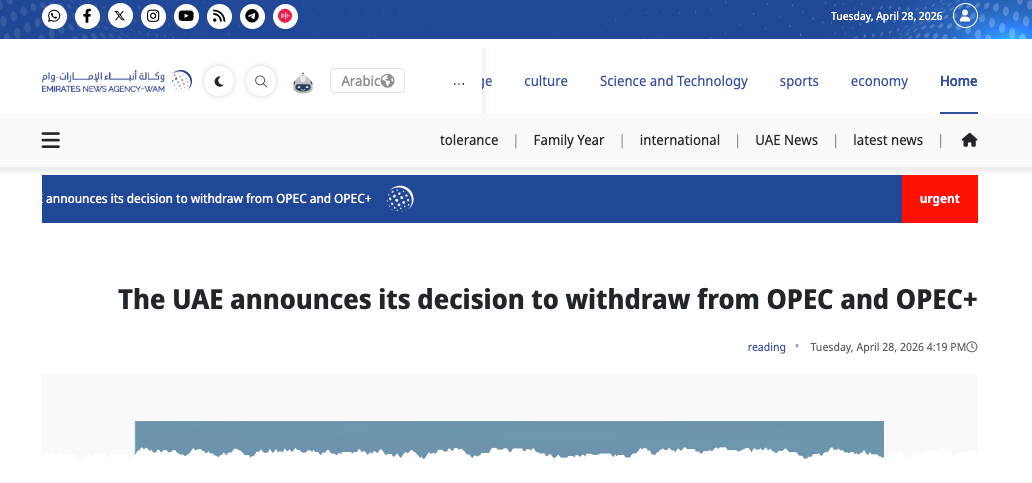
Important to note: UAE ranks among the top producers in OPEC (~4.05 million bpd), making it a major player with growing capacity ambitions (targeting 5 million bpd by 2027).
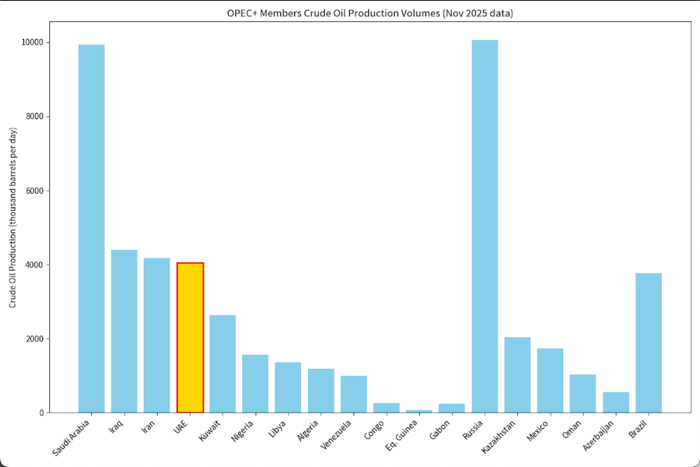
WTI futures fell on the news but have since rebounded.
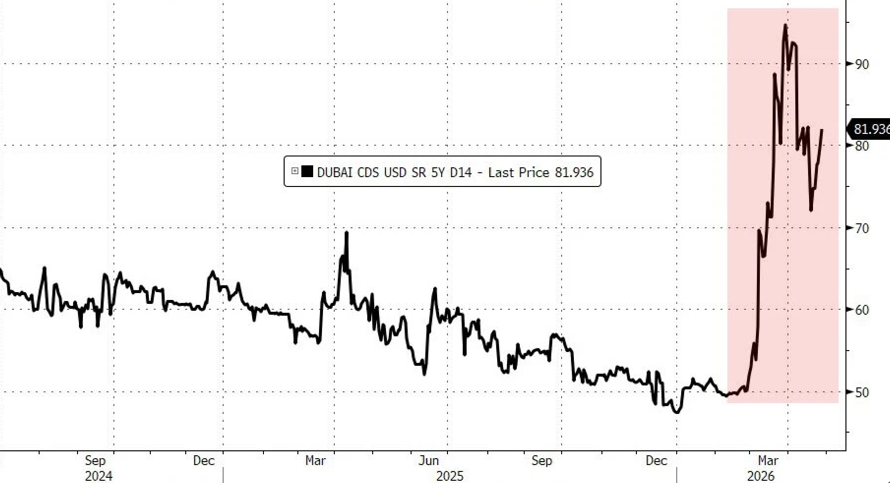
UAE credit risk has soared since the start of the war…
UBS analyst Matthew Cowley responded to the developing, telling clients: “This would weaken OPEC’s ability to defend price floors, especially during economic slowdowns.”
UAE’s full statement:
Abu Dhabi, April 28 / WAM / The United Arab Emirates announced today its decision to withdraw from the Organization of the Petroleum Exporting Countries (OPEC) and OPEC+, effective May 1, 2026.
This decision is in line with the UAE’s long-term strategic and economic vision and the development of its energy sector, including accelerating investment in domestic energy production, and reinforces its commitment to its role as a responsible and reliable producer that looks to the future of global energy markets.
This decision came after a thorough review of the UAE’s production policy and its current and future capacity, and in view of what the national interest requires and the state’s commitment to contribute effectively to meeting the urgent needs of the market, while geopolitical fluctuations continue in the near term through the disturbances in the Arabian Gulf and the Strait of Hormuz, which affect supply dynamics, as the basic trends indicate continued growth in global energy demand in the medium and long term.
The stability of the global energy system depends on the availability of flexible, reliable and affordable supplies, and the UAE has invested to meet the changing demands efficiently and responsibly, prioritizing supply stability, cost, and sustainability.
This decision comes after decades of constructive cooperation, as the UAE joined OPEC in 1967 through the Emirate of Abu Dhabi, and its membership continued after the establishment of the United Arab Emirates in 1971. During this period, the country played an active role in supporting the stability of the global oil market and promoting dialogue between producing countries.
The decision affirms the evolution of sector policies to enhance flexibility in responding to market dynamics, while continuing to contribute to market stability in a thoughtful and responsible manner.
The UAE is a reliable, cost-competitive, and low-carbon-intensity oil producer globally, contributing to global growth and emissions reduction.
After leaving OPEC, the UAE will continue its responsible role by gradually and thoughtfully increasing production, in line with demand and market conditions.
With a large and competitive resource base, the UAE will continue to work with partners to develop resources, supporting economic growth and diversification.
It is worth noting that this decision does not change the UAE’s commitment to the stability of global markets or its approach based on cooperation with producers and consumers, but rather enhances its ability to respond to changing market demands.
The UAE affirms its appreciation for the efforts of both OPEC and the OPEC+ alliance, as the country’s presence in the organization has made significant contributions and even greater sacrifices for the benefit of all. However, it is now time to focus efforts on what the UAE’s national interest requires, its commitment to its investment and importing partners, and the needs of the market, and this is what it will focus on in the future.
The UAE also affirms its continued commitment to responsible production policies and a focus on market stability, taking into account global supply and demand.
The state will continue to invest across the energy sector value chain, including oil and gas, renewable energy and low-carbon solutions, to support resilience and long-term transformation of the energy system.
The UAE values more than five decades of cooperation with partners, while continuing its active
Abu Dhabi’s departure weakens OPEC’s cohesion, and the oil cartel’s fate now remains uncertain.
Tyler Durden
Tue, 04/28/2026 – 08:40