


Futures, Bonds Tumble, Oil Soars After Trump Dashes Hopes For Early End To Iran War
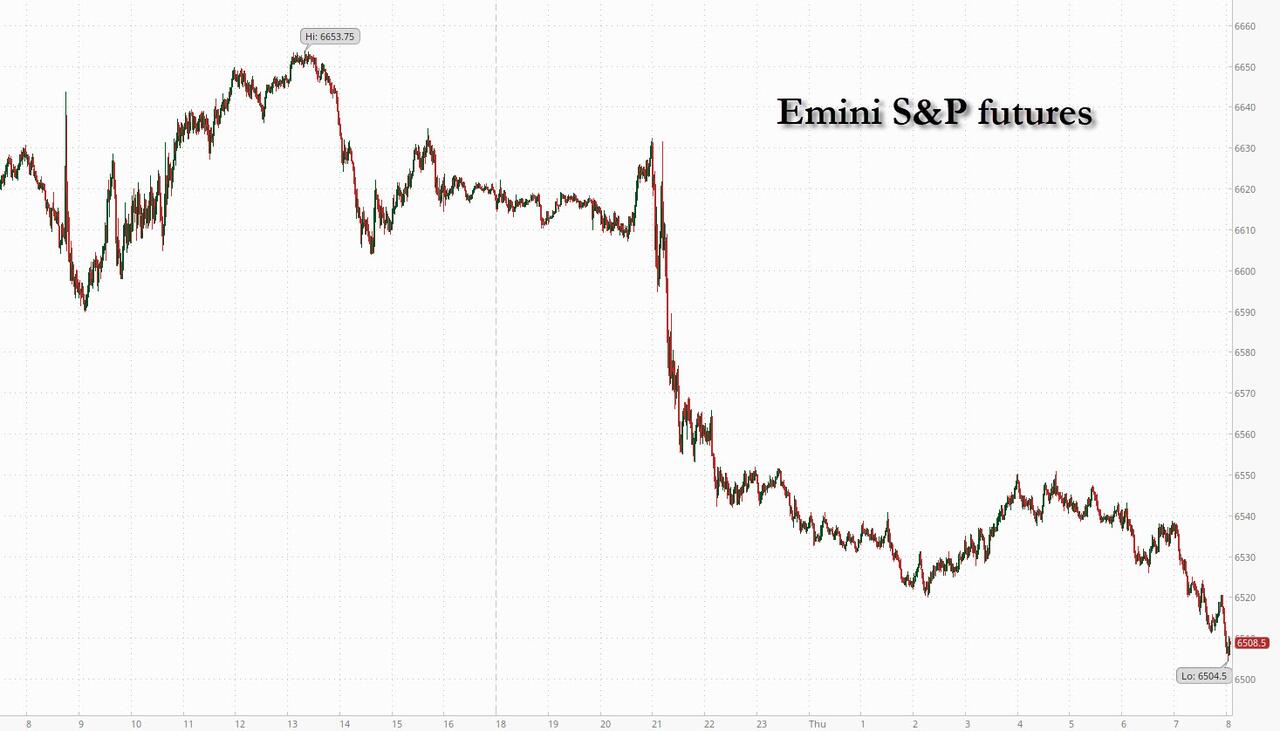
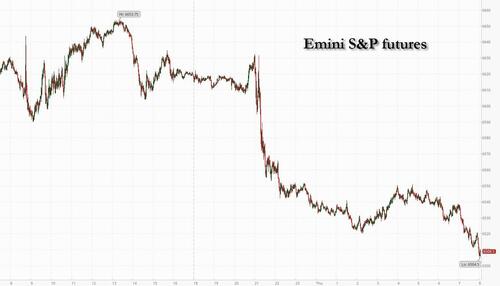
Global risk assets, including US equity futures and global markets, as well as Treasuries and precious metals, tumbled as oil soared with Brent hitting $110 this morning after Trump’s late Wednesday speech refused to pivot and dashed hopes that the Hormuz Strait would reopen soon and the war in the Middle East is nearing a swift resolution. As of 8:00am ET, S&P 500 futures dropped 1.7%, reversing yesterday’s short squeeze as investors refuse to add to risk positions ahead of the long weekend when many speculate a ground invasion of Iran may begin. Nasdaq 100 contracts slumped 2% amid a premarket selloff in big tech stocks and chipmakers. Tech is getting hit hard with Mag7 and Semis lagging while Cyclicals ex-Energy are underperforming Defensives with both Staples and Healthcare down in absolute terms pointing to broad-based de-risking into the holiday weekend. Energy should have a good day as investors re-gross in the sector and Integrateds are trading up ~3% pre-mkt. Brent soared 8.2% to more than $109 a barrel after Trump pledged more aggressive action against Iran and offered no concrete plans to reopen the Strait of Hormuz. European diesel futures hit $200 a barrel. Bonds tumbled as expectations that oil prices will stay higher for longer prompted traders to initiate fresh bets on tighter monetary policy. The dollar advance the most in a week while gold snapped a four-day streak of gains. US economic data calendar includes March Challenger job cuts (7:30am New York time), February trade balance and weekly jobless claims (8:30am). Fed speaker slate includes Logan (10:15am) and Bowman (12:45pm)
In premarket trading, Mag 7 stocks are all sharply lower (Nvidia -2.7%, Tesla -2.4%, Meta -2.4%, Alphabet -2.3%, Amazon -2.2%, Microsoft -1.3%, Apple -1%
Oil and gas companies rebound after Trump’s prime-time address. Movers include Chevron (CVX) +2.9% and Exxon (XOM) +3.2%.
Travel, mining and semiconductor stocks fall as the conflict and higher energy prices weigh on investor sentiment. Among movers: United Airlines (UAL) -4%, Newmont (NEM) -4.9%.
Globalstar (GSAT) rises 15% after a Financial Times report that Amazon.com Inc. is in talks to acquire the satellite provider.
Immunovant (IMVT) falls 7% after the drug developer said two late-stage studies of its experimental treatment for thyroid eye disease failed to meet their main goals.
Penguin Solutions (PENG) rises 9% after the semiconductor device company raised its full-year forecast for adjusted earnings.
Wingstop (WING) rises 1% as Piper Sandler and Raymond James upgrade the restaurant operator’s stock following a steep selloff.
In other corporate news, Amazon is said to be in talks to acquire satellite provider Globalstar, according to the FT, in a potential deal to bolster Amazon’s effort to build out its low-orbit satellite network to compete with SpaceX’s Starlink. In AI, Alibaba released its third proprietary AI model, Qwen3.6-Plus, in as many days to focus on profiting off its flagship AI services.
Global risk sentiment was crushed after Trump talked again about leaving Iran quickly, but warned of escalation as the US continues to amass military assets in the Middle East. Understandably, global headlines continue to be dominated by the Middle East conflict, geopolitics, oil and the Strait of Hormuz. Australia is weighing using powers amid a possible gas shortfall, oil inventory stockpiles are dropping and the UAE has called on the UN to approve measures, including force, to reopen the Strait of Hormuz.
“The speech didn’t bring forward an off-ramp, it pushed the timeline out and reintroduced escalation,” said Billy Leung, an investment strategist at Global X Management. While it is not a full big bear event, “the direction of travel has clearly worsened, and that’s what markets are reacting to.”
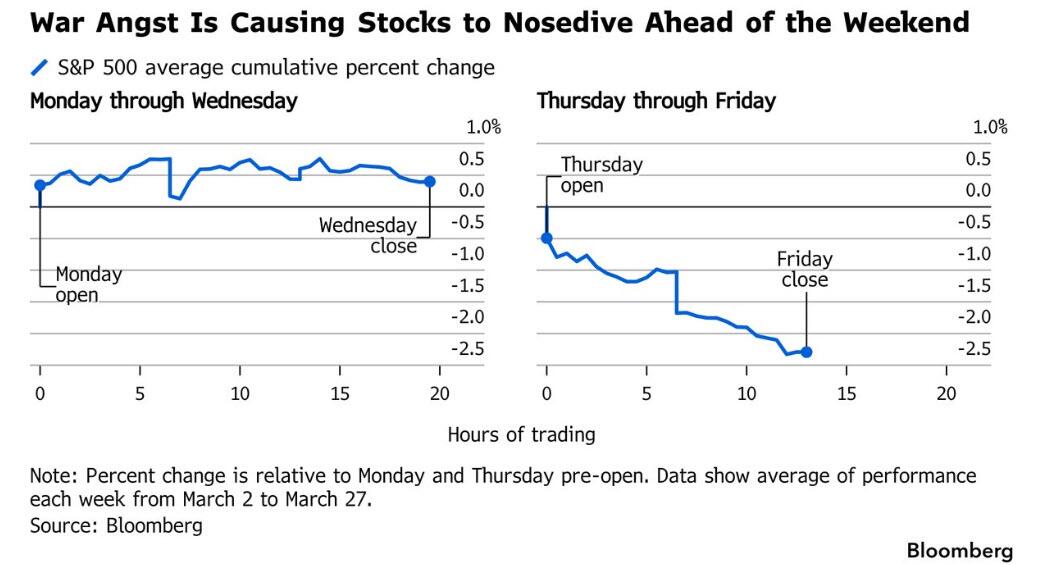
The US stock market has settled into a predictable weekly pattern since the Middle East war began. It starts the week on a strong note, drifts sideways toward the middle of the week and then collapses every Thursday and Friday, reflecting likely de-risking into a “trading blackout with unknowable risks.”
“This market just isn’t manageable,” said Laurent Lamagnere, deputy chief executive officer at Alphavalue in Paris. “We’re really concerned about second-round effects, not only on oil prices but also on oil supply, for example, airlines trimming destinations with harsh consequences for tourism.”
While markets are shut Friday, key economic data is still scheduled to be released. Bloomberg Economics expect March nonfarm payrolls rose 80k, reflecting a rebound in strike-affected payrolls, sluggish private-sector hiring and a continued drag from federal payrolls. Recent changes to the BLS’ birth-death model of business formations may continue to inject volatility into the monthly figures. As a net exporter of light, sweet crude, geopolitical risk is less concerning to US-levered energy operators relative to international peers and WTI oil-price inflation will likely be transitory, according to Bloomberg economists.
Elsewhere, the Trump administration is said to be close to announcing tariffs on drugmakers that haven’t struck deals guaranteeing low prices in the US. The US is set to roll out tiered tariffs on steel and aluminum products to simplify a process that has dogged American companies for months.
A KKR private credit fund for retail investors curbed redemptions after receiving an increase in such requests, according to a shareholder letter. Private equity sales have fallen by more than a third this year, with buyout firms selling deals valued at about $103 billion in the first quarter, roughly 36% lower than the same period a year ago. The SEC and Elon Musk said they are heading toward a trial over the regulator’s allegations that the billionaire cheated Twitter investors before his 2022 buyout.
Europe’s Stoxx 600 is down 1.2% with technology and mining stocks leading the decliners, while energy and food and beverage shares are the biggest outperformers. Here are the biggest movers Thursday:
European oil stocks gain after President Donald Trump dented hopes of a swift end to the war in Iran, sending crude prices higher. BP and Galp also benefited from analyst upgrades. Mining shares underperformed as metals prices eased
SSE shares gain as much as 0.7% after the utility firm upgraded the lower end of its guidance range for adjusted earnings per share this year
Fortum gains as much as 4% after Citi upgrades the Finnish utility to neutral and says its 2026 earnings may positively surprise the market on the back of higher spot power prices
Amplifon falls as much as 4% after the stock was downgraded to neutral from outperform at BNP Paribas, which called the Italian company’s plan to acquire GN Store Nord’s hearing-aid business a “discordant deal”
Mutares shares fell as much as 13%, the most in four months, on Germany’s Xetra exchange after the private equity firm sold shares via a private placement
Asian stocks fell after President Donald Trump’s threat to launch fresh attacks on Iran disappointed investors who were hoping for clearer signs of an end to the war. The MSCI Asia Pacific Index dropped as much as 2.6%, reversing small gains prior to Trump’s comments. South Korea, Japan and Taiwan led losses in the region. The Philippines market was closed for a holiday. The sudden downturn in sentiment came after Trump said that military operations could escalate over the next two to three weeks. Although he said the war in Iran was “very close” to completion, the US would hit electric plants in the country if no deal was reached, dampening hopes for a quick resolution to the conflict.
In FX, the Bloomberg Dollar Spot Index gains 0.5%. The Swedish krona is the weakest of the G-10 currencies, falling 1% against the greenback. The pound and Aussie dollar also underperform. Precious metals sink with spot silver down over 5%. Bitcoin falls 2.6%.
In rates, Treasury futures are off session lows with yields higher by 4bp to 6bp across the curve. Most losses occurred during Asia session following Trump’s prime-time address pledging more aggressive action against Iran and lacking a plan to reopen the Strait of Hormuz. 10-year Treasury yield near 4.36% is about 4bp cheaper on the day after peaking at 4.384%. Curve spreads remain within a basis point of Wednesday’s close. European government bonds fall as traders boost bets on rate hikes by the Bank of England and European Central Bank this year. UK and German 10-year yields rise 7 bps and 4 bps respectively. Gilts underperform, with 2-year yields are cheaper by around 10bp on the day. IG dollar issuance slate empty so far. Three offerings were priced Wednesday, with borrowers paying about 4bps in new issue concessions on deals that were 4.1 times oversubscribed. Dealers project about $115b of April supply vs about $105b a year earlier and about half of March’s $236.5b volume
In commodities, energy prices jump with Brent crude futures for June up around 7% and above $108 a barrel as investors weigh prolonged disruptions to energy flows through the vital Strait of Hormuz. European natural gas futures climb 4.5% while European diesel futures hit $200 a barrel.
US economic data calendar includes March Challenger job cuts (7:30am New York time), February trade balance and weekly jobless claims (8:30am). Fed speaker slate includes Logan (10:15am) and Bowman (12:45pm)
Market Snapshot
S&P 500 mini -1.6%
Nasdaq 100 mini -2.0%,
Russell 2000 mini -2.0%
Stoxx Europe 600 -1%,
DAX -1.6%,
CAC 40 -0.9%
10-year Treasury yield +5 basis points at 4.37%
VIX +2 points at 26.51
Bloomberg Dollar Index +0.4% at 1217.6,
euro -0.6% at $1.1524
WTI crude +7.2% at $107.31/barrel
Top Overnight News
Oil rose after President Trump’s prime-time address disappointed investors hoping for a quick end to the Iran war. In an address late Wednesday, Trump said he was still seeking a diplomatic agreement to end the conflict and that U.S. military aims would be completed “very shortly.” But he also vowed to hit Iran “extremely hard” in the coming weeks and pummel the country “back to the Stone Ages.” WSJ
Trump rattled markets and heightened political tensions with an address that offered no clear timeline for ending the Iran war, while pledging more aggressive action over the next two to three weeks. Iran and Israel continued to trade strikes and the US president renewed threats against Iranian electric plants. BBG
The Trump administration is preparing to impose tariffs of 100% on certain medicines as it pushes drugmakers to manufacture more in the US. The levies – set to be announced as soon as Thursday – would be applied to companies that have not struck deals with the White House. FT
Congressional Democrats sued to block Trump’s executive order that would prohibit mail-in voting for anyone not on a pre-approved list compiled by the DHS. BBG
China’s central bank withdrew cash from its financial system in March for the first time in a year, amid signs of an economic rebound. BBG
Former BOJ chief economist Toshitaka Sekine said the central bank may raise rates as soon as April, due to the risk of supply shocks. BBG
Swiss inflation accelerated 0.3% in March, the quickest pace in a year, as the energy supply crunch stoked the cost of heating oil. BBG
Global private equity sales have fallen by 36% this year, as developments in AI and the war in Iran heap pressure on a subdued exit market. FT
The US is set to outline a tiered regime for steel and aluminum, maintaining 50% duties on many products but applying lower rates to others. BBG
Oil’s near-term outlook turned more bullish after Trump’s speech, with June futures rising more than $8.5 a barrel above July as Hormuz disruptions cut about 11 million b/d. Traders expect continued supply strain and higher prices. BBG
Canadian PM said he spoke with US President Trump this evening to discuss Artemis II and the Middle East conflict.
US President Trump discussed firing Attorney General Pam Bondi and replacing Bondi with EPA Chief Zeldin, although he has not yet made a decision whether to fire Bondi, according to NYT.
US Senate may vote on DHS funding bill on Thursday, while the bill would fund DHS without ICE and CBP, according to NBC.
A more detailed look at global markets courtesy of Newsquawk
APAC stocks failed to sustain initial gains after US President Trump’s primetime address disappointed those hoping for an immediate de-escalation in the Iran conflict, in which he said they will hit Iran very hard over the next 2-3 weeks and will ‘bring Iran back to the stone age, where they belong’, while he also threatened to hit Iran’s electric plants if there is no deal and could hit their oil. ASX 200 reversed early gains as Trump’s remarks soured the broad risk sentiment, and with the declines led by weakness in the tech, mining, materials and resources industries, while the latest trade data from Australia had very little influence on price action. Nikkei 225 wiped out the initial spoils and slumped beneath the 53,000 level as US President Trump’s remarks triggered a broad risk-off mood and lifted oil prices. Hang Seng and Shanghai Comp were subdued amid notable weakness in the Hong Kong-listed blue chip tech stocks, and with the mainland also dampened following another paltry liquidity operation by the PBoC.
Top Asian News
South Korean Vice Finance Minister said they are closely monitoring FX market as speculative trading is being seen; to respond sternly to excessive herd-like behaviour FX markets.
Magnitude 7.8 earthquake strikes 119km WNW of Ternate, Indonesia, according to the USGS.
EMSC announces a tsunami alert after earthquake in Indonesia region.
European bourses (STOXX 600 -1.1%) began the session with decent losses after US President Trump’s nationwide address reignited tensions. He said that the mission in Iran will be finished very fast and the US will hit Iran very hard over the next 2–3 weeks, while warning of strikes on electric plants if there is no deal and could also target its oil facilities. Since the start of cash trade, losses have pared back slightly but indices are holding around the -1% mark. European sectors are broadly in the red. Energy is the outperformer while Food, Beverage and Tobacco follow closely behind. Technology sits at the bottom of the pile, after performing well over the past 3 sessions, while Basic Resources also suffers as precious metals slip.
Top European News
Swiss Inflation Rate YoY (Mar) Y/Y 0.3% vs. Exp. 0.6% (Prev. 0.1%, Low. 0.1%, High. 1.0%); Core 0.4% (prev. 0.4%).
Swiss Inflation Rate MoM (Mar) M/M 0.2% vs. Exp. 0.5% (Prev. 0.6%, Low. 0.2%, High. 0.9%).
FX
DXY is stronger this morning, with traders flocking back to the USD after US President Trump’s address dampened hopes of de-escalation with Iran. Overnight, he stated that he will hit Iran very hard over the next two to three weeks, adding that the US could also target Iran’s oil facilities. Trump’s rhetoric has seemingly shifted from a focus on the timeline for wind-down to a more aggressive military escalation within that same window. DXY jumped back above the 100 mark, to currently trade at the upper end of a 99.44-100.17 range; recent levels above this include 100.64 (high from 31 Mar).
Focus for today remains on any geopolitical updates, but that aside, there are a few important domestic data points to keep an eye on. Weekly initial jobless claims (212k expected from 210k) and continuing claims (1.84mln expected from 1.819mln), Revelio’s public labour statistics report, Challenger job cuts (90k expected in March from 48.3k) and international trade data are due. This all precedes the March NFP report on Good Friday, which is expected at 65k.
G10s are all losing against the stronger USD; Antipodeans underperform, given the risk tone, whilst the Loonie fares a little better than peers, given it does not rely on external energy. GBP also sits right towards the foot of the G10 pile and is underperforming vs the EUR. A Wednesday rally in Gilts and traders believing the BoE may be slower vs the ECB in containing the energy shock may explain the slight underperformance between the two. This also comes after BoE Governor Bailey suggested earlier in the week that markets were getting ahead of themselves by pricing in rate hikes. Cable currently sits at the bottom end of a 1.3195-1.3320 range.
CHF is also amongst the worst performers against the USD, but is incrementally losing against the EUR. Earlier, a cooler-than-expected (but stronger-than-prior) Swiss inflation report spurred some modest pressure in the Franc, before then reversing soon after. In a bit more detail, headline Y/Y printed at 0.3% (exp. 0.6%, prev. 0.1%); M/M 0.2% (exp. 0.5%). Much of the upside was facilitated by stronger energy prices, leading inflation to the strongest in over a year, and back away from the lower end of the SNB’s 0-2% target. For the time being, this will help alleviate fears at the Bank of bringing back negative interest rates, though policymakers have long reiterated that there is a high bar for such a move.
Central Banks
ECB’s Panetta said leading indicators are pointing towards a slowdown in the economy; tensions in energy markets are a cause for concern not only for the immediate impact, but also on growth. Non-bank financial intermediaries in some sectors show levels of leverage and liquidity which could prove inadequate during periods of acute stress.
ECB Economic Bulletin Issue 2, 2026: The risks to the growth outlook are tilted to the downside, especially in the near term.
ECB’s Simkus said caution is needed on rates and it is too early to say what is needed at the April meeting.
BoE DMP (Mar): 1yr ahead CPI expectation 3.5% (prev. 3.00%), 3yr ahead CPI expectation 2.7% (prev. 2.8%).
Fixed Income
A bearish start to the day as US President Trump’s primetime address reignited geopolitical tensions (recap on the feed, 07:35BST), lifting energy and in turn fanning the inflationary flame.
Specifically, USTs dropped from 111-02 pre-Trump to a 110-24 knee-jerk low and have since hit a 110-16 trough. Lifting yields across the curve, 10yr to a 4.38% peak, though shy of Monday’s 4.42% WTD peak. Similarly, the 2yr to a 3.86% peak, but shy of Monday’s 3.89% WTD best. Action that has seen the implied magnitude of near-term tightening tick up by just under a bp worth. Geopols aside, Challenge Jobs, claims and import/export data; Fed speak is also due.
EGBs and Gilts, in line with the above bearishness, Bunds hit a 125.19 trough with losses of 51 ticks at most, while Gilts got to a 87.85 low, with downside of 75 ticks. Since, they have bounced by around 20 ticks from extremes, but remain firmly in the red.
The European docket is a light one; action will continue to be dictated by energy movements and associated inflation/central bank expectations from it. For the ECB and BoE, markets continue to price in 60bps and 41bps of 2026 tightening, respectively. Despite the recent inflation print from the EZ not yet showing second round effects, and despite Bailey pushing back on market pricing this week.
France sold EUR 12.5bln vs exp. EUR 10.5-12.5bln 3.00% 2034, 3.50% 2035, 0.50% 2044 and 2.00% 2048 OAT.
Japan sold JPY 1.97tln 10yr JGBs, b/c 2.57x (prev. 3.30x), average yield 2.350% (prev. 2.122%).
Commodities
In geopolitics, President Trump’s address largely repeated recent messaging on the Middle East, offering little fresh clarity on a path to de-escalation. That being said, Trump’s rhetoric has seemingly shifted from a focus on the timeline for wind-down to a more aggressive military escalation within that same window. On March 31st, Trump claimed the US could “leave” Iran within “two or three weeks” because the mission to prevent a nuclear weapon had been “attained.” He framed the upcoming period as “finishing the job,” asserting that the US would exit regardless of whether a formal deal was reached. On April 1st, in his televised address, he paired the same timeframe with a promise of violence, stating the US would hit Iran “extremely hard” over the next two to three weeks and bring them back to the “Stone Ages”.
WTI and Brent futures have surged after US President Trump’s televised address, which dampened hopes of a near-term end to the conflict. Brent Jun’26 currently eyes USD 109/bbl to the upside (USD 99.08-108.97/bbl range) while WTI May’26 sits around USD 107/bbl (USD 97.50-107.38/bbl range). Meanwhile, European diesel futures hit USD 200/bbl as the Iranian war curbs supply. Dutch TTF is +3.5% at the time of writing, but off its best levels, with some citing forecasts of milder weather as a drag on prices despite the ongoing geopolitics. Analysts at ING suggest that “even if shipping through the Strait of Hormuz resumes, a return to pre‑war market conditions is likely to be slow, as upstream production restarts, logistics normalisation and inventory rebuilding will take time.”
Spot gold reversed an earlier gain after Trump’s speech offered little clarity on how the war might end. The bullion entered the European day around USD 4,600/oz after trading above USD 4,800/oz earlier in the APAC session. Spot silver briefly dipped under USD 70/oz before recovering to around USD 71.50/oz, but well off its earlier high of USD 76.42/oz.
Industrial metals also fell after Trump repeated that the US could strike Iran “extremely hard” and target its power plants if talks fail. 3M LME copper fell under USD 12,500/t but found support at USD 12,250/t. Elsewhere, the WSJ reported Trump is expected to overhaul US steel and aluminium tariffs, with finished goods made from imported metals potentially facing a 25% duty, while the administration is also preparing tariffs on drugmakers, possibly from Thursday, that have not agreed to guarantee low US prices.
South Korea’s Blue House denies the report regarding considering fees on passing through Hormuz. This comes following earlier reports that South Korea is reportedly considering whether to pay Iran to bring in Middle Eastern oil and gas.
The 8 members of the OPEC+ group still plan to hold their virtual meeting on the 5th of April, according to Kpler’s Bakr.
China has reportedly asked private refiners to maintain fuel output at all costs.
Russia imposes ban on gasoline exports for producers until the end of July, IFX reported.
Kpler’s Bakr posted “At this point and under the most optimistic scenario Hormuz will remain shut till May. Now brace for impact.”
Iraq’s oil ministry said it has began exporting oil through Syria.
Reconstructing Iran’s Khuzestan steel factory will take between 6-12 months, Mizan news reported.
New Zealand associate energy minister said will enter into an agreement to support an additional 90mln litres of storage for diesel at Marsden Point in Northland.
Colonial pipeline is reportedly down due to damage in Georgia.
Venezuela’s oil exports in March surpassed 1mln bpd for the first time n six months, according to shipping data.
Trade/tariffs
US President Trump’s administration is readying to impose tariffs of 100% on certain medicines as it pushes pharmaceutical companies to manufacture more in the US, according to FT.
US President Trump is expected to overhaul steel and aluminium tariffs, while altered rates on finished products would simplify compliance, but could increase costs for many imports, according to WSJ. Plans to alter tariff duties to 25% on the entire value of finished products. 50% tariff will remain for commodity-grade steel and aluminium products. Executive order could come as early as this week.
China’s MOFCOM said they are to enhance communications with the US on trade.
The EU is discussing setting up digital tech dialogue with the US and reiterates that digital legislation is not up for negotiation.
Geopolitics
US President Trump said in his primetime address that Iran’s navy is gone and its air force is in ruins, while he noted most of Iran’s leaders are dead, and its ability to launch missiles and drones has been curtailed. Trump stated they will never allow Iran to have a nuclear weapon and that US strategic objectives are nearing completion, as well as stated that the mission in Iran will be finished very fast and the US will hit Iran very hard over the next 2–3 weeks, and will bring Iran back to the stone ages, where they belong. Furthermore, he said countries reliant on Hormuz oil should take the lead and that Hormuz will reopen once the conflict ends, while he warned the US will strike Iran’s electric plants if there is no deal and could also target its oil facilities.
US President Trump said strategic objectives are nearing completion, must complete mission in Iran and will finish the job very fast, adds Iran can never be trusted with nuclear weapons. US has plenty of gas. Countries that get oil via Hormuz must cherish it and must take the lead and suggests countries buy oil from the US. Hormuz will naturally open when conflict is over.
US intelligence agencies assessed that Tehran is not currently willing to engage in substantial negotiations to end the conflict, while US intelligence agencies believe Iran’s government thinks Trump is not serious about negotiations, according to NYT.
US VP Vance is engaging with Pakistan mediators over Iran deal and passed a message to Iran via Pakistan on Tuesday, while US and Iran are discussing ceasefire for Hormuz reopening and Vance warned of increasing pressure without a deal, according to ABC.
UAE reportedly preparing to help the US fight Iran and open the Strait of Hormuz by force after being repeatedly struck by Iranian drones and missiles since the war began, NY Post reported citing Arab officials.
Senior Iran source said Tehran demands a guaranteed ceasefire to end war permanently and no talks have taken place via mediators for a temporary ceasefire, while intermediaries contacted Iran on Tuesday and discussions were about continuing diplomacy.
Iran’s military spokesperson said bigger, wider and more damaging attacks are coming soon, Tasnim reported.
Iranian President Pezeshkian said attacking Iran’s vital infrastructure shows an inability to achieve a sustainable solution, IRNA reported.
Faytuks Network posted on X citing Fox News that “Trump’s speech tonight will inform the public that we may require the use of ground troops to round up uranium in Iran” – UNCONFIRMED. This was later deleted.
Israeli sources say they have not been given the green light from the US yet for Israel to target infrastructure in Lebanon, Al Hadath reported.
US Embassy in Baghdad has told US citizens to leave Iraq with expectations of Iran-aligned militia to carry out attacks in central Baghdad within 24-48 hours.
Iran Supreme Leader’s advisor, Kamal Kharazi, was reportedly injured in US-Israeli attack on Tehran.
Iran’s atomic energy agency said US-Israeli attacks against facilities under IAEA supervision are a ‘war crime’.
Reports of strong explosions in proximity to US bases in Kuwait, N12 reported.
Pakistan foreign ministry spokesperson said there is no confirmation so far of any US delegation arriving for talks.
Explosion reported in Kuwait; explosions are caused by an attack on American positions, Mehr and Fars News report.
US Event Calendar
8:30 am: United States Feb Trade Balance, est. -60.55b, prior -54.5b
8:30 am: United States Mar 28 Initial Jobless Claims, est. 212k, prior 210k
8:30 am: United States Mar 21 Continuing Claims, est. 1836.5k, prior 1819k
10:15 am: United States Fed’s Logan Speaks at Dallas Fed Banking Conference
12:45 pm: United States Fed’s Bowman Speaks at Banking Conference (Closed event)
DB’s Jim Reid concludes the overnight wrap
After rallying sharply over the previous two sessions, market sentiment has deteriorated overnight after Trump’s much anticipated address last night delivered little to nothing new on potential timelines or conditions for ending hostilities against Iran. The US President claimed that the operation against Iran was “very close” to completion but also said the US “will hit Iran extremely hard over the next 2-3 weeks”. Trump again raised the threat to hit Iran’s power plants if there is no negotiated deal and reiterated the view that shipping via the Strait of Hormuz was other countries’ problem. So while Trump sounded flexible on remaining war aims, for instance claiming that Iran is “no longer a threat”, there was no signal of the US seeking an imminent offramp out of the war.
In response, markets have reversed the continued positive momentum they’d seen yesterday amid rising hopes that an end to the conflict might be coming into view. In oil markets, Brent crude is +6.24% higher at $107.47 this morning, a level last seen on Tuesday, even as it had briefly fallen below $100/bbl yesterday evening just before Trump’s address. Equity futures are losing ground overnight, with S&P 500 futures (-1.25%) more than erasing yesterday’s +0.72% regular session gain, while STOXX 50 futures are down -1.75% after posting their best session in almost a year yesterday. In Asia, equity markets have lost ground, with the KOSPI (-4.23%) standing out as the largest underperformer this morning. The Nikkei (-2.42%), Hang Seng (-1.09%), and S&P/ASX 200 (-1.14%) are also seeing significant declines, though in mainland China the CSI (-0.75%) and the Shanghai Composite (-0.50%) are more stable.
In the rates space, 10yr Treasury yields are +5.5bps higher at 4.37% this morning after Wednesday’s stable session, while in FX, the dollar index (+0.39%) has more than reversed yesterday’s -0.31% decline. Gold (-1.89%) is similarly reversing yesterday’s +1.94% gain.
Prior to the overnight news, the continued rally yesterday appeared to be one of hope more than conviction as investors navigated a dizzying influx of competing headlines. Among those was Trump’s post early yesterday that Iran’s “New Regime President” had asked the US for a ceasefire, which Trump said he would only consider when the Strait of Hormuz is “open, free and clear”. Iran’s foreign ministry later responded, calling the ceasefire claim “false and baseless“. That response arrived amidst an Axios report that the US and Iran were negotiating a ceasefire. Meanwhile, Iran’s President Pezeshkian released an open letter, claiming that Iran harboured no enmity towards the people of America.
Another headline-drawing Trump comment yesterday was that he was strongly considering pulling out of NATO, though he then did not directly raise this topic in his overnight address. We also heard that NATO Secretary General Rutte is due to visit Washington next week. Note that the political bar for formal US withdrawal from NATO is high, as this would require a two thirds majority in the Senate or passing an act of Congress. The role of US allies has been a rising topic in its own right, with news that the UK will today convene virtual talks with some 35 countries not including the US to discuss a plan to restore shipping via the Strait of Hormuz.
In terms of yesterday’s other news, 2yr US Treasury yields (+0.9bps) inched higher as the decline in oil prices was outweighed by solid US data. The March ISM manufacturing came in at 52.7 vs 52.3 expected, with the prices paid component rising to 78.3 (vs 74.0 expected), its highest reading since mid-2022. The US ADP private employment figures for March (+62K vs +40K) were also on the stronger side.
US labour market data will remain in focus with the latest weekly claims today and then the March jobs report on Friday, even as most markets are closed for Good Friday. For Friday’s non-farm payrolls our US economists see headline gains of +50k (vs -92k previous) and private payrolls at +60k (vs -86k), reflecting a return closer to the average pace of job gains over the latter half of 2025. 01
In terms of the details of yesterday’s upbeat market moves, the +0.72% gain for the S&P 500 was again led by tech stocks, as the NASDAQ (+1.16%) and the Mag-7 (+1.37%) powered ahead for a second day. Credit also saw a strong rally, with US HY credit spreads (-16bps after -18bps Tuesday) registering their best two-day run since last May. And European equities saw a sharp surge as investors caught up to the US rally that started on Tuesday, with the STOXX 600 (+2.50%), DAX (+2.73%) and the FTSE 100 (+1.85%) all posting their largest jumps since last April.
European bonds also rallied on the prospect of lower oil prices as well as declining natural gas prices, as front month TTF futures fell by -5.49% to €47.51/MWh, their lowest level since March 10. Yields on 10yr bunds fell -1.8bps to 2.98%, while BTPs (-7.8bps) and OATs (-5.2bps) outperformed amid the risk-on mood. Gilt yields saw an even larger pullback, with the 10yr down -8.6bps as the UK manufacturing PMI for March was revised down from 51.4 to 51.0. That was in contrast to a moderate upward revision to the Euro Area manufacturing PMI (51.6 from 51.4), which showed more resilience to the energy shock.
Yesterday, I published a note looking at what the March PMIs tell us about the impact of the Iran war on the global economy. While we’ve seen a major inflation and supply shock, this has varied across countries and there are some silver linings. For instance, the behaviour of output prices across the G10 has been more akin to the pre-Covid era than the 2021-22 inflationary period, which may offer some breathing room for central banks concerned about inflationary risks. See the note here.
In data out of Asia this morning, South Korea’s consumer inflation picked up from +2.0% to +2.2% in March, though this is below consensus expectations of +2.3%. So providing some tentative relief to policymakers dealing with the spillover effects of curtailed energy supplies out of the Middle East.
To the day ahead now, we will get further US data, with the February trade balance and latest weekly jobless claims. And while we take a break on Good Friday, the US will release the March jobs report.
Tyler Durden
Thu, 04/02/2026 – 08:33