





Germany’s Debt Spiral: Bundesbank Chief Breaks Silence
Submitted by Thomas Kolbe
It’s not every day that top officials of the German Bundesbank take an explicit stance on daily politics.
Nagel’s stark warnings about Germany’s debt and the government’s creative accounting were surely met with grim recognition in Berlin’s corridors of power. Open criticism is rare there, and when it comes from credible insiders, it stings even more.
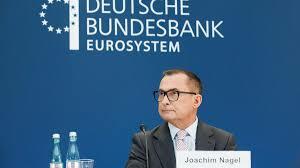
Bundesbank President Joachim Nagel
Chancellor Friedrich Merz and his Finance Minister Lars Klingbeil apparently still believe the fairy tale that debt-fueled demand policy can create economic miracles, generate growth, and deliver real prosperity. The result: a staggering debt binge that threatens to finish Germany economically.
Of course, this is a Keynesian nursery tale, endlessly repeated by politicians. With this simplified version of economics, political power is cemented – while the anonymous masses of taxpayers are left to clean up the debt disaster.
The government assumes the taxpayer backstop—and has surrounded itself with a state-friendly media sector, like a protective membrane. This behavior is conditioned.
The truth about mounting state debt, its destructive impact on private business, inflation, and the erosion of middle-class purchasing power is rarely discussed, and only in the media’s backrooms. When criticism reaches the public eye, its proponents are aggressively attacked and their valid arguments systematically sterilized.
Since January 2022, Joachim Nagel has led the Bundesbank. Recently, he warned for the first time about the unchecked growth of public debt—breaking Berlin’s long-standing elite vow of silence. Last year, he said, national debt rose by €144 billion to €2.84 trillion, pushing the debt-to-GDP ratio to 63.5 percent.
Some may recall the Maastricht limit, which capped debt at 60 percent. Those times are long gone, and the official debt numbers are, of course, grossly misleading.
For years—especially since the banking bailouts 15 years ago—the government has operated shadow budgets. Hoping the public won’t dig into fiscal details, these rarely illuminated debt channels are declared “special funds,” off the official books. Over 20 such hidden debt pots inflate actual state debt by at least €550 billion. Germany’s real debt likely sits near 80 percent of GDP and could exceed 85 percent by the end of this fiscal year.
The most infamous of these special funds originates from the debt crisis 15 years ago. The Financial Market Stabilization Fund (FMS) provided €400 billion in government guarantees and €80 billion in potential recapitalizations. Ultimately, €168 billion in guarantees and around €30 billion in direct transfers to financial institutions were used, while roughly €50 billion in debts from that era remain.
One of the largest black funds in federal history. Only Merz’s half-trillion-euro special fund will surpass this scale. Lesson learned: state financing has become an undeniable Ponzi scheme. Bond markets will ultimately dictate when the fiat money spree ends—they are the final arbiters of decades of political chaos.
Merz and his debt-hungry, insatiable finance minister are deliberately driving state spending to dizzying heights, yet must acknowledge that the heavily damaged German “economic tanker” can no longer move forward.
To buy time, the tragicomic duo plans to tighten middle-class taxes to the limit, holding taxpayers accountable for their fiscal free-for-all.
This is irresponsible, economically destructive policy unseen in Germany since WWII—the construction of a new socialism.
Against this backdrop, the Bundesbank president urged a return to sound budget planning. Deficits must be reduced mid-term without cutting essential infrastructure. Sadly, Nagel stopped short of endorsing free-market principles outright, missing the chance to clarify that the diversion of additional debt via special funds is systemic.
Policy cannot be fiscally restrained as long as bond markets are manipulated by monetary policy. According to the ifo Institute, 95 percent of this additional debt was added to the pre-existing debt binge and diverted. Social policy with a money printer—this is how far German fiscal policy has sunk.
Those seeking the real debt picture must dig deep—including pension obligations and current retirement promises. The scale of these liabilities defies imagination.
Germany—and nearly all of the EU—is trapped in a debt spiral. Turmoil in capital markets, broad restructuring, and massive wealth and debt redistribution loom. A standalone debt haircut would be systemic death: it would shrink circulating fiat credit and trigger a deflationary shock beyond the capacity of banks to absorb—a dead-end.
When will Germany begin monetizing its treasure, its massive gold reserves? Four years ago, the government under then-Chancellor Olaf Scholz pressured the Bundesbank to sell part of its gold to fund the defense special fund.
“Top” economists at Spiegel were reportedly inflamed by this idea—in these circles, the significance of collateralized, limited-quantity assets is poorly understood, even though they may one day underpin a new monetary regime.
It is fortunate that Nagel held the firewall against political adventurers and media amateurs. The Bundesbank may one day play a decisive role in a severe currency and debt crisis.
* * *
About the author: Thomas Kolbe is a German graduate economist. For over 25 years, he has worked as a journalist and media producer for clients from various industries and business associations. As a publicist, he focuses on economic processes and observes geopolitical events from the perspective of the capital markets. His publications follow a philosophy that focuses on the individual and their right to self-determination
Tyler Durden
Tue, 04/07/2026 – 06:30