






Gulf States Considering Network Of New Pipelines To Bypass Strait Of Hormuz
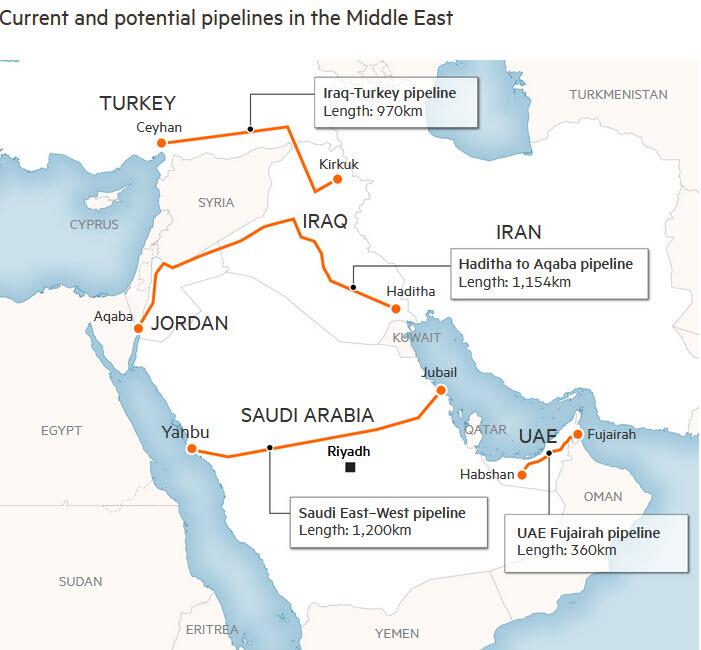
One month ago, at the start of the war, we said it was surprising that UAE’s oil export terminal of Fujairah was not a bigger terminal as it bypasses the Straits completely, and predicted a “major infrastructure push here after the war.”
Surprising Fujairah is not a bigger oil terminal: it bypasses the straits completely.
Expect major infrastructure push here after the war. https://t.co/Do1gK7KBDQ
— zerohedge (@zerohedge) March 3, 2026
Couple that with the latest news that the Saudi East-West pipeline is now running at capacity of roughly 7mmb/d (including non-oil products), and one can see the urgency gripping the Gulf in finding alternatives to the Strait of Hormuz which has emerged as Iran’s biggest source of leverage in the war.
And that’s just the start.
Confirming our observation from a month ago, the FT writes today that the threat of open-ended Iranian control over the Strait of Hormuz is pushing Gulf countries to revisit costly plans for pipelines to bypass the choke point so they can continue to export oil and gas.
According to officials and industry executives, new pipelines may be the only way to reduce Gulf countries’ enduring vulnerability to disruption in the strait, even though such projects would be expensive, politically complex and take years to complete.
We have already discussed the 1200km East-West pipeline: the war has underscored the strategic value of this Hormuz bypass. Built in the 1980s after fears that the Iran-Iraq “tanker war” would close the strait, it is now a key lifeline, delivering 7mn barrels of oil a day to the Red Sea port of Yanbu, bypassing Hormuz entirely.
“In hindsight the East-West pipeline looks like a genius masterstroke,” said one senior Gulf energy executive.
Amin Nasser, chief executive of Saudi’s state-run oil giant Aramco, told analysts last month that the pipeline is the “main route that we are capitalizing on right now”.
Now, the kingdom is considering how it can export more of its 10.2mn barrels of daily production by pipeline, rather than through Iranian-controlled waters. This includes examining whether it should expand the capacity of the East-West pipeline further or build new routes. According to the FT. previous plans for pipelines across the region have repeatedly stalled, undone by high costs and complexity. But Maisoon Kafafy, a senior adviser to the Atlantic Council’s Middle East programs, said the mood in the Gulf has now changed.
“I’m sensing a shift from hypotheticals into operational reality,” she said. “Everyone is looking at the same map and they are drawing the same conclusions.”
To eliminate the threat of centralized “points of failure”, rather than individual projects, the most resilient option “is not a single alternative pipeline but rather a network, a web of corridors”, said Kafafy, although she added that it would also be the hardest to achieve.
In the longer term, any new pipelines are likely to form part of trade routes through which a wider range of goods beyond oil and gas can flow. One option is the revival of US-led plans for an ambitious corridor that would run from India through the Gulf and then to Europe, called IMEC, one Gulf official said, although part of this project originally included a politically tricky pipeline that ran to the Israeli port of Haifa.
Yossi Abu, the chief executive of Israeli company NewMed Energy, said he was confident that pipelines to the Mediterranean Sea would be built, whether they terminated at Israeli or Egyptian ports.
“People need to control their own destinies, with their friends,” he said. “You need oil pipelines, railway connectivity, throughout the region, onshore, without giving others bottlenecks to choke us.”
A push for more bypasses means bumper revenues for local contruction companies. Christopher Bush, the CEO of Cat Group, the private Lebanese company that was one of the main builders of Saudi’s East-West pipeline, said there was plenty of interest in new projects even before the war began. “We have had inquiries about various different pipelines,” he said. “I have multiple different presentations on my desk.”
But the obstacles remain immense, he added. The cost of replicating the East-West pipeline today, which involved blasting through the hard basalt of the Hijaz mountain on Saudi’s Red Sea coast, would be at least $5bn, Bush estimated. Proposals for more complicated multi-country routes from Iraq through Jordan, Syria or Turkey would cost $15bn to $20bn. “It has been looked at. There are even front-end engineering studies for [such routes from] Iraq. There is an opportunity that has been discussed,” he said.
But security risks include “a lot” of unexploded bombs in Iraq and the continuing presence of Isis or other militants. Pipelines running south to ports in Oman would also face the difficulty of passing through both desert and hard-rock mountains, Bush warned. Ports in Oman are not immune from Iranian security threats. Drone attacks on the key port of Salalah in recent days forced it to shut temporarily.
Political challenges also include who will operate the pipeline and control the flow. A network of pipelines would require Gulf countries “to abandon their individualist policies and combine. It was always deemed cheaper and safer to bring a ship, load a ship and sail a ship,” Bush added.
In the near term, the most viable options may be to expand the East-West pipeline and also Abu Dhabi’s existing route to Fujairah, just as we suggested weeks ago. This would increase capacity without the complications of new cross-border infrastructure.
Saudi Arabia could also develop additional export terminals on its Red Sea coast, including at the deepwater port being built for the Neom project. “I am sure they are looking at it as a possibility,” said Bush. “You have a lot of smart minds looking at all of this now. It is a big problem.”
One senior energy executive said Abu Dhabi had “always had a plan B for a second pipeline to Fujairah”. But they added that no decisions are likely to be made until the long-term status of the Strait of Hormuz becomes clear.
Kafafy agreed that Gulf states will take a while to assess the situation with the waterway, but said they now recognise that the scale of the current energy crisis demands a new way of thinking. “The conversations have moved further along the chain,” she said. “I do not expect [the status quo] to return to where it was pre-conflict.”
Tyler Durden
Thu, 04/02/2026 – 13:40