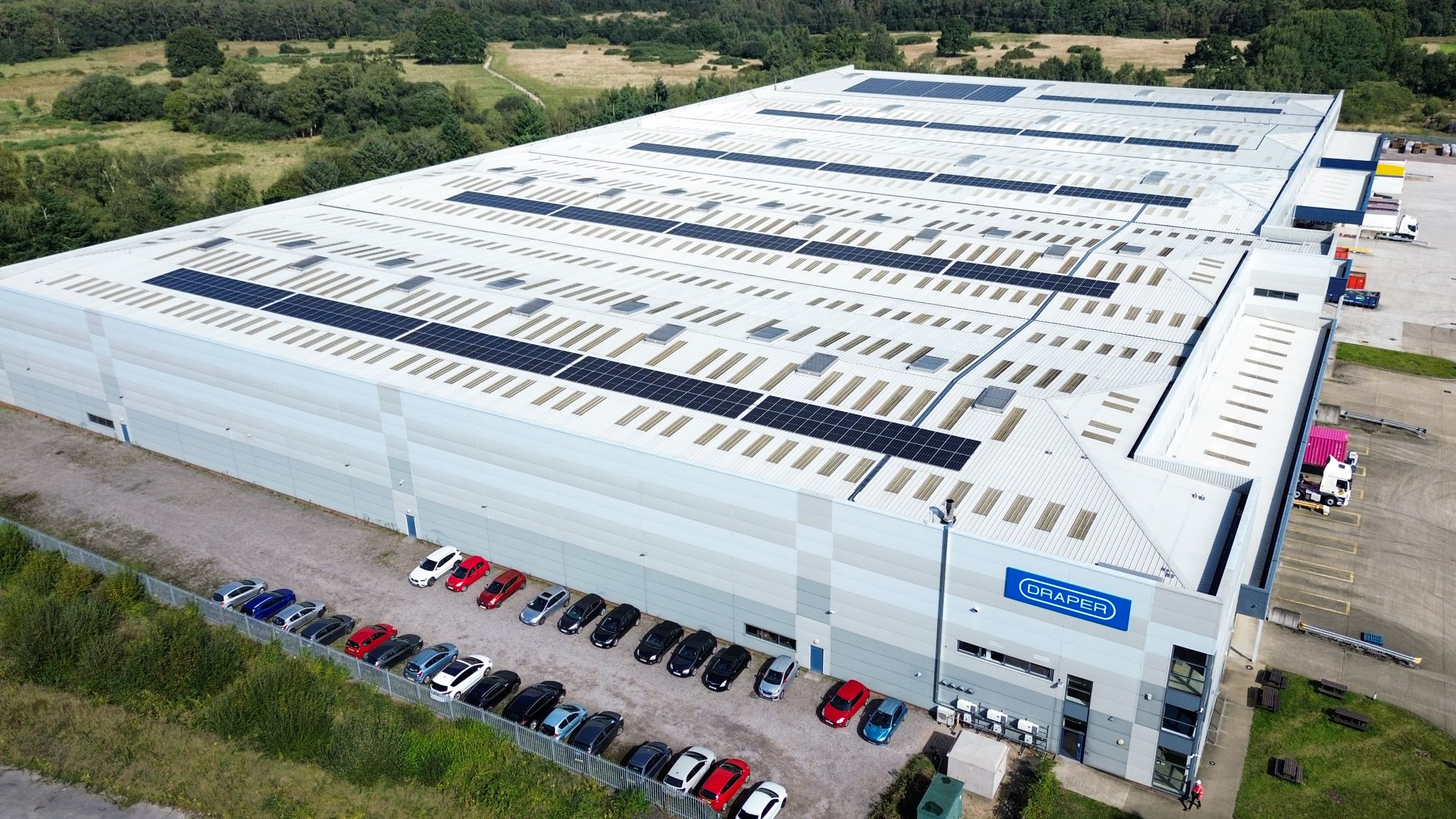





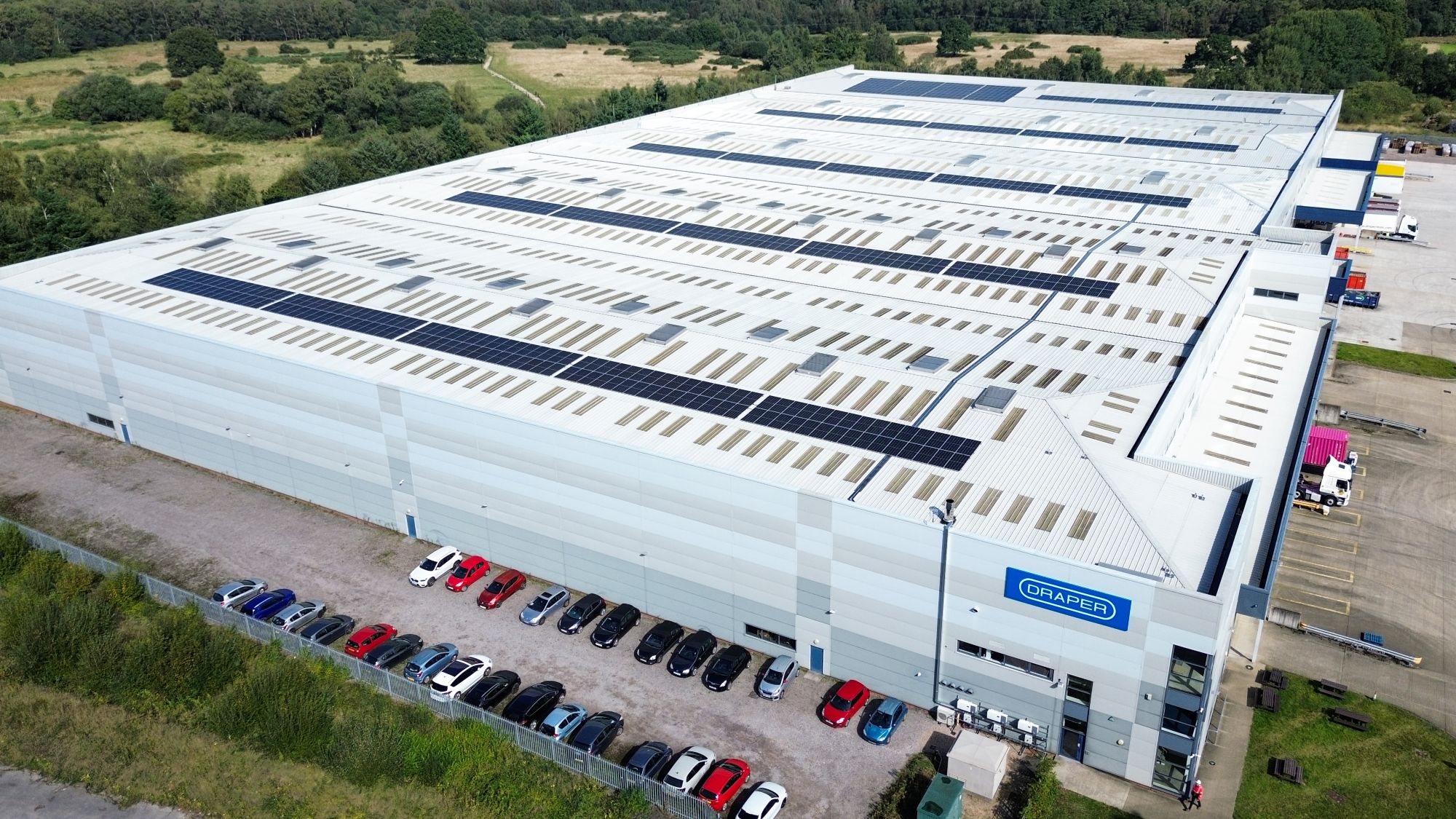


Draper Tools installed 904 of Absolar’s solar panels across a roof containing more than 700 skylights.
A new set of reports appears to highlight a significant opportunity for the vast untapped rooftop potential that exists in the UK. University of Southampton spin-off company Absolar has published a nationwide set of Solar Performance Wrap Reports for its customers, which the group says demonstrate how high precision solar modelling and installation are transforming energy use and carbon reduction across a wide range of UK organisations. Here, the group explains its approach, and the results attainable, referencing customer successes.
Drawing on advanced AI powered remote sensing, high-resolution GIS analysis and proprietary building level modelling, Absolar is demonstrating how accurately assessing solar capacity, even before installation, can lead to dramatically improved system performance and measurable carbon savings.
The Southampton based company, founded by scientists and engineers from the University of Southampton, combines digital mapping technology with full end to end solar installation and continuous optimisation.
This approach has drawn interest from major institutions such as the Royal Air Force, which commissioned Absolar to assess solar potential across its estate as part of its commitment to reach net zero by 2040 (10 years ahead of its original target).
Key findings reveal a major opportunity for the UK’s rooftops
The newly published Wrap reports highlight that across Absolar’s installation portfolio, buildings generated nearly 2.5 million kWh of clean energy in the past year, enough to make 53 million cups of tea! https://www.absolar.co.uk/2025wrap
The systems collectively avoided 382.5 tonnes of CO₂, while reducing energy costs for businesses nationwide.
Despite escalating policy pressure to decarbonise, less than 4% of UK buildings currently have onsite solar. Absolar argues that this is not due to lack of potential, but a lack of accurate insights.
Its remote assessment technology identifies suitable buildings without the need for manual surveys, making it possible to evaluate entire towns, cities and estates. This is a challenge that has historically held back rooftop solar at scale.
These are completely free for organisations and require no site visit (try it out here by entering your building’s address: Absolar | Remote Solar Survey).
Draper Tools: Industrial decarbonisation at scale
Draper Tools installed 904 Absolar solar panels across a roof containing more than 700 skylights, which was a complex environment requiring precise modelling.
Its Wrap Report shows:
505,046 kWh of clean energy generated in year one
105 tonnes of CO₂ emissions avoided
3,635 kWh record daily output
3,781 operational hours in 12 months
CEO Matt Sheen said: “Seeing our system generate over half a million kilowatt-hours in its first year demonstrates just how worthwhile this investment has been. The detailed performance data is invaluable for our long-term sustainability planning.”
University of Southampton Science Park: A solar-powered innovation ecosystem
Home to more than 100 businesses, including Absolar itself, the Science Park has transformed its campus with Absolar’s rooftop solar panels on every building.
Its unique Wrap Report revealed:
634,429 kWh generated
Enough for 14 million cups of tea
123 tonnes of CO₂ avoided
A major contribution to the University’s long-term sustainability goals
Why this matters
Rooftop solar remains one of the most promising avenues for decentralised clean energy generation, yet adoption rates remain alarmingly low. Absolar’s data highlights systemic issues including the facts that most viable rooftops have never been assessed and traditional surveys are often slow, costly (especially to apply at scale) and inconsistent.
Absolar’s innovative modelling recreates buildings and entire cities in virtual 3D, delivering insights on potential energy yield, cost savings, shading impacts and CO₂ reduction, thereby addressing the pressing need for scalable solutions in the renewable energy sector.
A research driven approach to climate action
Dr Phil Wu, co-founder of Absolar, said: “Solar has enormous potential to reduce carbon emissions, but organisations often lack the accurate information needed to invest confidently. Our technology reveals the true solar capacity of buildings and shows exactly how much energy can be saved. These Wrap Reports translate complex modelling into clear, measurable impact.
“To tackle climate change, we need tools that make sustainable decisions easier, faster and based on reliable data. We’re proud to support businesses and institutions across the UK in taking meaningful, evidence led climate action.”
From assessment to installation, and through to long term optimisation
Unlike mapping-only platforms, Absolar also installs the solar systems it designs, ensuring that modelling translates into actual carbon savings.
Installations meet relevant CDM, IEC, and BS EN standards and systems are continuously optimised to create transparent, yearly performance records that support ESG reporting. Absolar treats its customer relationships as long term partnerships which is deemed to be another key difference to other solar panel companies who manually assess, install and move onto the next project.
Organisations are invited to find out their building’s solar potential with Absolar’s free, online tool Absolar | Remote Solar Survey.