






What Iran is doing right now is something we have seen repeatedly throughout history whenever a currency begins to die. Governments start issuing larger and larger banknotes because the existing denominations no longer function in daily life. This took place in the Weimar Republic hyperinflation, where trillion-mark notes were printed, and again in Zimbabwe hyperinflation, where 100 trillion dollar notes became commonplace. The pattern is always the same. The currency loses purchasing power, prices rise uncontrollably, and instead of fixing the underlying problem, governments simply add more zeros. Iran introducing a 10 million rial note is the same historical signal that the currency is worthless.
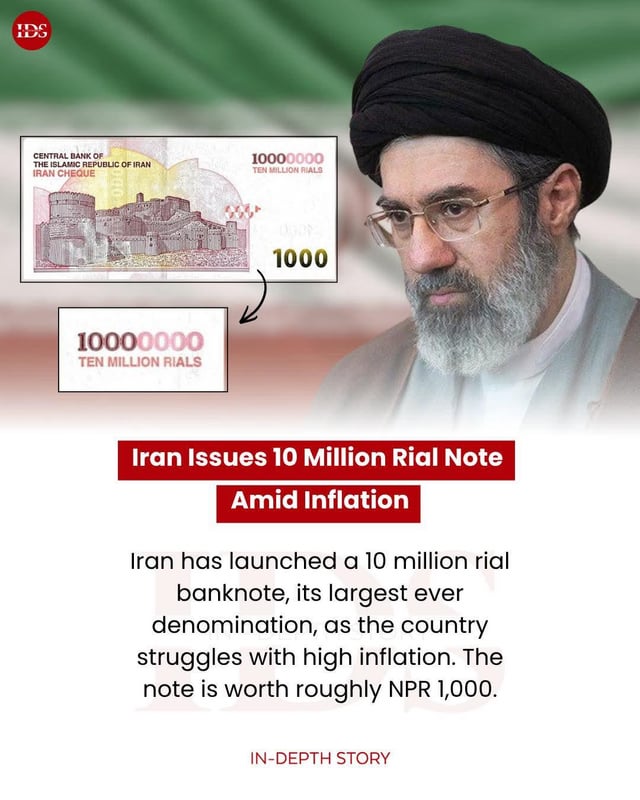
The introduction of a 10 million rial banknote, now the highest denomination in the country’s history, is being presented as a practical measure to “facilitate transactions.” In reality, it is an admission that the currency itself has failed. When a nation must print larger and larger notes just to keep commerce functioning, that is not stability, it is a monetary breakdown.
The new 10 million rial note is reportedly worth roughly $7 USD at current exchange rates. A “million” denomination has become meaningless. People no longer think in terms of value but in terms of survival. The numbers grow larger, but purchasing power collapses.
The reality on the ground confirms this collapse in confidence. The Iranian rial is now trading around 1.4 to 1.6 million per US dollar on the open market, levels that reflect a dramatic erosion in trust. At the time of the 1979 revolution, the exchange rate was roughly 70 rials per dollar, meaning the currency has lost tens of thousands of times its value over time. Even in the past year alone, the decline has accelerated, showing that this is not a slow deterioration but a rapid phase of collapse.
Official figures place inflation near 48–50%, with food prices rising even faster. This is where the destruction becomes visible to the average person. Prices rise faster than wages, savings are wiped out, and the middle class disappears. When you combine a collapsing currency with inflation approaching 50%, what you are really seeing is purchasing power being annihilated. People are not becoming poorer because they earn less. They are becoming poorer because their money no longer holds value.
What is even more telling is the government’s response. Before introducing the 10 million note, they rolled out a 5 million rial note worth only a few dollars. First, the denominations increase incrementally, then they accelerate as confidence disappears. These are all clear signs of a failed currency.
There have long been reports of people rushing to withdraw cash, fearing further currency weakness and potential restrictions. The public knows their currency is worthless. People have withdrawn whatever they could, spent it quickly, or converted it into hard assets or foreign currency.
The underlying cause here is not mysterious. Iran has been financing deficits through money creation for years while facing sanctions and internal corruption. This combination destroys confidence in both the government and the currency. Printing money does not create wealth. It simply dilutes what already exists.
When governments lose control of their finances, they always turn to the printing press. But printing money does not solve the problem. The introduction of a 10 million rial note is not a solution. It is a symptom. Iran is now in a phase where the currency is no longer trusted, and the entire economic system is at risk.