



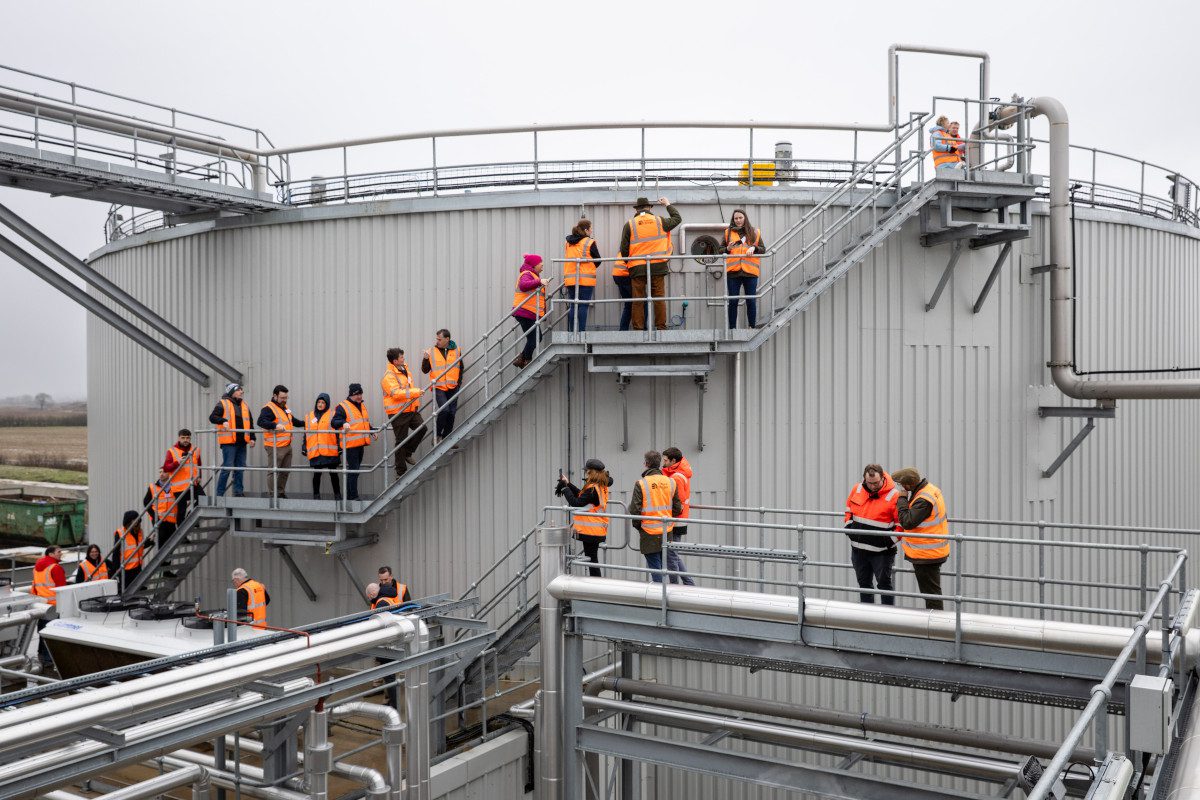


A delegation of more than 20 Irish energy and policy stakeholders has visited Future Biogas’s Moor Bioenergy anaerobic digestion (AD) facility in Lincolnshire, as Ireland accelerates regulatory and market frameworks for large energy users and renewable gas deployment. Topics explored included the potential match-up between this kind of energy generation and emerging legislation.
The fact-finding visit follows recent Irish policy developments including the Large Energy User Action Plan (LEAP) and Large Energy Users Connection Policy (LEU), which are tightening renewable sourcing expectations and system responsibility requirements—particularly for data centres and other energy-intensive industries.
Delegates included representatives from government agencies, in addition to local authorities, utilities, engineering consultancies, trade bodies, the UK’s DESNZ, and the EU innovation agency Climate KIC
The visit focused on biomethane’s role as a dispatchable, drop-in alternative to fossil gas that can be deployed without waiting for constrained grid connections.
Philipp Lukas, CEO of Future Biogas, said: “We are immensely proud that so many influential Irish organisations expressed such strong interest in our flagship Moor Bioenergy facility – the UK’s first industrial-scale, unsubsidised biomethane plant. The visit underlined growing demand from Ireland’s central and local government, utilities, industry and their collective advisors for an immediate drop-in substitute to fossil gas, both for baseload and dispatchable power. Biomethane is a clear and proven solution, whether sleeved in the short term through existing UK interconnectors or produced domestically in plants across Ireland.
“We look forward to continued discussions with this group to support the delivery of the Irish government’s step-change ambition for 5.7 TWh per year of biomethane supply by 2030 – serving energy intensive sectors such as food and beverage, packaging and glass, utilities and data centres.”
Moor Bioenergy, near Grantham in Lincolnshire, is the UK’s first unsubsidised bioenergy with carbon capture and storage (BECCS) facility. It produces biomethane under an exclusive 15-year offtake agreement with AstraZeneca, and captures approximately 14,000 tonnes of biogenic CO₂ per year for use in food and beverage production. Combined with equivalent agreements with feedstock growers, this creates the commercial stability needed for the facility to operate without public subsidy.
In Ireland this economic proposition is even stronger since, unlike the UK, grid-injected biomethane is treated as zero-emission under the EU Emissions Trading Scheme. Through its recent LEAP and CRU policy initiatives, Irish regulators’ expectations on renewable sourcing and system responsibility for large energy users are tightening – especially for data centres. However, many energy-intensive projects remain without connection certainty; with grid congestion and delays becoming a growing site-selection constraint. Biomethane can bypass these logjams, as an immediate drop-in substitute for fossil gas in turbines, gas engines, combined heat and power (CHP) plants or fuel cells.
Breda Maher, from Ireland’s Climate Action Regional Offices, added: “Future Biogas’s work at Moor Bioenergy is a powerful demonstration of how environmental ambition and economic opportunity can go hand in hand. Beyond generating green energy, its circular, locally rooted model is strengthening the rural economy and enhancing farm resilience; keeping value within the community and delivering benefits far beyond emissions reduction alone. Seeing it first‑hand has truly highlighted the breadth and potential of sustainable energy infrastructure.”
Looking at the wider European context, in Denmark 40% of gas supply already comes from domestic biomethane, with the country on course to reach 100% by 2030. While France is targeting 16% biomethane in its distribution network by 2030. The technology is not experimental; it’s becoming fundamental to energy transition strategies across Europe.
Denyse Julien, Program Manager at Climate KIC continued: “Future Biogas’s Moor Bioenergy facility is an excellent demonstration of how innovation, community partnership and climate ambition can come together to deliver real decarbonisation solutions. It shows what’s possible when we take a truly holistic approach to developing and managing a bioenergy facility. As Ireland moves forward with its national biomethane strategy, there is enormous opportunity to adopt locally‑driven approaches to build circular, resilient economies that work for farmers, industry and the climate. As Climate KIC, we’re proud to facilitate this collaboration between the UK and Ireland, and advance biomethane as a cornerstone of the circular bioeconomy.”
Since it opened in February 2025, Moor Bioenergy has injected over 100 gigawatt hours (GWh) of renewable biomethane into the gas grid, avoiding approximately 18,000 tonnes of carbon dioxide equivalent emissions (CO₂e) that would otherwise have come from fossil gas. This not only represents around 20% of total global gas consumption for AstraZeneca but also demonstrates genuine additionality: rather than purchasing existing renewable gas certificates, AstraZeneca’s partnership directly enabled new production capacity.
Beyond energy generation, Moor Bioenergy says it has established itself as a key contributor to the local rural economy. The plant sources feedstock exclusively from regenerative energy crops, grown on a rotational basis within a 15-mile radius, under five-year contracts that give local farmers financial security and provide them with diversification opportunities. The residue or ‘digestate’ from the plant is returned to farmers as a soil-improver, replacing costly and carbon intensive traditional fertilisers which are typically manufactured or mined overseas.
Biomethane offers a proven, scalable, renewable gas that strengthens energy security, supports rural communities, and delivers verifiable decarbonisation for hard-to-abate industries.
Kara Owen, British Ambassador to Ireland, concluded: “The British Embassy Dublin is proud to support closer collaboration between the UK and Ireland in advancing renewable energy solutions. The visit to Moor Bioenergy highlighted the innovation already underway and the opportunities that biomethane presents for both our countries. Continued partnership between governments, industry and communities will be essential as we work together toward a secure, sustainable, and low‑carbon future.”