




Lloyd’s Of London Says Gulf Tanker Coverage Available As Strait Chaos Erupts Again
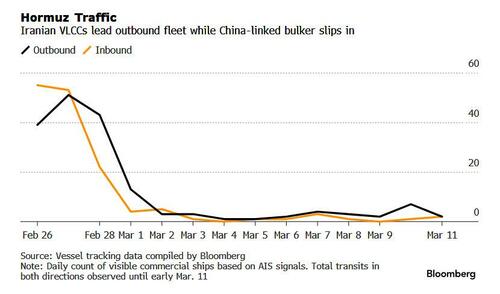
What caught the attention of one UBS analyst earlier this morning was a Financial Times report stating that Lloyd’s of London is pushing back against claims that insurers are choking off traffic through the Strait of Hormuz. As we have outlined, tanker flows are beginning to creep higher in the strait by midweek, with some tankers switching off their transponders while transiting the narrow waterway.
Lloyd’s head of underwriting, Patrick Davison, told the FT that the insurance market is “still providing cover to basically anyone who asks,” but stressed that the slowdown in Strait traffic is “not an insurance issue – it’s a question of vessel and crew safety.”
“All the insurers at Lloyd’s are still quoting business, and will still provide cover to basically anyone who asks,” Davison said.
War-risk insurance premiums for any commercial ship transiting the world’s most important energy chokepoint surged well before the conflict and then skyrocketed, with rates now up twelvefold.
Therefore, the real constraint is not so much the insurance as the extreme danger facing tankers, bulk carriers, and container ships, as Tehran threatens vessels with drones, missiles, and water-based mines.
Related:
Insurance As A Weapon: How The Strait Of Hormuz Shapes Global Power And Energy Markets
The US is in the early stages of preparing a potential $20 billion reinsurance backstop to help restart transits through the strait. Underwriters in London learned of the US plan only recently and question whether it will ever be launched.
Last week, an FT report said the US Development Finance Corporation will create a $20 billion reinsurance facility to restart maritime cargo and oil commerce. There are other reports that the US could use its naval power to shadow commercial vessels in the waterway.
However, a Reuters report states that those military escorts are not yet ready, and that near-daily US military requests from tankers have been denied this week.
Chaos in the Strait continued in the overnight hours, with a Reuters report saying three vessels had been hit by unknown projectiles.
BREAKING:
Iran strikes a Thai ship attempting to pass through the Strait of Hormuz.
Thai authorities said the bulk carrier Mayuree Naree, sailing under the Thailand flag, was struck by projectiles while travelling about 18km north of Oman.
— Visegrád 24 (@visegrad24) March 11, 2026
That explains that.
*IRAN WON’T ALLOW A SINGLE LITER OF ‘HOSTILE OIL’ TO PASS HORMUZ
*IRAN SAYS STRIKES TO BE CONTINUOUS FROM NOW ON: FARS
*IRAN MILITARY SAYS POLICY OF RECIPROCAL STRIKES IS OVER: FARS
— zerohedge (@zerohedge) March 11, 2026
By now, readers understand how critical the Hormuz chokepoint is, as it serves as a key energy artery for about 20% of global oil and gas supply. Since Operation Epic Fury, energy supplies across the Gulf area have dramatically slowed, prompting panic among G-7 leaders and the IEA, who are set to release their plan to release the “largest ever” SPR dump onto markets to cap Brent and WTI prices.
Tyler Durden
Wed, 03/11/2026 – 08:50