


NHTSA Ends Probe Into Tesla’s Remote-Driving Feature, Citing Low Risk
Authored by Rob Sabo via The Epoch Times,
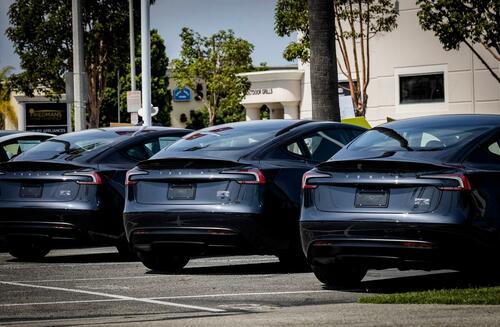
The National Highway Traffic Safety Administration (NHTSA) said on April 6 that it had closed its investigation into Tesla’s Actually Smart Summon feature, a remote driving function that allows low-speed vehicle movement over short distances in parking areas using a smartphone app.
The NHTSA opened its probe into the feature in January 2025 following multiple reports of crashes and incidents while the system was active.
The NHTSA’s Office of Defects Investigation (ODI) probe involved 2.85 million Tesla Model X, Model Y, and Model 3 vehicles equipped with the company’s Full Self Driving software package made between 2016 and 2025.
The ODI received 159 reports involving incidents with Actually Smart Summon sessions. The incidents typically were minor impacts stemming from the system failing to fully detect the vehicles’ surroundings and resulted in minor property damage.
Incidents took place when users did not have a full 360-degree view of their surroundings, in which the app could completely assess situational awareness, the NHTSA reported.
“This limited the app user’s ability to determine whether an impact was imminent during initial vehicle maneuvers such as reversing in close proximity to an obstacle or a curb,” the ODI report noted.
Most damage occurred from Tesla vehicles striking parking gates, nearby vehicles, or parking barrier posts, the NHTSA said. There were no reports of accidents where the vehicles’ airbags deployed, injuries, or fatalities, the federal agency added.
Only a minute fraction of Summon sessions resulted in incidents, the NHTSA noted. Two accidents involved wet conditions in snow-covered parking lots. Tesla owners tried to use the Actually Smart Summon feature to move their cars, but snow was blocking the forward-facing cameras and vehicles’ clipped unoccupied cars in adjacent parking spaces. In both instances, the NHTSA said, the Tesla owners did not command their vehicles to stop moving despite not having a clear field of view in the app.
In another incident, a Tesla powered with the Summons app failed to detect a gate arm that was blocking the exit lane of a parking garage.
The NHTSA said it dropped its investigation into the app after Tesla released six over-the-air software updates to improve blockage detection with the vehicles’ cameras. Tesla also released additional firmware updates that reduced false negative camera blockage detections under wet and snowy conditions.
“Due to low incident occurrence and low incident severity, this preliminary evaluation is closed,” the NHTSA report said.
Tesla did not immediately respond to a request for comment by The Epoch Times.
Tesla is still under an active investigation by the ODI related to its Full Self Driving (FSD) feature. The inquiry began in early October following a spate of crashes and safety violations involving drivers using the vehicle’s automated driving system. That investigation originally involved 2.88 million vehicles, but the probe was expanded in mid-March to include roughly 3.2 million vehicles.
The ODI is currently evaluating Tesla’s FSD ability to properly detect degraded and adverse roadway conditions and give drivers enough time to react.
Tyler Durden
Mon, 04/06/2026 – 20:05