





One In Five California Home Sales Canceled Due To Unaffordable Insurance
Authored by Mike Shedlock via MishTalk.com,
Ponder a $44,000 insurance bill. This does not count as inflation in the CPI.
Dysfunction in California’s Insurance Market
The Wall Street Journal reports A $44,000 Bill Shows the Dysfunction in California’s Home-Insurance Market
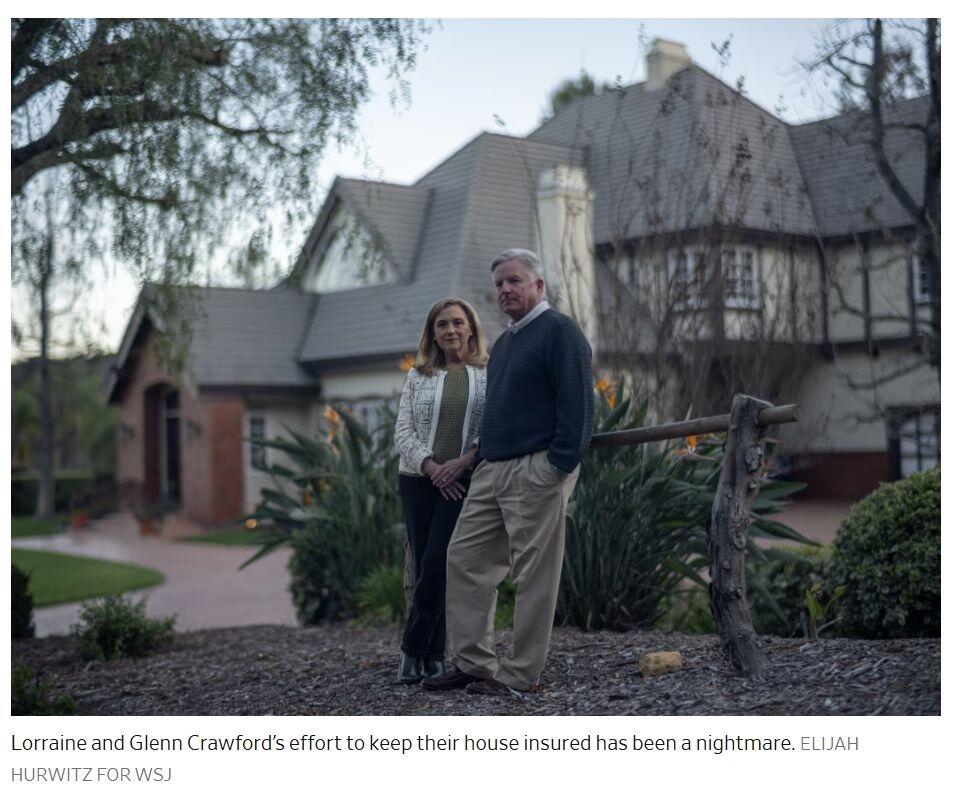
Glenn and Lorraine Crawford paid about $500 a month to insure their home in Agoura Hills northwest of Los Angeles when they bought it in 2012.
The Crawfords say they have little alternative but to pay the bill that arrived last month, which, at more than $44,000 a year, is almost as much as their mortgage bill. The only other insurer willing to cover their home, Lloyd’s of London, quoted them $80,000 a year.
More than a year after infernos tore through Los Angeles County, millions of Californians like the Crawfords are suffering through a home-insurance crisis that has rolled on for years with eye-watering rate increases, canceled policies and rejected claims.
Two of the biggest insurers, State Farm and Allstate, aren’t selling to new customers in the state, despite getting double-digit rate increases approved for their existing policyholders. A third, Farmers Insurance, has committed to cover more homes in fire-prone areas, but only a fraction compared with the drop in its overall number of policies since the crisis began.
The insurance dysfunction has spread to California’s housing market, the country’s biggest and most expensive, with nearly one-in-five real-estate agents reporting a canceled sale last year because of clients unable to find affordable insurance, according to a survey by the trade body California Association of Realtors.
The roots of California’s insurance crisis go back years. The state’s tough rate caps kept premiums low. But home insurers eventually balked, saying they couldn’t charge enough to cover rising wildfire and other losses, made worse by climate change and development. Insurers didn’t renew tens of thousands of policies, especially in fire-prone areas.
California’s uphill battle to draw insurers back could prove a template—or cautionary tale—for other disaster-prone states. New rules implemented last year, for instance, require home-insurers in the state to pledge to sell new policies in high-risk wildfire zones, in return for allowing them to charge higher rates.
As part of a request for a 6.99% rate increase, Farmers, the second-biggest home-insurer in the state, pledged to add at least 5,596 policies in high-risk areas by September 2028. That is less than a 10th of the 59,806 reduction in Farmers’ total number of California home-insurance policies in the previous two years, according to a Consumer Watchdog analysis.
Others continue to shun the state despite winning big concessions. California regulators approved a 34% rate increase for Allstate in 2024. Yet it has no “growth aspirations” in California home insurance, Chief Executive Tom Wilson said last year, adding that it would take time to fix the market. A spokesman said that remains Allstate’s position.
The disaster also almost felled California’s biggest home insurer, State Farm General. Lara last year backed an emergency 17% rate increase to keep the State Farm subsidiary afloat. “We’re on the Titanic, and we see the iceberg,” one of Lara’s lawyers told a hearing last year.
Truflation BS
Meanwhile, Truflation reports an absolutely absurd year-over-over year inflation rate of 0.87 percent.
@truflation pic.twitter.com/1vrtJkWMFJ
— Randy Woodward (@TheBondFreak) February 18, 2026
Faster Nonsense
Truflation is nothing but more timely nonsense. Like the BLS and BEA, Truflation does not factor in homeowner’s insurance or property taxes.
Truflation’s measure of rent are ridiculous. Truflation has too high a weight on new leases rather than existing leases. Existing leases are close to 90 percent of the market.
While the price of new leases is falling in some areas, existing leases are moving much slower.
Neither the BLS nor BEA weigh food properly. I strongly suspect Truflation doesn’t either.
I don’t doubt that Truflation has better and more timely collection methods than the BLS, but like the rest of the inflation models, it’s nonsense.
Economists don’t understand why people are upset. The answer is obvious. When you exclude real prices people pay, all you are offering is garbage.
We don’t need better measures of nonsense, we need better measures of reality, and Truflation sure isn’t it.
Food at Home vs Away
Note the BLS food weights for home vs away are reversed from where people actually spend their money.
For more details, please consider Where Do You Spend Money on Food? How Screwed Up Are the BLS Weights?
Does the BLS match your budget?
Homeowners Insurance
On August 11, 2025, I asked Is Homeowners Insurance Understated in the CPI? Shop Around!
Our Insurance went up by $2,000. Then another $2,000. Here’s our story.
What’s the Insurance Weight?
The BLS says shelter is 35.473 of the CPI. Of that, Tenants’ and household insurance is allegedly 0.414 percent.
Sound right?
If you own a home, what percent of your income is spent on your homeowners’ insurance?
Under 1/2 of 1 percent?
ON January 14, I noted The Fed Has Missed Its Inflation Target on Ten Different Measures
The Atlanta Fed tracks various inflation targets. Let’s have a look.
Does that match your experience or does Truflation?
And none of the measures include homeowners insurance. It’s all nonsense, yet economists believe it.
Tyler Durden
Wed, 02/25/2026 – 12:05