

PIMCO Privately Lends Over $10 Billion To Dollar-Strapped Gulf States
Just days after the UAE hinted at a growing dollar shortage in the Gulf nation by requesting swap lines with the Fed, Bloomberg reports that as Iran’s struggling neighbors scramble to build cash buffers to deal with any potential economic fallout from the Iran war, one large buyer has stepped in: the world’s largest bond manager, Pacific Investment Management Co.
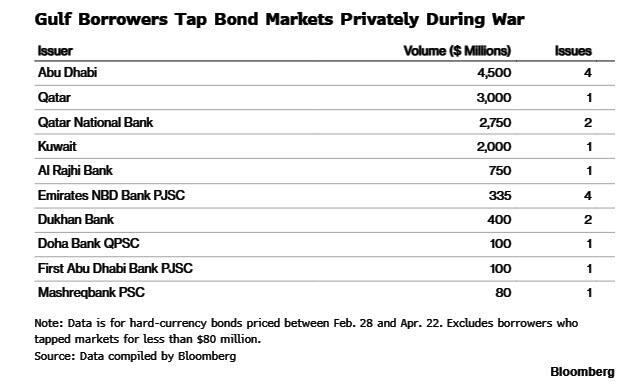
Since the start of the Iran war, Pimco has lent more than $10 billion to state-backed and government borrowers in the Gulf via so-called private placements. The $2.27 trillion asset manager has been a significant buyer of privately placed bonds issued by the governments of Abu Dhabi, Qatar and Kuwait, as well as by Qatar National Bank. Pimco also participated alongside other investors in several placements that boosted the size of existing Abu Dhabi bonds by a combined $2.5 billion.
In total, regional borrowers raised $13.8 billion from Feb. 28 to April 23, in privately placed bonds denominated in hard currency, according to data compiled by Bloomberg, with Pimco accounting for a majority of that lending.
Private placements offer trade-offs for issuers rushing to get to market: they can be more expensive than public debt (and thus soffer higher returns for buyers such as Pimco). In return, sellers are able to borrow faster, with more privacy and greater flexibility on deal terms.
The coupon on Qatar’s privately placed bond was 4.8%. That was about 0.3% higher than implied by the yield curve for the country’s public traded bonds, according to Bloomberg calculations. The actual yield for bondholders depends on the price at which they bought it from the issuer, which wasn’t disclosed.
“Not all countries have the option of borrowing at reasonable interest rates at a time of geopolitical uncertainty. It’s notable that the three Gulf nations with the strongest balance sheets are the ones tapping the market,” said Ziad Daoud, chief emerging markets economist at Bloomberg Economics. “And they’re resorting to private borrowing instead of public issuance. The latter probably requires more disclosure and higher transparency.”
To Pimco, which has been invested heavily in emerging market bonds, the Gulf scramble to find buyers for its bonds has been a boon. The Newport Beach-based fund opened an office in Dubai last year, joining a rush of investment companies seeking to deepen their presence in a region flush with sovereign wealth. Pimco said this move built on over 20 years of managing assets for investors in the Middle East.
Pimco intends to hold the bonds over the long term, a Bloomberg source said. Earlier this month, Pimco – which is rapidly emerging as a lender of last resort – bought all of a $400 million bond issued by a Blue Owl Capital, in an important vote of confidence for the private credit specialist.
Gulf bond markets have been among the busiest globally in recent years, with regional borrowers selling about $50 billion of public debt in the first two months of this year. But those markets have effectively shut since the conflict began.
Before a ceasefire between the US and Iran was agreed in early April, Gulf Arab states contended with thousands of missiles and drones over several weeks, intercepting the vast majority. The effective closure of the Strait of Hormuz disrupted energy exports — a key source of government revenue — prompting the International Monetary Fund to cut growth forecasts across the region.
Over the weekend, the WSJ reported that the UAE informally inquired about a currency swap, if the economic and financial impact of the war worsens. The Emirati ambassador to Washington signaled the country had no need for external financing, and Bloomberg Economics’ Daoud described the inquiry as “a call for confidence, not a call for help.”
US Treasury Secretary Scott Bessent said Wednesday that many Persian Gulf allies had requested foreign exchange swap lines with the US, a day after President Donald Trump said an arrangement with the UAE is under consideration.
Tyler Durden
Thu, 04/23/2026 – 18:15