






Pull-Forward Demand Boosts PC Shipments Amid Memory Crunch Woes
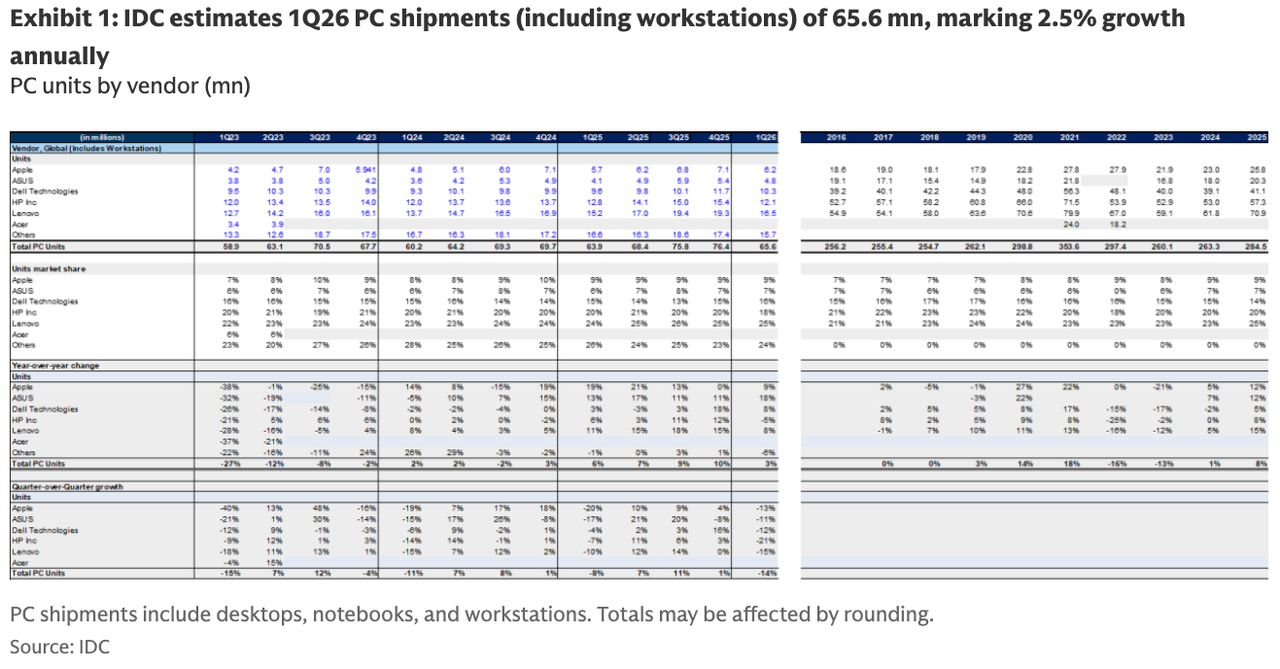
The latest snapshot of the global PC market, from International Data Corporation’s first-quarter shipment tracker, shows units rising 2.5% year over year to 65.6 million.
“Despite deteriorating macroeconomic conditions and memory shortage issues, the PC market recorded another quarter of positive growth,” IDC wrote in the report published on Thursday morning.
IDC said last quarter’s growth was “mostly fueled by the anticipation of rising component prices, Windows 10 migration, and new product introductions.”
Jean Philippe Bouchard, research vice president at IDC, noted, “The strength of every PC vendor’s supply chain and ability to access core components, such as memory, will be tested,” adding, “IDC believes that demand will be met by PC vendors who have best secured access to memory and have a device portfolio capable of addressing all price tiers of the market.”
Here are the key 1Q26 numbers on global PC shipments:
1Q26 Regional Shipments:
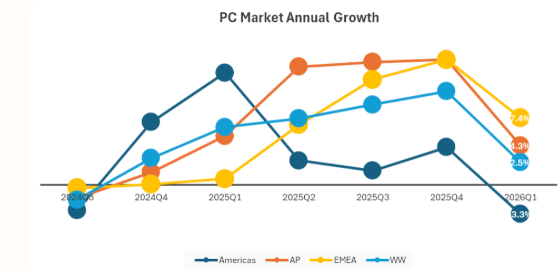
IDC estimates industry PC shipments of 65.6 mn grew +2.5% year over year. Global growth was driven by EMEA (+7.4% year over year) and Asia/Pacific (+4.3% year over year), while Americas was down (-3.3% year over year v. +4% in C4Q25). IDC PC unit shipments also include workstations.
1Q26 Vendor Market Share:
IDC estimates that Lenovo, Dell, Apple, and ASUS grew ahead of the market, while HP lagged. Specifically, Lenovo shipments grew 8.6% (25% share), Dell shipments grew +7.7% (16% share), Apple shipments grew +9% (9.5% share), and ASUS shipments grew 17% (7% share), while HP units declined -4.9% (18.5% share).
IDC estimates 1Q26 PC shipments (via Goldman):
Goldman analyst Katherine Murphy commented on IDC’s report and agreed that much of the PC growth in the first quarter was attributed to “a pull-forward ahead of anticipated price increases.”
The pull-forward in PC shipments comes as little surprise, given that industry insiders warned consumers in late January to buy devices heavily dependent on memory before the shortage worsened. However, in recent weeks, “Google’s DeepSeek moment” appears to have forced memory stick hoarders to dump supply onto the market, pushing prices lower.
Tyler Durden
Fri, 04/10/2026 – 13:20