




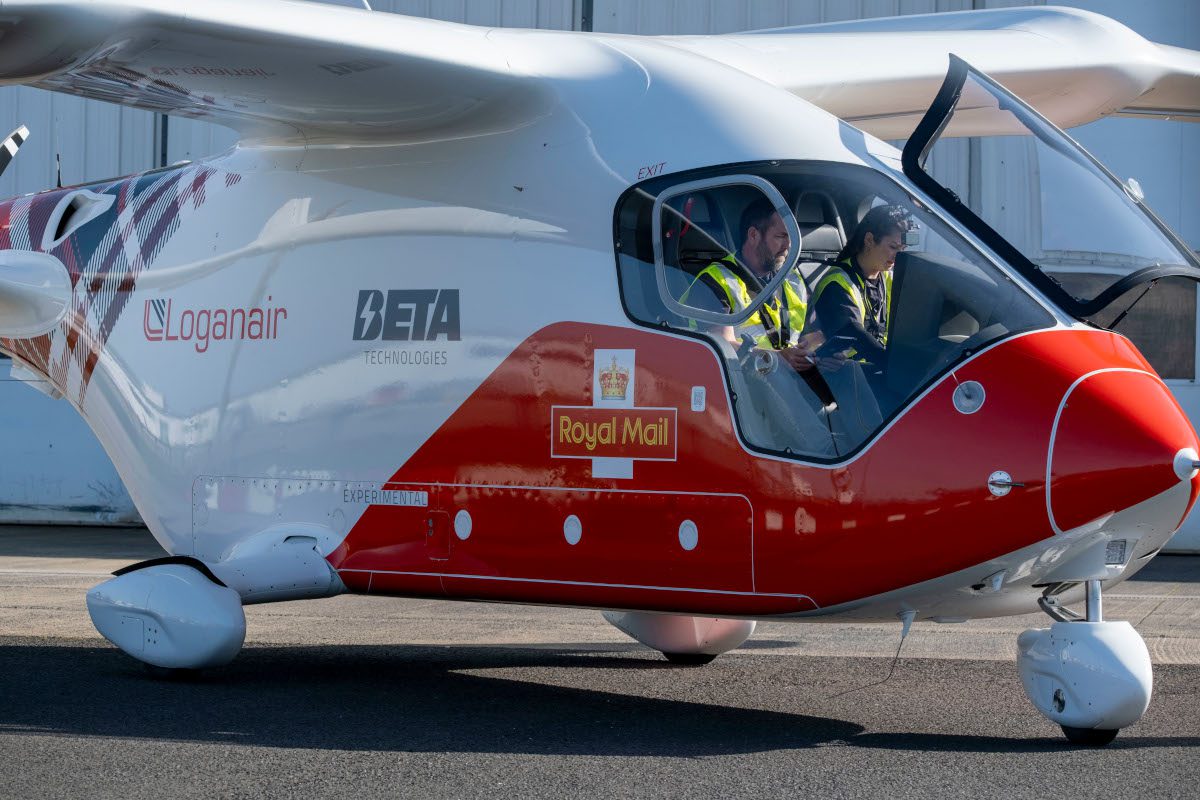




Royal Mail, Loganair and US electric aerospace company BETA Technologies have begun the UK’s first live demonstration of electric aircraft on operational postal routes, marking a significant step in the decarbonisation of regional aviation.
The initial flight took place on 20 March between Glasgow and Dundee, with additional demonstration routes planned across Scotland’s regional airport network, including Aberdeen, Inverness, Wick and Orkney. The programme will carry representative letters and parcels, mirroring the daily services that connect remote communities across the Highlands and Islands.
At the centre of the trial is BETA Technologies’ ALIA CTOL, an all-electric conventional takeoff and landing aircraft designed for regional cargo and passenger use. The aircraft can operate from existing runways without requiring new infrastructure and recharge in approximately 20–40 minutes. With a demonstrated range of 336 nautical miles and payload capacity of up to 560kg, it is positioned as a viable option for short, high-frequency routes.
The demonstrations aim to assess how electric aircraft could be integrated into existing logistics networks without disruption—an important consideration for Royal Mail’s Universal Service Obligation, which requires deliveries to all 32 million UK addresses, including some of the country’s most remote locations.
The initiative builds on Royal Mail’s broader decarbonisation strategy. The company announced in 2024 that it would halve domestic flights as part of its Net-Zero by 2040 target, while expanding its use of electric delivery vans and drone services for island communities.
Chris Paxton, Strategic Insight and Innovation Manager at Royal Mail, said: “This is an important step towards making electric mail flights a reality for some of the UK’s most remote communities. By working with Loganair and BETA Technologies, we’re proud to be the first UK delivery company to test an electric aircraft, supporting our journey to Net-Zero by 2040 while continuing to serve all 32 million addresses across the UK.”
Industry stakeholders say Scotland’s geography makes it a strong testbed for electric aviation, due to its short regional routes and reliance on air connectivity.
Simon Newitt, Head of Sales and Support at BETA Technologies, said: “Scotland’s geography makes it one of the most compelling environments for electric aviation anywhere in the world — short routes, existing infrastructure, and communities that have depended on reliable air connections for generations. Flying real postal routes alongside an operator with Loganair’s experience is exactly how you validate this technology. We’re proud to be working with partners like Loganair and Royal Mail, who recognise that keeping these communities connected and doing it sustainably are not competing priorities.”
Loganair described the programme as a major milestone for commercial aviation in Europe, shifting electric flight from concept to real-world application.
Luke Farajallah, CEO at Loganair, said: “This is a landmark day for European aviation, and in-particular for Scotland’s airline Loganair. We are not talking about concepts, prototypes, or distant ambition, this is a real tangible programme of flying across our network which will provide invaluable data on how an electric aircraft could perform in a real commercial environment.”
The trial has received backing from government and regulators, who see electric aviation as a key component of wider decarbonisation and connectivity strategies.
First Minister John Swinney said: “I am pleased to see Loganair make history as the first commercial airline to trial an all-electric aircraft across its network.
“This next-generation technology ensures that Scotland is well placed to play a leading role in reducing the carbon emissions associated with aviation, while supporting regional connectivity for communities in the Highlands and Islands.
“I would like to congratulate Loganair for the work involved in reaching this important milestone and thank them for their continued efforts in supporting sustainable aviation.”
Sophie O’Sullivan, Director of Future Safety & Innovation at the UK Civil Aviation Authority said: “Electric aircraft offer the possibility of cleaner, quieter flights, with improved connectivity and greater reliability.
“The UK Civil Aviation Authority have granted permission for Loganair and Beta to demonstrate their electric aircraft across Loganair’s commercial network.
“As electric aerospace technology advances, trials like this contribute to our work to establish the regulatory framework for advanced air mobility, helping us enable this new technology to develop safely.”
The UK Government has also highlighted the economic and industrial potential of zero-emission aviation technologies.
Keir Mather, Aviation, Maritime and Decarbonisation Minister: “We’re backing UK business with £43 million to power up green aviation and it’s great to see Loganair leading the charge towards greener aircraft and zero emission flights.
“Zero emission aircraft, hydrogen fuels and advanced air mobility will unlock economic growth, reduce climate impacts from flying, and help deliver our airport expansion plans to boost connectivity and growth whilst creating highly skilled jobs across the UK.”
Industry groups say the trial demonstrates tangible progress in aviation decarbonisation, alongside parallel efforts such as sustainable aviation fuels and airspace modernisation.
Tim Alderslade, CEO at Airlines UK: “Congratulations to Loganair on this world-first all-electric flight by a commercial airline on its route network. This flight highlights the exciting, real-world developments on decarbonising aviation that are happening today. Alongside industry efforts to deliver more sustainable aviation fuels, modernise UK airspace and bring more efficient aircraft into fleets, this is further proof we have the tools to grow our sector whilst driving down our environmental impact, which must happen whilst keeping flying affordable for all.”
Airport operators involved in the trial say electric aviation could deliver both environmental and regional economic benefits.
Fiona Smith, Sustainability Director at AGS Airports: “We are delighted that Glasgow and Aberdeen International Airports will support these milestone flight demonstrations showcasing the real world potential of electric aircraft on essential services such as Royal Mail operations. We have long championed the industry’s transition to net zero, through our airspace modernisation work, our role on the UK’s Jet Zero Taskforce, co-chairing the national hydrogen infrastructure group, and leading the CAELUS drone project for the NHS.
“Electric aviation represents a major opportunity to bring meaningful reductions in carbon emissions while strengthening social and economic connectivity for the communities we serve and our airports are very well placed to facilitate the earliest iteration of an electric aircraft flying network.”