




Sotomayor Blames Colleagues For Flood Of Emergency Appeals
Authored by Jackson Richman via The Epoch Times,
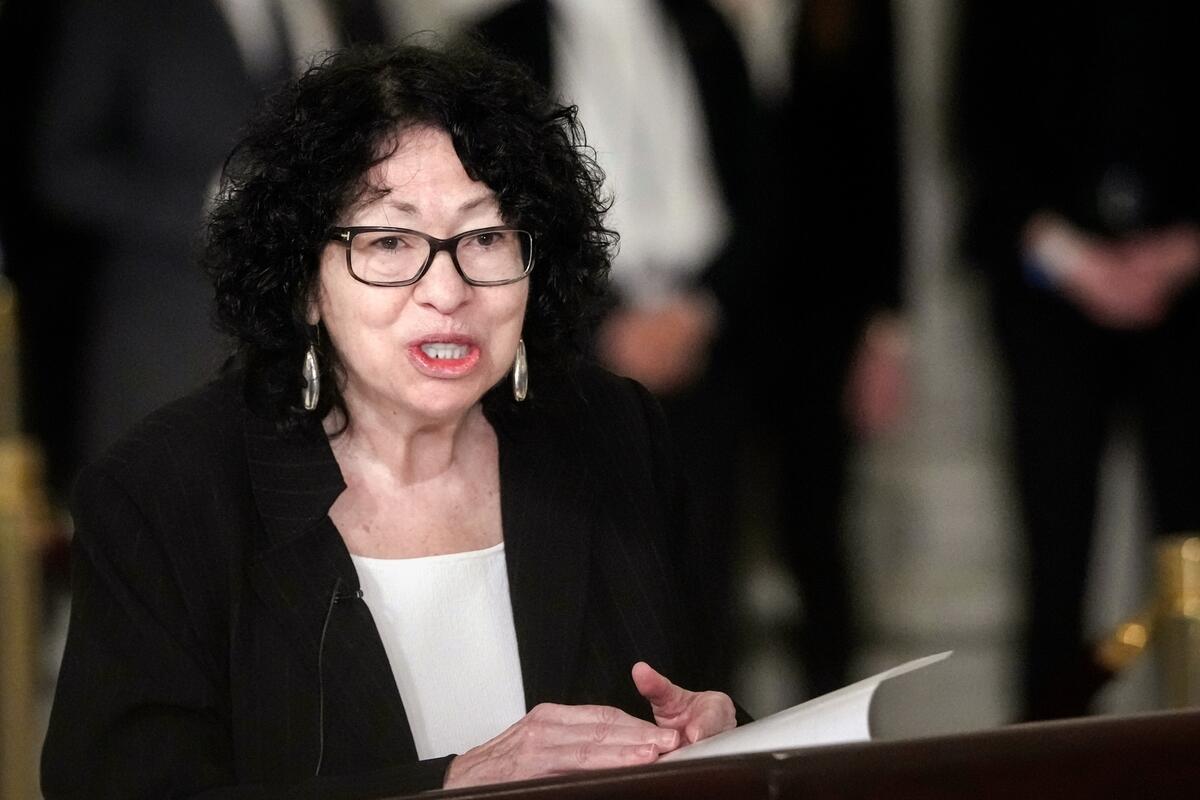
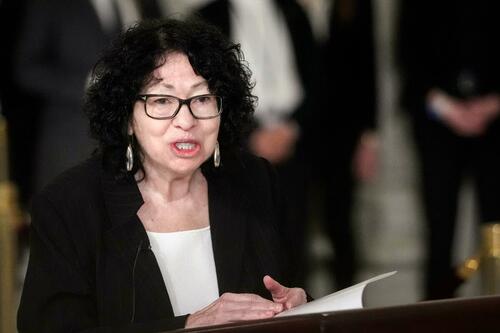
Justice Sonia Sotomayor said a surge in emergency appeals to the Supreme Court is largely the court’s own doing.
“We’ve done it to ourselves,” she said during an April 9 event at the University of Alabama School of Law.
She said that the volume of emergency filings has reached levels never seen before in the court’s history.
Over the past 15 months, the Trump administration submitted about 30 emergency requests to the court, succeeding in more than 80 percent of them.
Many of those rulings divided the justices along ideological lines, with 6–3 outcomes.
Sotomayor, appointed by President Barack Obama in 2009, suggested those wins reflect a shift among some of her colleagues, who now tend to assume that blocking federal policies automatically causes irreparable harm—grounds for the court to intervene.
She also said that “there’s a disagreement among us right now.”
Some justices, she said, believe that when Congress enacts a law, preventing it from taking effect inherently harms both lawmakers and the public.
“It has changed the paradigm on the court.”
Her comments were the latest from justices expressing concerns about the court’s use of the emergency docket, which is used to temporarily halt lower-court orders as litigation proceeds.
Sotomayor commented on the issue in a dissent last year after the court allowed a policy expanding deportations of immigrants to countries where they have no prior connections.
“Other litigants must follow the rules, but the administration has the Supreme Court on speed dial,” she wrote.
Supreme Court justices have been disagreeing over the emergency docket.
At an annual lecture on March 9, Justices Brett Kavanaugh and Ketanji Brown Jackson disagreed about the court’s increasing use of emergency orders, many of which have enabled President Donald Trump to move forward with key policies.
These cases are typically handled on a fast track, with limited written arguments and usually no oral hearings.
The resulting decisions are often unsigned and may include little explanation, though individual justices sometimes write concurring or dissenting opinions.
A key question in these emergency appeals is whether a challenged policy should take effect immediately while the legal process—often lasting years—continues.
Lower courts have blocked parts of Trump’s policy agenda, prompting his administration to seek emergency intervention from the Supreme Court. In many instances, the justices have granted relief by lifting those lower court orders.
Jackson, who has frequently dissented in such cases, criticized the trend during the event. She argued that the court’s conservative majority, including Kavanaugh, has too often sided with Trump in emergency rulings, undermining both the institution and the country.
She said administrations are implementing new policies and pushing for them to take effect right away, even before courts have fully reviewed their legality.
According to Jackson, the court’s growing willingness to step in at this early stage is “unfortunate” and distorts the legal process by effectively predicting outcomes before full arguments are presented.
Kavanaugh defended the court’s role, saying it is simply responding to the emergency requests brought before it.
He noted that turning to the Supreme Court for urgent relief did not begin with the Trump administration.
As passing legislation through Congress has become more difficult, Kavanaugh said, administrations increasingly rely on regulatory actions, some of which are legally valid and others not.
He also argued that some critics have been inconsistent, pointing out that similar objections were not raised when the court allowed policies from the Biden administration to take effect while legal challenges were still pending.
Tyler Durden
Sat, 04/11/2026 – 15:10