







TACO Vs TAW: Fade This (Equity) Rally
Authored by Peter Tchir via Academy Securities,
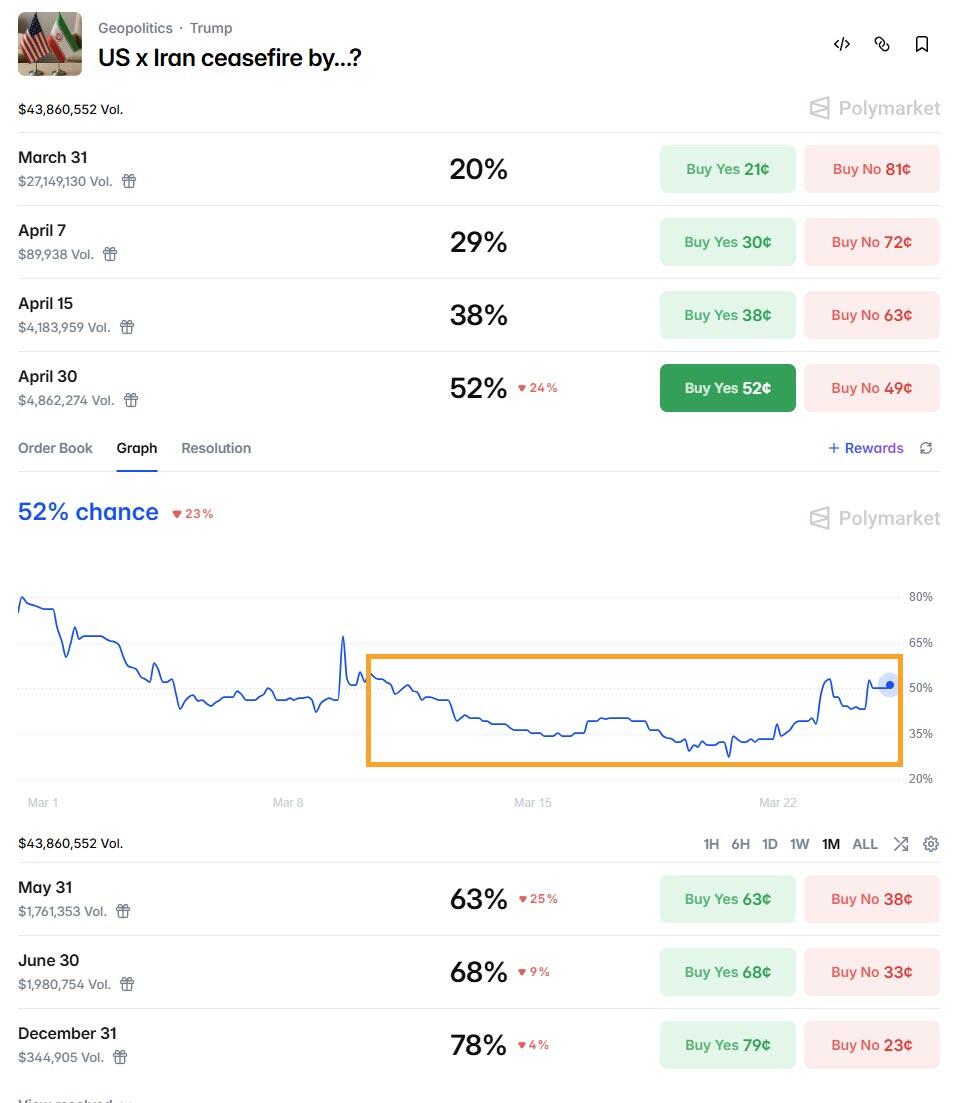
Ceasefire?
The U.S., via Pakistan, and apparently consistent with negotiations being carried out by Witkoff and Kushner, has delivered a 15 point agreement for a ceasefire.
Markets responded with oil down (Brent futures, at 5:30 am are back down below $100, from a high of $105 on Tuesday).
Stock futures and treasuries are rebounding as well (even the 2-year, after the drubbing it took after yesterday’s auction noticeable for an absence of “direct” bids).
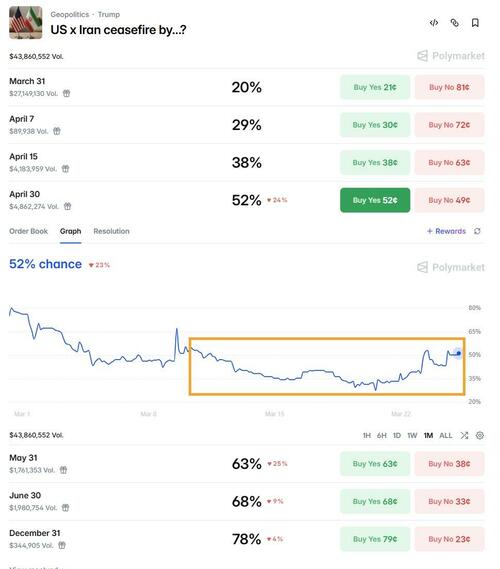
Many of the Polymarket Strait of Hormuz “prediction” markets have barely moved in response to the ceasefire proposal announcement, fwiw.
What to do?
We Have Already Had Regime Change
I think the most important thing said yesterday, was that the President, for the first time, made the case that the regime is so different (due to so many senior leaders being killed), there has been a regime change.
We have argued, since day 1, that true regime change, without boots on the ground, etc., is difficult to achieve. Finding a powerful enough faction who wants to protect their own lives and those of their family, willing to make a deal to achieve that and retain whatever power and wealth, they currently have, seemed more plausible.
While it is unclear who exactly the U.S. is negotiating with, it is important that the President has started to frame, whatever the new leadership structure is, in Iran, it meets “our” definition of regime change.
TACO vs TAW
We hear so much about “TACO” – Trump Always Chickens Out, that we don’t focus as much on the “TAW” – Trump Always Wins.
The President frames every outcome as him winning. From Liberation Day to Greenland, his steps and the end result are framed as having won.
To some degree, I think you can look at the series of social media posts and statements as “trial balloons”.
Toss out an idea and see if you can convince enough people to see it as “victory” and move on.
This may be a key component of the U.S. next steps. If enough of the public agrees that this ceasefire (or some form of ceasefire) is a “win” then he can move on.
We will get a sense of public opinion in the coming days, which I do think will shape the administration’s next steps.
The NFL “Scripted Play” Strategy Comparison of Where We are in Iran
In response to questions such as “what inning” is the conflict in Iran in, or how much longer to go, one of our generals argues (persuasively) that we are near the end of the “scripted play” segment of a football game. Many coaches “script” plays ahead of time and then execute on those plays.
Similarly, the U.S. had a list of prioritized targets. The U.S. has been going through that list. At the same time, Iran also had “scripted” responses. If this happens, then we do X.
Both sides have been war gaming, planning, strategizing about this conflict for years.
It doesn’t mean that you don’t adjust plans on the fly, but you do go through a relatively “scripted” set of actions to achieve objectives. The side that is “winning” has more ability to stick to their script.
After more than 3 weeks of fighting, both sides have experienced wins and losses. Both sides have likely seen things work, go according to plan, or even exceed their expectations. Similarly, there are likely disappointments and some consternation.
From everything we can see, it seems like the U.S. has had more wins, with Iran mounting more losses, but difficult to know. We only have some transparency into the U.S. side (and we should not have full transparency as that could put troops at risk, or make it difficult for the U.S. to negotiate, using bluffs, etc., to get the upper hand). We know very little about Iran’s expectations and where they stand relative to what they thought.
All of this leads Geopolitical Intelligence Group member after member to see 2 to 4 weeks more of fighting to make it highly probable that we can open the Strait (things could happen faster, but consensus seems to be forming around that timeframe given all that we have seen so far).
Buying Time?
The GIG, on that timeframe sees ultimate success in being able to re-open the Strait.
Part of the reason they see it potentially taking that long is that not all U.S. assets are in theater. The Marines coming from Japan are on their way. The Boxer (which Academy’s Brett Lowry served on) is now headed there. Airborne units, more vessels and more marines are all on their way.
It takes time for them to get to station and then time for them to become fully operational.
All that time, the Strait continues to see limited traffic, largely controlled by Iran.
If a 30-day ceasefire is achieved, the U.S. will be in an even stronger position then, than we are today (resupply, etc., can all occur).
The entire world can try and stock up on as much oil, gas, LNG, diesel, urea, etc., as possible during the ceasefire window.
We already have Air Supremacy (better than Air Superiority) and that is not going away in 30 days.
Should We Stop?
Many people are advocating that we have an opportunity to truly end the threat of Iran on the region, the world and even many of their own people, and that we should not stop.
Never has leadership there been in more disarray. Not only is Iran on its heels militarily, but their proxies have been hit hard and so far have been ineffective since the start of this conflict.
It is easy to see a world after all of this where Iran is not plotting for revenge, but is part of a much more robust and peaceful Middle East. Where the region’s economies can thrive, which would also help the entire global economy with cheaper and better access to all the goods and products and commodities produced in the region.
Had this outcome been sold better (or at all) to the world and even the domestic audience, we might not be as miserable and worried every time oil spikes higher. Maybe we would have the “fortitude” to withstand more affordability issues, with a clear end in sight.
Red Teaming the Negotiations
The U.S. plan seems clear:
Get agreement and enforce it and call it regime change and win (or call it a win).
Be better prepared (and allow the world to be better prepared) for the resumption of hostilities after the ceasefire.
What about Iran:
Iran has now been attacked twice while “negotiating”. The element of surprise helped those attacks, but it must leave a lot of doubt in the mind of the Iranians, that any ceasefire will be honored. The “best” case, is that if they decide to take that risk, it is probably because they too are prepared to violate the ceasefire.
What can Iran do in 30 days to offset what the U.S. and the rest of the world can do in 30 days? Iran would be insane not to think that the rest of the world will be much better prepared for any supply constrictions. It would be shocking to see anything less than the biggest restocking of energy products in the next 30 days, that the world has ever seen. So your economic leverage gets lower than it is today. It is clear that the U.S. and maybe even some forces from the rest of the world will be bigger and more prepared for the next round. Is Iran hauling missiles out of bunkers so deeply buried that they haven’t been hit?
Does Iran believe that they can use the next 30 days to be in position to inflict more damage on a bigger, freshly supplied enemy, and a world that stocked up on oil?
Are their own people coalescing around a common enemy? Have the attacks reduced the pressure for regime change from within? Or is the regime itself being blamed by the people, making the regime’s position even more precarious? This could be playing out in either direction and it is difficult to tell since we get so little information from within Iran.
What happens to the IRGC members if they are not in power after a deal? To be brutally honest, the consensus view is they will be killed. This is a powerful group, who have created links between powerful families within the IRGC. They have wealth. They have power. They have been brutal. Not exactly ideal conditions to slink off, in the event of loss.
Does Iran believe that there is some amount of “time” where the disruption to global trade (oil and more) causes the U.S. to offer better terms. Economic problems (and recession probabilities) are already growing in Asia and Europe. We had the CEO of a domestic homebuilder mention the conflict in the Middle East as a headwind for home sales in the U.S. Yes, we are somewhat isolated, but we are not an oasis, that won’t feel the impact.
Bottom Line
It is easy to see why we would make these proposals.
If Iran agrees to them all and we truly believe they won’t just try rebuild (as they have done time and time again, like they did after the 12 days of attacks last year), then we have truly won (even if some faction within the IRGC remains in power).
If we change our minds and decide to attack again, unless Iran has some surprises up its sleeve (which is a possibility as they just recently launched missiles with a longer range than they have previously admitted to), we will be in better shape to attack.
It is more difficult to see why Iran decides to take the chance, rather than continue the fight now.
So, my inclination is to “fade” this rally, because I struggle more to see Iran agreeing.
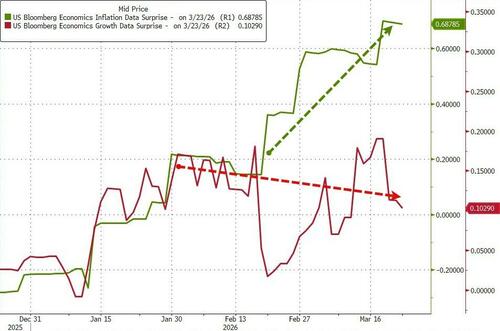
Also, even if we get a “deal” and rally more, I think the rally is capped as there is already damage done to the global economy, affordability has shaken confidence again, and all the issues (especially around jobs, private credit, etc.) have not been resolved.
If anything, quietly, behind the scenes (because Iran is front and center) those issues seem to be deteriorating rather than improving.
Tyler Durden
Wed, 03/25/2026 – 08:05