





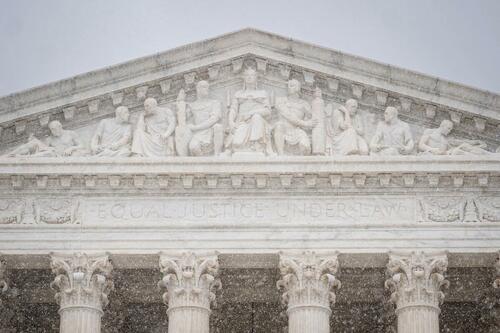
Trump Drops By Supreme Court To Hear Challenge To Birthright Citizenship Order
Update (0950ET): President Trump dropped by the Supreme Court on Wednesday for oral arguments in the high-profile Trump v. Barbara challenging his executive order restricting birthright citizenship – making him the first sitting US president to attend Supreme Court oral arguments.
BREAKING
President Trump has just arrived at the Supreme Court as the Justices hear oral arguments in the Birthright Citizenship case. pic.twitter.com/gc1jUdclki
— Conservative Brief (@ConservBrief) April 1, 2026
The stop was on Trump’s official schedule sent out by the White House, which Trump announced on Tuesday.
🚨 BREAKING: President Trump said he is GOING to the Supreme Court when they hear the birthright citizenship case tomorrow
Wow!
This could truly be THE most important case in modern US history—and 47’s taking it seriously
No more anchor babies! pic.twitter.com/e5BZZzk0ws
— Nick Sortor (@nicksortor) March 31, 2026
The line has already formed outside of the Supreme Court for Wednesday’s oral arguments in Trump v. Barbara, which will determine the legality of Trump’s executive order restricting birthright citizenship. People at the front of the line told me they got here yesterday. pic.twitter.com/OnXAWzhKsz
— amanda moore 🐢 (@noturtlesoup17) March 31, 2026
* * *
Authored by Matthew Vadum via The Epoch Times,
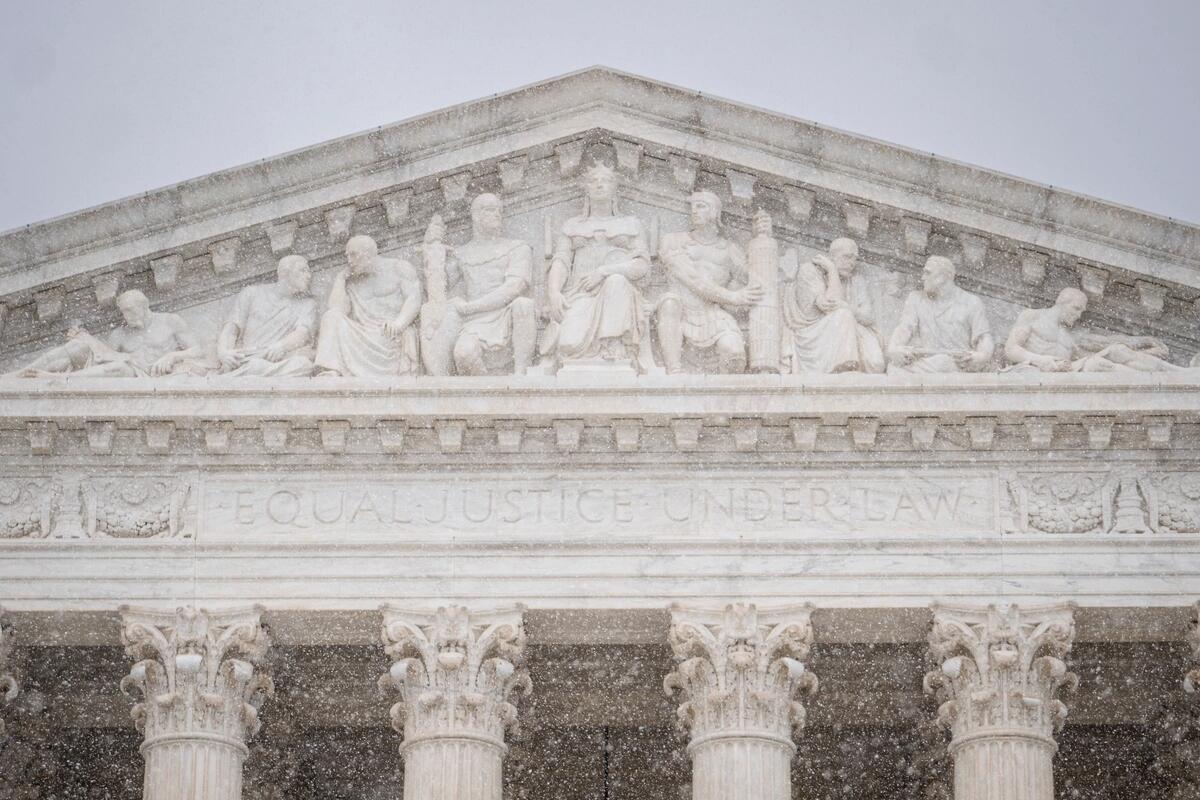
The U.S. Supreme Court on April 1 will consider whether President Donald Trump’s executive order excluding the children of illegal immigrants and legal temporary visitors from automatic birthright citizenship is constitutional.
Trump, who has frequently used the term “anchor babies” to refer to children born in the United States to illegal immigrant parents, issued Executive Order 14160 on Jan. 20, 2025, in hopes of ending the practice. His order, which is about to be considered by the justices, was blocked by lower courts.
U.S. Solicitor General D. John Sauer said in the government’s petition that automatic citizenship “operates as a powerful incentive for illegal migration,” presents national security concerns, and “has spawned an industry of modern ‘birth tourism,’ by which foreigners travel to the United States solely for the purpose of giving birth here and obtaining citizenship for their children.”
About 8 percent of all births in the United States in 2023 were to illegal immigrants and legal temporary visitors.
The Center for Immigration Studies estimated in February 2025 that in 2023, up to 250,000 babies were born to illegal immigrants, and about 70,000 babies were born to legal temporary visitors. Slightly under 4 million births took place in the United States in 2023, the Centers for Disease Control estimated.
Landmark Precedent
Since the Supreme Court’s landmark 1898 decision in United States v. Wong Kim Ark, the federal government has recognized that almost all persons born in the United States are U.S. citizens at birth.
Wong was born in San Francisco in 1873 to Chinese parents who were legally residing permanently in the United States. Because his parents were not serving in a diplomatic or official capacity for the then-Emperor of China, the court held that he was a U.S. citizen by birth.
Trump’s executive order uses a different interpretation of the 14th Amendment’s citizenship clause, which states: “All persons born or naturalized in the United States, and subject to the jurisdiction thereof, are citizens of the United States and of the state wherein they reside.”
The order said that, even though the clause adopted in 1868 “rightly repudiated” Dred Scott v. Sandford (1857), which misconstrued the Constitution to exclude people of African descent from citizenship based on race, it was never interpreted to bestow citizenship on everyone born in the United States.
The amendment has always excluded from birthright citizenship individuals who were born in the United States but not “subject to the jurisdiction thereof,” said the order, adding that Section 1401 of Title 8 of U.S. Code, enacted in 1952, which generally mirrors the 14th Amendment, did the same.
The order states that “the Fourteenth Amendment has never been interpreted to extend citizenship universally to everyone born within the United States.”
According to the order, an individual born in the United States is not “subject to the jurisdiction thereof” if that person’s mother was unlawfully present in the country and the individual’s father was not a U.S. citizen or lawful permanent resident at the time of the person’s birth.
Trump said on March 30 that the country’s current birthright citizenship policy was created to grant citizenship to freed slaves and their children, not to children born to temporary visitors.
Opposing Positions
A federal district court in New Hampshire temporarily blocked the executive order, finding it likely contradicts the 14th Amendment, Supreme Court precedent, and Section 1401.
The federal government appealed to the U.S. Court of Appeals for the First Circuit, but did not wait for a ruling, and asked the Supreme Court to intervene. In the meantime, the appeals court upheld a preliminary injunction blocking the executive order in a separate case.
The high court granted the government’s petition in Trump v. Barbara on Dec. 5, 2025. Sauer said in the petition that the executive order restores the clause’s original meaning which was “to grant citizenship to newly freed slaves and their children—not to those of temporary visitors or illegal aliens.”
The government argues that the citizenship clause and Section 1401, which reinforces it, do not give citizenship to children of temporary visitors or illegal immigrants.
The text of the clause, its history, and the way it was originally understood, and Supreme Court rulings, agree with the idea that the clause applies to children who are “completely subject” to the “political jurisdiction” of the United States, which means they owe “direct and immediate allegiance” to this country and may claim its protection.
The court held in Wong Kim Ark that children of citizens, as well as those with “‘a permanent domicile and residence in the United States,’ meet that criterion,” according to the petition.
Historical evidence supports the idea that citizenship does not extend to children of parents who were temporarily present in the country “for health, or occasional business.”
During congressional debates over the 14th Amendment, lawmakers said the clause would not give citizenship to anyone “born here of parents from abroad temporarily in this country,” the petition said.
Wong Kim Ark recognized that the clause guarantees citizenship not just to children of U.S. citizens, but also to children of aliens “enjoying a permanent domicil [sic] and residence” in the United States.
Those challenging the executive order argue that Wong Kim Ark was correctly interpreted by the high court to “specifically foreclose the government’s parental domicile argument.” The president’s executive order violates both the clause and Section 1401 by attempting to add a parental status requirement, they say.
The court’s analysis of the clause found that foreign nationals temporarily present in the country for “business or pleasure” are “‘amenable to the jurisdiction of the country.’”
While ambassadors may be immune from jurisdiction and are treated as if present in their home countries, “there is no such fiction for ordinary foreign nationals” present in the United States who are “completely subject to its jurisdiction,” they said in a brief.
Exempting foreign nationals from U.S. jurisdiction would be “inconvenient and dangerous to society, and would subject the laws to continual infraction, and the government to degradation,” the brief says, quoting Wong Kim Ark.
What Does the ‘Subject’ Phrase Mean?
How the justices rule may turn on what “subject to the jurisdiction thereof” in the citizenship clause means.
Michael O’Neill, legal affairs vice president at Landmark Legal Foundation, said the order correctly interprets the phrase.
Evidence shows “the ratifiers of the 14th Amendment intended it to apply to political jurisdiction, rather than territorial jurisdiction,” O’Neill told The Epoch Times.
“Mere presence” isn’t enough, he said. “You need to owe some political allegiance to the United States of America in order for you to have birthright citizenship today.”
Chris Hajec, deputy counsel at the Federation for American Immigration Reform, suggested the executive order was “95 percent” constitutional but went too far in excluding the children of temporary workers on visas and foreign students.
Surely, children of people who have resided here for years while working or attending school would be citizens, he told The Epoch Times.
David Super, a professor at Georgetown University Law Center, suggested the executive order overreached.
Someone born at a foreign embassy would not be subject to U.S. power under international treaties concerning diplomats, “but everyone else is subject to U.S. power whether they acknowledge it or not,” Super told The Epoch Times.
Jim Burling, senior legal counsel at Pacific Legal Foundation, said the government has a “really huge burden.”
The actual text makes it “clear that if you’re born here, you’re subject to the jurisdiction, and pretty much everybody here is,” he told The Epoch Times.
Illegal immigration wasn’t a public concern when the clause was adopted, but nowadays, supporters of the executive order are putting a “historical gloss on the interpretation of a constitutional provision based on future history,” Burling said.
Tyler Durden
Wed, 04/01/2026 – 09:45