






UBS: Trump’s Historic Military Budget Request Could Boost Beaten-Down Defense Stocks
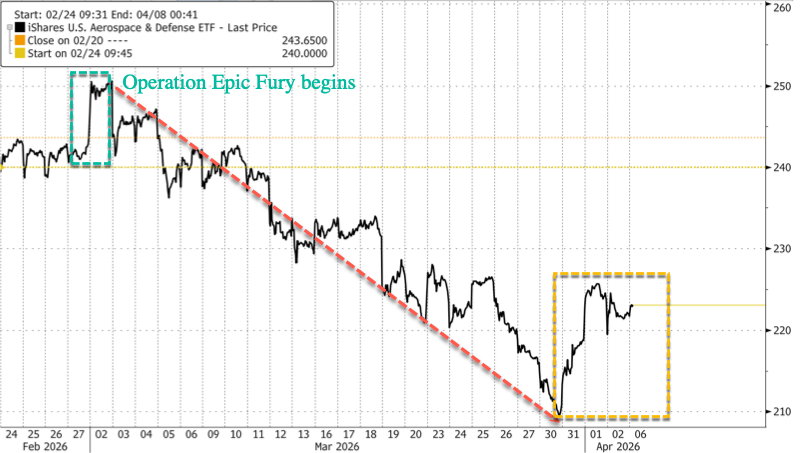
U.S. defense stocks showed signs of stabilizing in April after tumbling since Operation Epic Fury began in late February and sustaining a Mach bloodbath. The improvement followed Friday’s White House proposal to lift military spending sharply, to roughly $1.5 trillion in 2027.
UBS analyst Allyson Gordon said Monday morning that the White House budget request “should help sentiment,” which has deteriorated since the U.S.-Iran conflict began. Last week, Gordon asked, “Why is U.S. defense performance lackluster?”
Earlier, the analyst said:
Defense stocks are in focus after Trump requested a $1.5 trn FY2027 defense budget on Friday. The headline is positive for the group, though market reaction remains to be determined.
On the supportive side, defense stocks have underperformed expectations since the Iran conflict began for several reasons, and the size of the budget request should help sentiment. However, investors remain skeptical that Congress will ultimately pass a $1.5 trn budget, raising the question of whether this is “as good as it gets.”
Analyst Gavin Parsons outlined the key elements of the proposal and the relative winners and losers. Missiles appear to be a major beneficiary, reinforcing the bullish narrative for RTX. Shipbuilding also stands out as a positive (GD, HII), while the proposed B‑21 reduction was a surprise negative for NOC. That said, investor positioning is likely to reflect continued uncertainty around what ultimately makes it through Congress.
From here, the proposal moves to Congress, which must pass a budget by September 30 to avoid a shutdown or continuing resolution at the start of FY2027 (October 1).
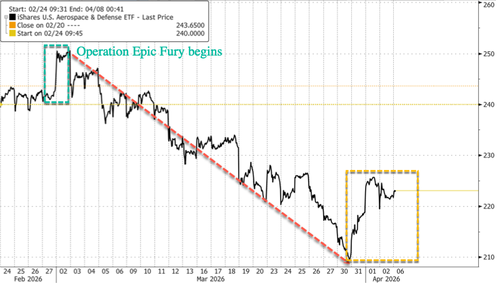
The iShares U.S. Aerospace & Defense ETF, or ITA, a basket of major U.S. defense firms, initially ramped in the early days of the U.S.-Iran conflict but then dumped into a deep 16% correction from the early March high. By the end of the month, and into late last week, ITA began to stabilize, up 6.5% from the low.
Last week, in a separate note, Melius analyst Scott Mikus upgraded RTX to a “Buy” from “Hold,” citing “Epic Fury tailwinds.”
Mikus said, “Given the need to replace missiles, missile interceptors, damaged radars, aircraft, and other equipment used in Operation Epic Fury, we are raising our estimates and price targets for the large defense primes.”
“We see margin tailwinds for defense contractors as they move past stale-priced contracts and receive awards for mature production programs that are margin accretive,” added Mikus.
Now the question is: How will defense stocks respond to President Trump’s Tuesday evening deadline for Iran to reopen the Hormuz chokepoint?
*IRAN REJECTS A CEAESFIRE IN REPLY TO US VIA PAKISTAN: IRNA https://t.co/yrWftZNKvI
— zerohedge (@zerohedge) April 6, 2026
IRNA’s foreign policy correspondent says that its response, which consists of ten paragraphs, Iran has emphasized the need for a permanent end to the war, taking into account Iran’s considerations, while rejecting a ceasefire.
This answer includes a set of demands from Iran,… https://t.co/anVYR1uZVm
— zerohedge (@zerohedge) April 6, 2026
Any rejection of a ceasefire could result in the next phase of the conflict, one in which the U.S. begins targeting critical infrastructure nodes and continues to drain key stockpiles of missiles and bombs that will clearly need to be replaced at some point, hence Mikus’s note on “Epic Fury tailwinds.”
Professional subscribers can read the latest defense stocks notes at our new Marketdesk.ai portal
Tyler Durden
Mon, 04/06/2026 – 15:40