




US-Israel War On Iran ‘Decided Weeks Ago’ Under Cover Of Nuclear Talks: Report
The unprovoked US-Israeli war against Iran launched on Saturday had “been planned for months, and the launch date decided weeks ago,” even as the US and Iran carried out indirect nuclear negotiations, an Israeli defense official told Reuters.
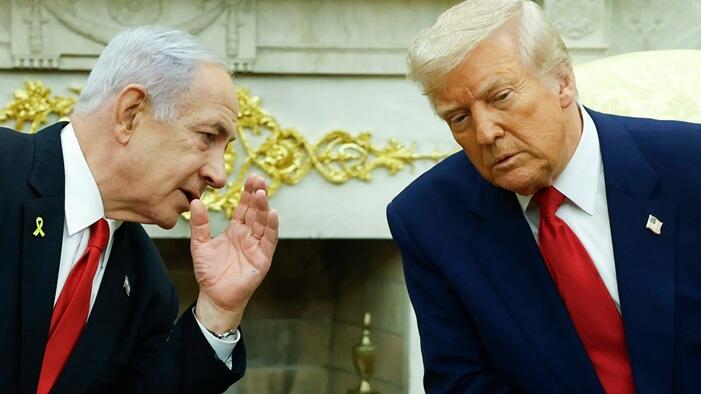
Washington and Tel Aviv renewed negotiations in February over Iran’s nuclear program. President Trump was under pressure from Israel force Iran to give up uranium enrichment, as well as its ballistic missile program and support for regional resistance forces (such as the pro-Iranian Iraqi popular mobilization units, and Hezbollah, etc). Amid the negotiations, Trump sent an “armada” of US naval ships and warplanes to the region, threatening to launch an attack if officials in Tehran refused to make a deal. After the latest round of talks on Thursday, a senior US official told Axios the talks were “positive.”
Omani Foreign Minister Badr Albusaidi, who mediated the talks, said the talks had shown “significant progress.” Iranian Foreign Minister Abbas Araghchi also expressed optimism, saying both sides had shown a “clear seriousness” about getting a deal. However, the US and Israel launched large-scale attacks against Iranian targets early Saturday, suggesting the negotiations had never been serious. In the wake of the attacks, Omani Foreign Minister Albusaidi said that the negotiations he mediated had been “deliberately undermined.”
Mehran Kamrava, director of the Iranian studies unit at the Arab Center for Research and Policy Studies and professor at Georgetown University in Qatar, stated that Israel “appears to have launched an attack designed to derail the negotiations.“
A planning document prepared years ago by the US think tank Brookings Institution provided a blueprint for regime change in Iran that outlined such a strategy.
“Which Path to Persia? Options for a New American Strategy Toward Iran,” written by analysts at the Brookings Institution in 2009, recommended that the US carry out negotiations ahead of a planned attack to give the false impression that the US had done everything possible to avoid war.
Iran could then be blamed for rejecting a “good deal,” thereby shifting blame onto the Islamic Republic for what would be an unpopular war both among the US public and internationally.
“The best way to minimize international opprobrium and maximize support (however, grudging or covert) is to strike only when there is a widespread conviction that the Iranians were given but then rejected a superb offer—one so good that only a regime determined to acquire nuclear weapons and acquire them for the wrong reasons would turn it down,” the document stated.
“Under those circumstances, the United States (or Israel) could portray its operations as taken in sorrow, not anger, and at least some in the international community would conclude that the Iranians’ brought it on themselves’ by refusing a very good deal,” the document added.
🇺🇸/Iran: The US is going to attack Iran as soon as preparations are final and if Iran and its allies fail to sufficiently deter US aggression.
There were never any real negotiations.
The decision to attack Iran was made in the 1970s when Iran rightfully ousted the US… pic.twitter.com/v0CsZmP6mB
— Brian Berletic (@BrianJBerletic) February 20, 2026
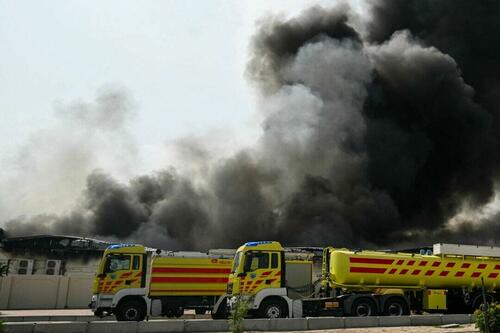
After the start of the US and Israeli strikes, Iran’s Islamic Revolutionary Guard Corps (IRGC) launched barrages of ballistic missiles and drones at targets in Israel and US bases in the region.
Damage to targets within Israel is difficult to assess due to media censorship imposed by the Israeli military. However, sirens were heard across Israel as the military issued a “proactive alert to prepare the public for the possibility of missiles being launched toward the state of Israel.”
The military announced the closure of schools and workplaces, with exceptions for essential sectors. The Israel Airports Authority announced its airspace had been closed to all civilian flights.
One official describes Kushner reading the Iranian 7 page proposal, which they say the US team could not take with them. It does not sound like they understood even a symbolic minimal research enrichment proposal at all, not just as not good enough, but as sinister
— Laura Rozen (@lrozen) February 28, 2026
Amid the Iranian attacks, Israel’s energy sector shifted into emergency mode. Israel’s energy ministry instructed Greek firm Energean to temporarily suspend production at its offshore Karish gas field.
The ministry also ordered the closure of the country’s largest gas field, Leviathan, as a precautionary measure. Some units of the Haifa oil refinery were also shuttered.
* * *
Iranian FM statement:
A deal was within reach. We left Geneva with understanding that we’d seal a deal next time we meet. Those who wanted to spoil diplomacy succeeded in their mission. But it was Mr. Trump, yet again, who ultimately ordered bombing of the negotiating table.
— Seyed Abbas Araghchi (@araghchi) March 1, 2026
Tyler Durden
Sun, 03/01/2026 – 22:40