


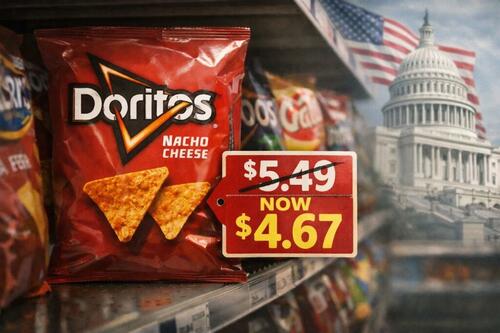

When Government Subsidies Stopped, Doritos Got 15% Cheaper
Authored by James Hickman via SchiffSovereign.com,
PepsiCo spent $2.8 million last year lobbying to keep junk food eligible for food stamps.
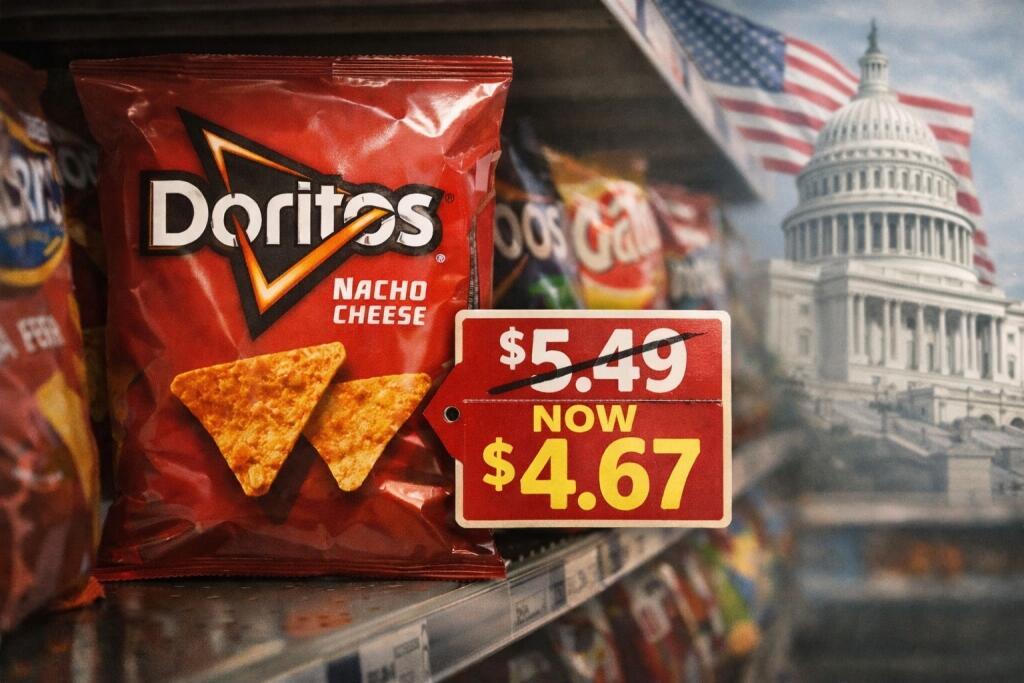
But last week – after Health and Human Services Secretary Robert F. Kennedy Jr. got 18 states to ban SNAP purchases of products like soda, candy, and processed snacks – PepsiCo announced price cuts of up to 15% on Doritos, Lay’s, Tostitos, and other Frito-Lay products.
The company’s official explanation was “affordability.” CEO Ramon Laguarta cited low-income consumers are switching to store brands.
But the timing tells the real story.
The Supplemental Nutrition Assistance Program— food stamps— is a $100 billion per year program serving roughly 42 million Americans. And according to the USDA’s own data, about 20 cents of every SNAP dollar goes to sweetened beverages, candy, salty snacks, and sugar.
In fact soft drinks alone are the single largest category of SNAP purchases.
And, until last week, products from Pepsi’s Frito-Lay division were in 7.2% of all shopping trips paid for with SNAP (i.e. taxpayer-funded) benefits.
So when the government stopped subsidizing demand for their products, PepsiCo had to do something they hadn’t needed to do in years: compete.
This is what the free market does— it forces companies to be more efficient, cut prices, and pass savings on to their customers.
But here’s the thing— this is one company, one product line, one government program.
Zoom out and you can see just how much of price inflation in our daily lives is due directly to government spending— before we even get into monetary policy like printing money.
When a guaranteed buyer shows up with a bottomless wallet, prices go up.
Just look at college tuition. In 1965, Congress passed the Higher Education Act and began backing student loans with federal dollars.
Since then, tuition has risen roughly three times faster than inflation. A year at a private university that cost $2,800 in 1963 now costs over $85,000.
The New York Federal Reserve studied this directly and found that for every dollar increase in subsidized student loans, tuition rose by up to 60 cents.
The mechanism is simple: when the government guarantees the tuition money, universities raise prices… simply because they can.
Healthcare is even worse.
Before Medicare and Medicaid were created in 1965, the government’s share of healthcare spending was about 31%. Today it’s roughly 64%. Medicaid spending alone has grown from $13 billion in 1975 to over $900 billion today.
And— shocker— healthcare prices have risen dramatically over the same period. The US now spends nearly $5 trillion per year on healthcare, far more per capita than any other developed country, with outcomes that are often worse.
The pattern is the same everywhere you look: the government shows up with money. Prices rise to absorb it. The subsidy becomes permanent. The industry restructures itself around the guaranteed revenue. And then anyone who suggests pulling back the money is accused of “cutting” a vital service.
Now consider the scale of this in America today.
Federal spending has risen from about 18% of GDP in the 1990s to nearly 24% today. That means almost a quarter of the entire American economy is government money.
Of this, Treasury Secretary Scott Bessent has publicly estimated that 10% of the federal budget— roughly $600 billion per year— is lost to outright fraud of the Somali daycare type in Minnesota.
Then there’s the legal graft. California alone received roughly $100 billion in federal grants over the past few years for DEI initiatives that produced nothing except more government jobs and campaign contributions.
So how much of America’s economic output is actually real?
How much is just government money making a round trip— borrow more debt, hand it out through some boondoggle program where it is spent at a PepsiCo subsidiary, counted as “economic activity,” making people obese… then more money spent on healthcare to keep them alive and paying enough taxes for the government to be able to pay interest on the debt…
It’s absurd when you think about it. We don’t have a precise answer. But the Pepsi story gives us a clue. The moment the government stopped subsidizing one small corner of the economy, prices dropped by 15% within a week.
RFK didn’t regulate PepsiCo. He didn’t cap prices. He didn’t launch an antitrust investigation. He simply stopped the government from funneling taxpayer dollars into unhealthy food… and the market corrected overnight.
Now imagine what would happen if the government stopped subsidizing entire industries— the defense contractors billing $10,000 for a toilet seat, the universities charging $85,000 for a degree in gender studies, the healthcare system where nobody can tell you what anything costs.
We might finally find out how much of this economy is real.
And that, frankly, is what makes it so hard to fix. Because so many peoples’ livelihoods now depend on the government gravy train.
But this trajectory has an expiration date. The federal government borrows $2 trillion a year to keep it all going. Interest on that debt already exceeds $1 trillion annually— more than the entire military budget— and it’s growing faster than any other line item.
If rates stay elevated because inflation won’t come down, the cost of servicing the debt crowds out everything else.
If the government responds by printing money to cover the gap, inflation gets worse.
And it makes sense to have a Plan B that doesn’t depend on Washington finding fiscal discipline before the math catches up with them.
Tyler Durden
Tue, 02/10/2026 – 20:05