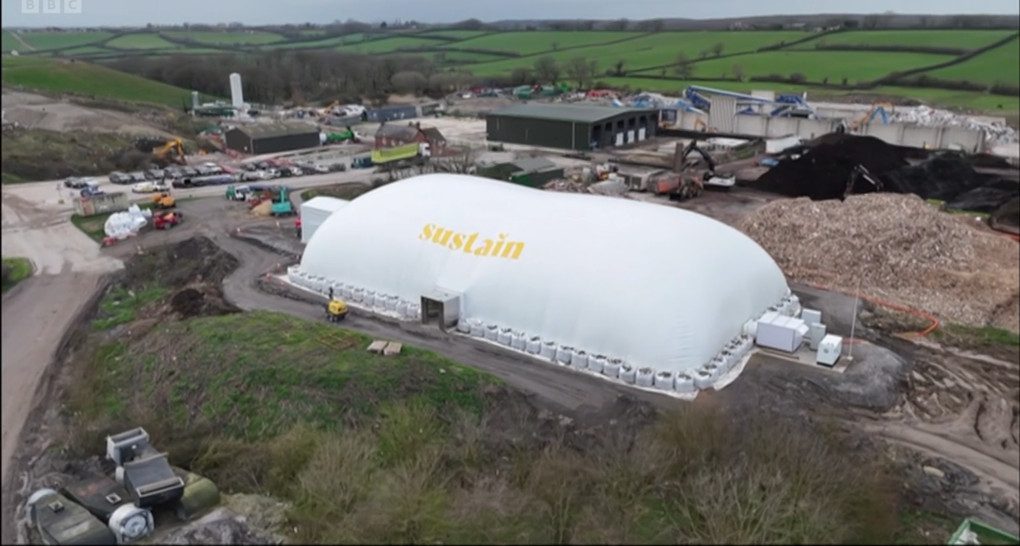




Crops grown within the giant dome will meet the needs of ten local families, at this stage, in the vision of the group.
A pilot project in Wiltshire demonstrates the possibilities of turning landfill sites into low carbon, affordable fruit and vegetable production hubs.
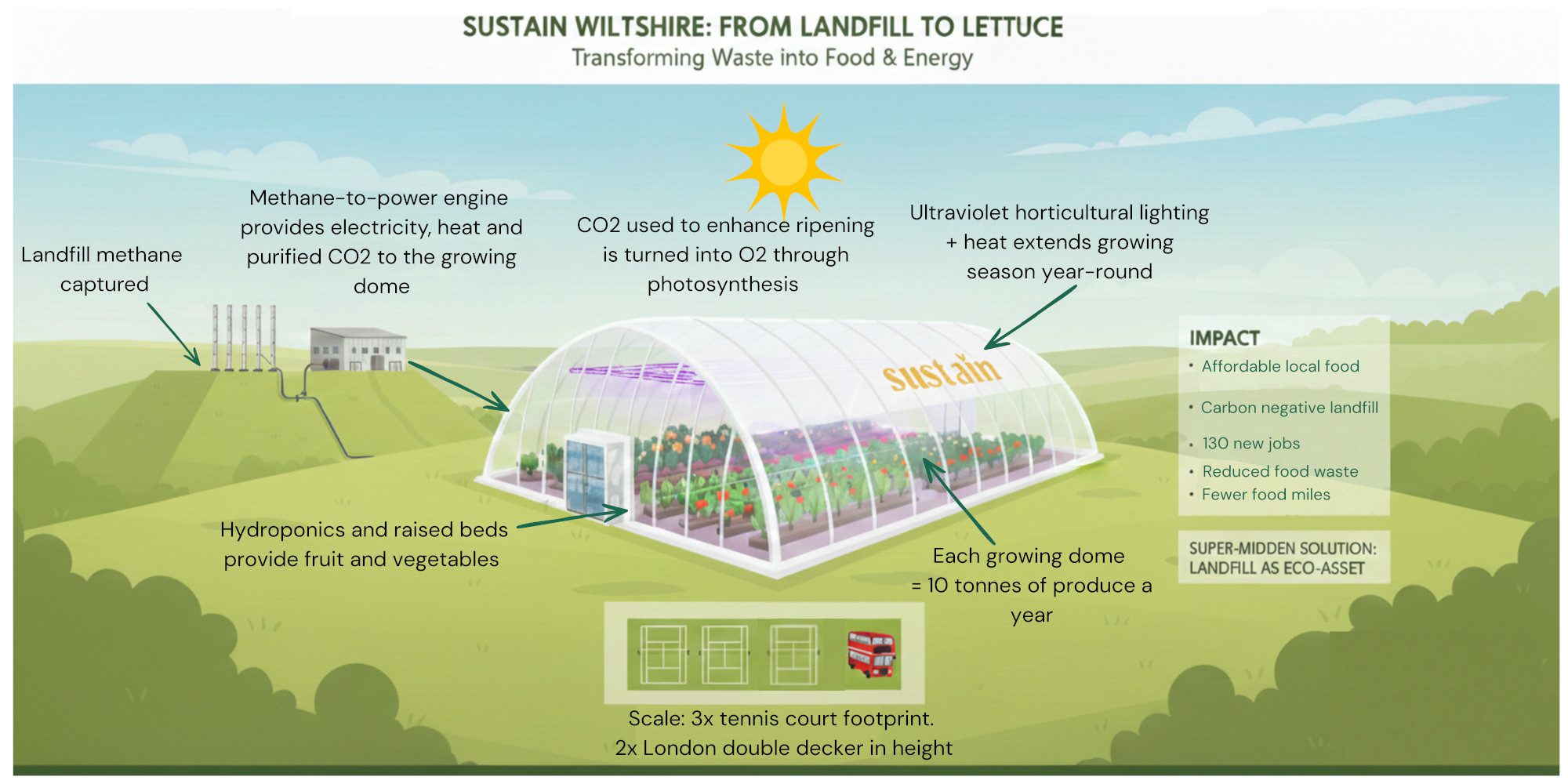
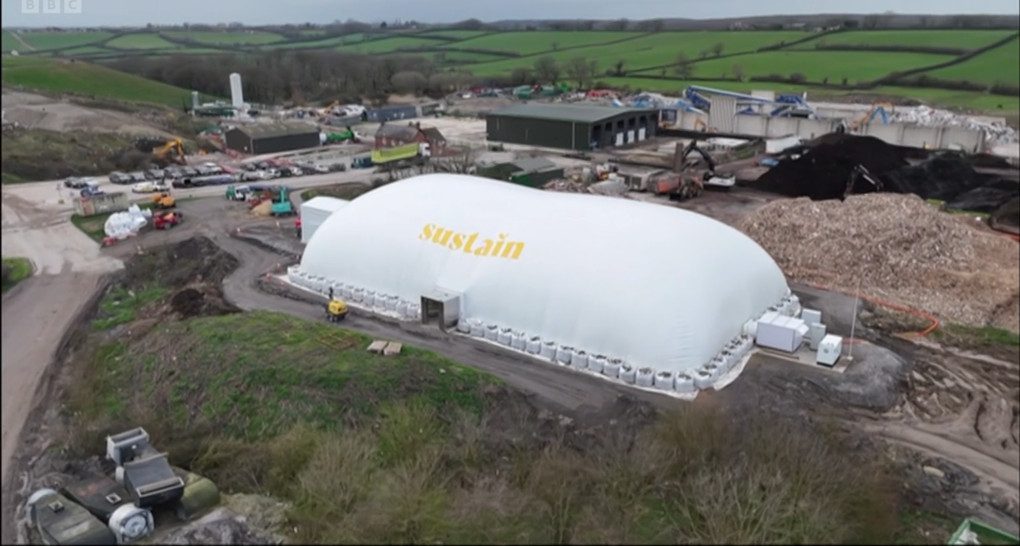
Unveiled by Sustain Wiltshire in Royal Wooton Bassett, the project appears somewhat novel in its combination of landfill waste-to-energy technology with controlled-environment agriculture – the latter situated within a positively-pressured growing dome three times the size of a standard tennis court, and twice the height of a London double decker bus.
As the group explains, landfill gas tapped from Crapper and Sons’ landfill site will be turned into heat, power and CO2, to support ideal year-round growing conditions within giant, positively pressured, inflated growing domes located on the site.
Landfill gas-to-energy technology is obviously widely deployed but here it is supplemented by an extra step of capturing and purfying CO2 from the engine exhaust. This will be pumped into the newly-erected bio-secure growing dome to promote the growing of plants and crops.
Heat and power from the gas engine combined with ultraviolet horticulture lighting will be used to provide the optimal growing conditions. Publicity accompanying the announcement mentions capabilities that will sound familiar to those acquainted with vertical farming and greenhouse-based horticulture, and its promise of being able to extend the growing season year-round. This seems to be commercially viable with a number of crop types, including leafy greens, as well as tomatoes, peppers and cucumbers – things which grow quickly and present relatively modest energy requirements.
The interior of the dome.
The group’s publicity makes much of the possibilities of multi-cropping and the harvesting of “everything from carrots to avocados, even in the depths of winter”.
As with much else in the UK today, energy costs can be a bottleneck, so the possibility of exploiting a ready supply of landfill gas for such purposes seems a nifty bit of circular thinking.
The growing dome will be trialled and tested over the coming year, says the group. “Using a mix of hydroponics, raised growing beds and plant containers, a broad selection of produce will be grown from the spring, ready to meet the needs of ten local families.”
“Using advanced modelling technology, just-in-time demand-based fruit and vegetables will be grown, which Sustain Wiltshire believes will enable it to keep its costs lower than the major supermarkets.”
All of which, if feasible, presents a compelling alternative to the logistics-led norms of supermarket-based food production and distribution, which depends on warehousing and distribution centres. “Food can be grown locally and delivered to the doorstep, cutting transport fuel miles, food waste and storage energy.”
Sustain Wiltshire, a Community Interest Company, says it hopes to gain permission for 100 of the 40m x 20m growing domes to be erected at the site over the next 10-15 years, ready to feed the local community with affordable produce.
“Capable of producing 10 tonnes of fruit and vegetables per growing dome, Sustain Wiltshire aims to supply up to 80% of all fruit and vegetable requirements for Royal Wootton Basset, Purton and Brinkworth, with future expansion planned to cover Malmesbury.”
Described by the group as the world’s first growing dome powered by landfill methane, the “Super-Midden” works with gas captured from the site’s solid waste anaerobic treatment process, although the branding is a conceptual nod to more ancient practices.
The development is part of the Sustain vision of creating self-sustaining communities.